
CIP-0105 has set a long-term locking framework for Super Validators on Canton Network, linking forward Super Validator Weight to actively locked lifetime-earned Canton Coin rewards.
The proposal was approved on March 2, 2026. It gives Super Validators a voluntary path to lock a portion of their aggregate lifetime-earned rewards in order to maintain forward SV Weight, with the same rules applied across participants.
The framework applies to one of Canton’s core operator roles. Super Validators run Global Synchronizer infrastructure, sequence transactions, validate Canton Coin transactions and participate in governance. CIP-0105 adds a measurable economic commitment to that role.
Under the proposal, only actively locked Canton Coin counts toward the Super Validator weighting algorithm. The calculation includes both historical rewards earned before activation and future rewards earned afterward. For organizations operating more than one Super Validator, the requirement is measured at the organization level rather than only at the individual validator-instance level.
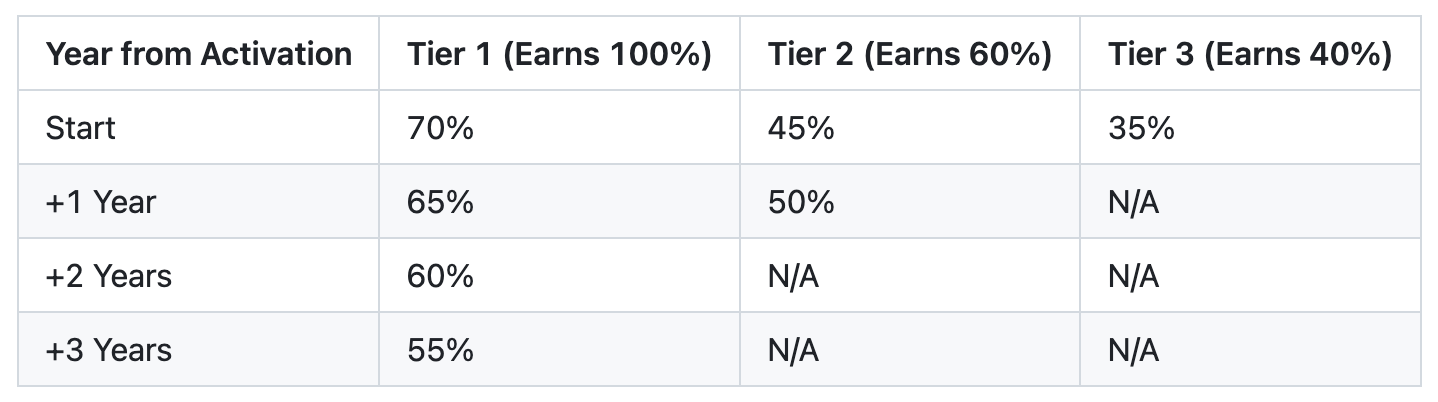
The initial tier schedule gives full forward SV Weight to Super Validators that lock 70% of aggregate lifetime-earned SV rewards. A 45% lock earns 60% weight, while a 35% lock earns 40% weight.
The top-tier requirement declines over time. It falls to 65% after one year, 60% after two years and 55% after three years. The CIP says the lock-up requirement will automatically terminate 30 days after the next reward step-down, currently forecast for late summer 2029.
The framework is voluntary, but under-locking has defined consequences. If a Super Validator falls below its current tier, the under-locked portion of its SV Weight is removed from the active SV pool within seven days. The Super Validator then has 30 days from the initial under-lock event to restore the lock. If it does not, the removed weight is permanently removed from the SV pool and cannot be reclaimed.
CIP-0105 also introduces a one-year vesting model for unlocks. A Super Validator may initiate an unlock of any size at any time, but only 1/365.25 of the requested amount becomes liquid each day. During that period, only the fully locked portion continues to count toward SV Weight.
The custody rules leave room for different operating models. Super Validators may lock from self-custody wallets, institutional custodians or qualified third-party custody providers. Locked CC does not have to be held on a validator, in a specific wallet or with a specific custodian. Multiple wallets, custodians and PartyIds can count toward the aggregate threshold.
The proposal also states that there are no exemptions for the Foundation, ecosystem funds or any other entities. The framework applies uniformly to all Super Validators.
Implementation is split into two phases. Phase 1 is transitional enforcement, where Super Validators disclose segregated PartyIds holding locked CC to the Foundation, SV Weight is evaluated weekly and under-locking rules apply.
Phase 2 begins once CC locking contracts are deployed to MainNet. At that stage, only on-chain locked CC counts, unlock vesting applies automatically and SV Weight updates continuously.
That distinction matters. CIP-0105 has been approved, but the proposal separates transitional enforcement from full contract-based enforcement. The framework should not be read as confirmation that every Phase 2 feature is already live unless separately confirmed.
CIP-0105 does not make participation mandatory, and it does not guarantee any market outcome. Its significance is narrower and more concrete: it gives Canton a formal way to connect Super Validator weight to locked earned CC over time.
For a network built around privacy, synchronization and regulated financial workflows, operator alignment is part of the infrastructure story. CIP-0105 makes that alignment easier to measure.