
Canton Network: The Trojan Horse of Crypto — Why CC Could Become a Top-10 Altcoin
For years, crypto investors have been trained to look for the next narrative.
Bitcoin was digital gold.
Ethereum became the programmable financial layer.
XRP built one of the strongest communities around the idea of global payments.
But what if the next major narrative isn’t simply another cryptocurrency?
What if it is the infrastructure quietly being built underneath the world’s financial system?
That is where Canton Network and Canton Coin (CC) become extremely interesting.
CC Isn’t Top 10 Yet — But That’s Exactly the Point
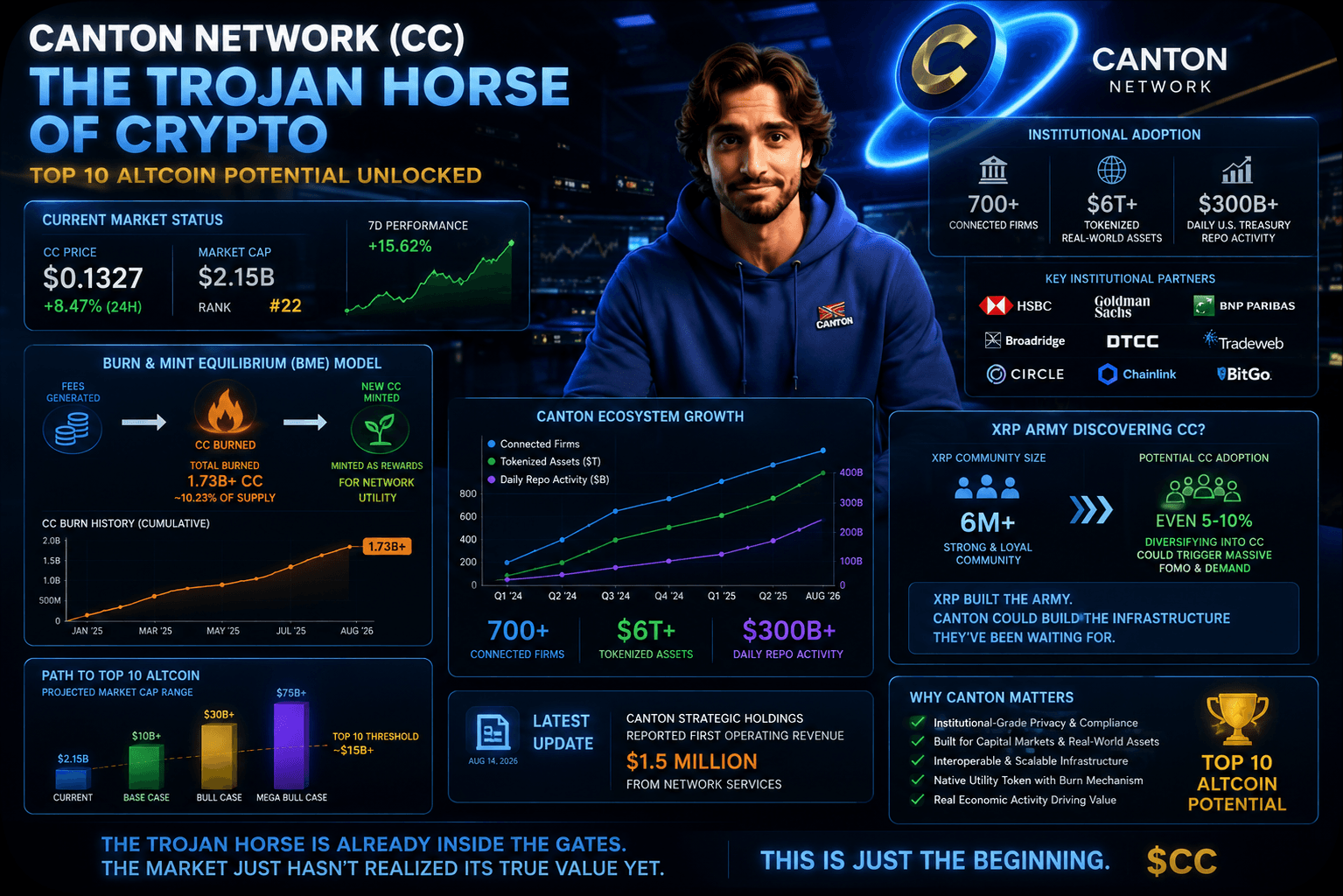
Canton has already pushed into the upper tier of the cryptocurrency market. Depending on the market-data provider, CC is currently sitting around the top 20–25 by market capitalization. (CoinGecko)
The question isn’t whether Canton has entered the conversation.
The question is:
What happens if the market finally realizes what is being built behind the token?
Canton is targeting one of the largest markets on Earth: financial infrastructure.
The network says more than 700 firms are connected to its ecosystem, with more than $6 trillion in tokenized real-world assets and over $300 billion in daily U.S. Treasury repo activity represented across its network and ecosystem. (Canton Network)
That puts Canton in a very different category from many altcoins whose primary growth engine is speculation.
Canton is attempting to become infrastructure for institutions.
And that is why the Trojan horse analogy becomes so powerful.
The Trojan Horse Theory
The crypto market may initially see CC as another altcoin.
Institutions may see something completely different.
Canton was designed around privacy, interoperability and institutional-grade financial applications. Its architecture allows financial participants to transact while controlling who can see sensitive transaction information — an important requirement for regulated markets. (SEC)
This creates an unusual situation.
The public crypto market can speculate on CC while institutions gradually build financial infrastructure on Canton.
The token becomes the visible asset sitting on top of an increasingly important financial network.
That is the Trojan horse:
Crypto investors think they are buying an altcoin.
The underlying network is attempting to become financial infrastructure.
And Then There Is the Burn Mechanism
This may be one of the most misunderstood parts of the Canton story.
Canton Coin uses a Burn-and-Mint Equilibrium (BME) model.
Network activity generates fees.
Those fees are paid in CC.
The fees are then burned permanently.
At the same time, new CC is minted as rewards for participants who provide measurable utility to the network. (Canton Network)
That distinction matters.
Canton isn’t simply saying:
“Buy CC because the supply is limited.”
The thesis is:
More network activity → more fees → more CC burned.
Meanwhile, issuance is connected to participants providing actual network utility.
That creates a feedback loop between the token and the network’s economic activity.
And the bigger Canton becomes, the more important that relationship potentially becomes.
Current public network tracking already shows billions of CC burned cumulatively, demonstrating that the burn mechanism isn’t merely theoretical. (CantonNews)
Institutional Adoption Is the Real Story
This is where the Canton narrative starts getting uncomfortable for people who still view it as “just another crypto project.”
Canton’s ecosystem includes major financial institutions and infrastructure providers.
Its own newsroom highlights developments involving institutions such as HSBC and major financial-market participants, while recent announcements include on-chain U.S. Treasury activity facilitated through Tradeweb. (Canton Network)
And the institutional footprint goes much deeper.
Public research tracking Canton has identified activity involving platforms and institutions including Broadridge, HSBC Orion, Goldman Sachs’ Digital Asset Platform and BNP Paribas’ tokenized bond infrastructure.
This is important because institutional adoption doesn’t necessarily arrive with millions of retail users downloading a wallet.
It arrives through:
Treasuries.
Collateral.
Securities.
Repos.
Tokenized assets.
Settlement.
Capital markets.
And those markets are enormous.
The XRP Connection Could Become the Wild Card
Now we get to the part that could create the biggest FOMO in the crypto market.
The XRP community has one of the strongest and most passionate armies in crypto.
For years, the XRP thesis has revolved around institutional adoption, global financial infrastructure and the modernization of settlement.
But Canton is now entering many of the same conversations — while approaching the problem from a different technological angle.
Canton and XRP are not identical and should not be presented as direct replacements. Canton is primarily an institutional network and financial infrastructure layer, while XRP/XRPL has its own distinct architecture and use cases. (Coin Reporter)
But imagine what happens if even a fraction of the XRP community begins viewing CC as complementary — or potentially as another major institutional-finance play.
That doesn’t require the entire XRP Army to “leave XRP.”
It only requires a percentage of XRP holders to diversify.
Then the narrative changes.
XRP holders start asking:
“Why don’t I own CC?”
Crypto influencers start comparing the two.
YouTube channels start covering Canton.
XRP communities begin discussing Canton.
Retail investors start researching CC.
And suddenly a token that was sitting outside the traditional top-10 conversation becomes one of the most talked-about institutional altcoins in the market.
That is how FOMO begins.
The Top-10 Scenario
Getting into the top 10 would require a dramatically larger valuation than Canton has today.
But the ingredients for that conversation are beginning to appear:
Institutional adoption.
Tokenized real-world assets.
Financial-market infrastructure.
Growing network activity.
A native utility token.
A burn mechanism.
Exchange liquidity.
And a growing retail community.
The market is still capable of valuing crypto networks primarily by narrative.
But eventually, the market may start asking a different question:
How much economic activity is this blockchain actually capable of supporting?
That question could favor Canton.
The Most Dangerous Part of the Thesis
The biggest mistake would be assuming institutional adoption automatically means CC must go up.
It doesn’t.
Canton still faces competition.
Ethereum, Solana, XRP Ledger, Avalanche, Ondo’s ecosystem and numerous institutional blockchain projects are all fighting for pieces of the tokenization and financial-infrastructure market.
And CC remains volatile.
But Canton has something that many speculative altcoins don’t:
a potential connection between token economics and real financial activity.
That is the part investors should be watching.
Not just the chart.
Not just the market cap.
Not just Twitter.
Watch the network.
Watch the institutions.
Watch tokenized assets.
Watch transaction activity.
Watch fees.
And most importantly:
Watch the burn.
The FOMO Nobody Is Talking About Yet
The crypto market loves discovering narratives after they become obvious.
By the time everyone agrees that a project belongs in the top 10, the early opportunity may already be gone.
Canton’s current position makes the situation particularly interesting.
It doesn’t need to become the next meme coin.
It doesn’t need millions of retail transactions every day.
It needs to become increasingly important to the financial institutions moving trillions of dollars of value onchain.
If that happens, CC could evolve from being viewed as another altcoin into something much bigger:
the native economic asset of an institutional financial network.
And if the XRP Army, Ethereum community, traditional finance investors and RWA investors all eventually converge on the same conclusion — that Canton deserves a place in their portfolios — the resulting demand could be explosive.
The Trojan horse may already be inside the gates.
The market just hasn’t decided how valuable the horse is yet.
Canton doesn’t need to defeat crypto.
It needs to become the infrastructure that crypto and traditional finance increasingly depend on.
And if that happens…
Top 10 may not be the ceiling.
Background reading: Canton Network beginner guide. This replaces an unavailable overview link and is general background, not substantiation of individual adoption claims.