Settlement risk lives between two networks.
On @FT's The Next Five, @YuvalRooz discusses how programmable transactions execute only when both legs meet their conditions, removing the mismatches between payments and securities on separate systems.
Canton Pulse
Real-time updates from across the Canton ecosystem
A second check for AI-written Daml.
@ChainSafeth's Daml Reason is an MCP server built on 1,461 curated patterns from daml-finance, Splice and the Daml SDK.
Agents get a verdict on draft code before compiling, and an abstain when nothing strong matches.

Builders keep building the same way.
Start on the Global Synchronizer, move to a dedicated one when SLAs or throughput call for it, and reach a deeper pool of TradFi assets.
@Neperien and @ShaulKfir discuss what CIP-0129 means for app developer teams.
Moving a DeFi protocol to @CantonNetwork takes more than translating its code from Solidity to Daml. Protocols that rely on a global state have to be rethought for a network built around privacy.
Zenith Head of Ecosystem @GArentoft explains the problem in a new episode of Tokenization Talks with @haumicharts, and why Zenith takes a different route: Solidity applications deployed on an EVM environment inside Canton’s consensus, where they can interact with Canton-native assets.
Chapters worth jumping to:
> 06:25 How Zenith connects Ethereum applications to Canton
> 10:42 Daml, privacy and the developer challenge
> 15:10 Canton super validators and governance
> 20:33 Can Canton build a retail ecosystem?
Listen now on ↓
YouTube:
Spotify:
Apple Podcasts:
Zth.
Watch enough rebalances and you can start to piece together a curator’s strategy.
Depositors should know where their capital can go. Competing desks don’t need to see every move.
That’s why we’re building vaults on @CantonNetwork.
Privacy by default.
Introducing $CANTOWN
Built for the people of Canton
Welcome to @Cantownfun
• Website:
• Supanova:
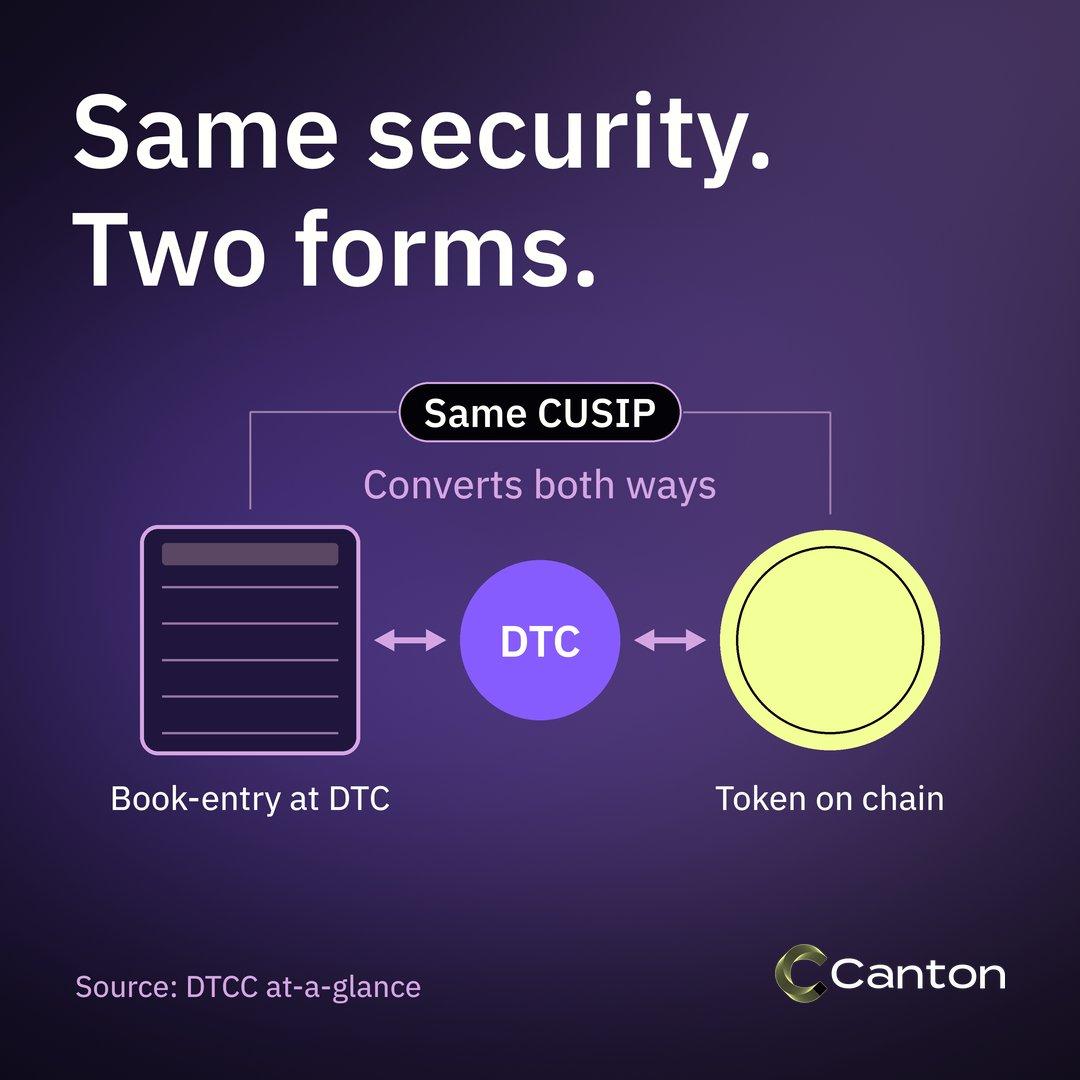
Each DTC-tokenized security keeps its CUSIP.
It holds the same rights and investor protections as the book-entry position and converts between traditional and tokenized forms through DTC.
Registered wallets on a chain transfer it peer to peer, 24/7.
Treasury bills on-chain within five years.
Canton already handles $300B to $400B in repo a day.
@YuvalRooz discusses with @TheStreet why Treasuries go first, and why he expects 24/7 creation and redemption for money market funds and stablecoins.
Last week on the network.
🗓️ 11/2/26
Solidity, proven and settled on Canton.
@RomeProtocol's Ostia proves each EVM block with zero-knowledge and commits it with its Canton actions in a single Canton transaction.
On DevNet since Oct 22: 53,600+ blocks committed.
Every market is heading to 24/7.
@Wesarn_real joined @TheRollupCo's @Andyyy and @StrataMedia_'s @JacqMelinek at DAS London to discuss how margin cycles tighten, what building to DTCC's requirements took, and why participant readiness now sets the pace.
Watch now.
DA CEO @YuvalRooz told @TheStreet Roundtable at @Token2049 the US Treasury could issue bills directly onchain within two to five years, calling it a hundred percent likely.
@CantonNetwork already settles $300B to $400B in daily repo.
Full breakdown.
On Canton, tokens share one standard.
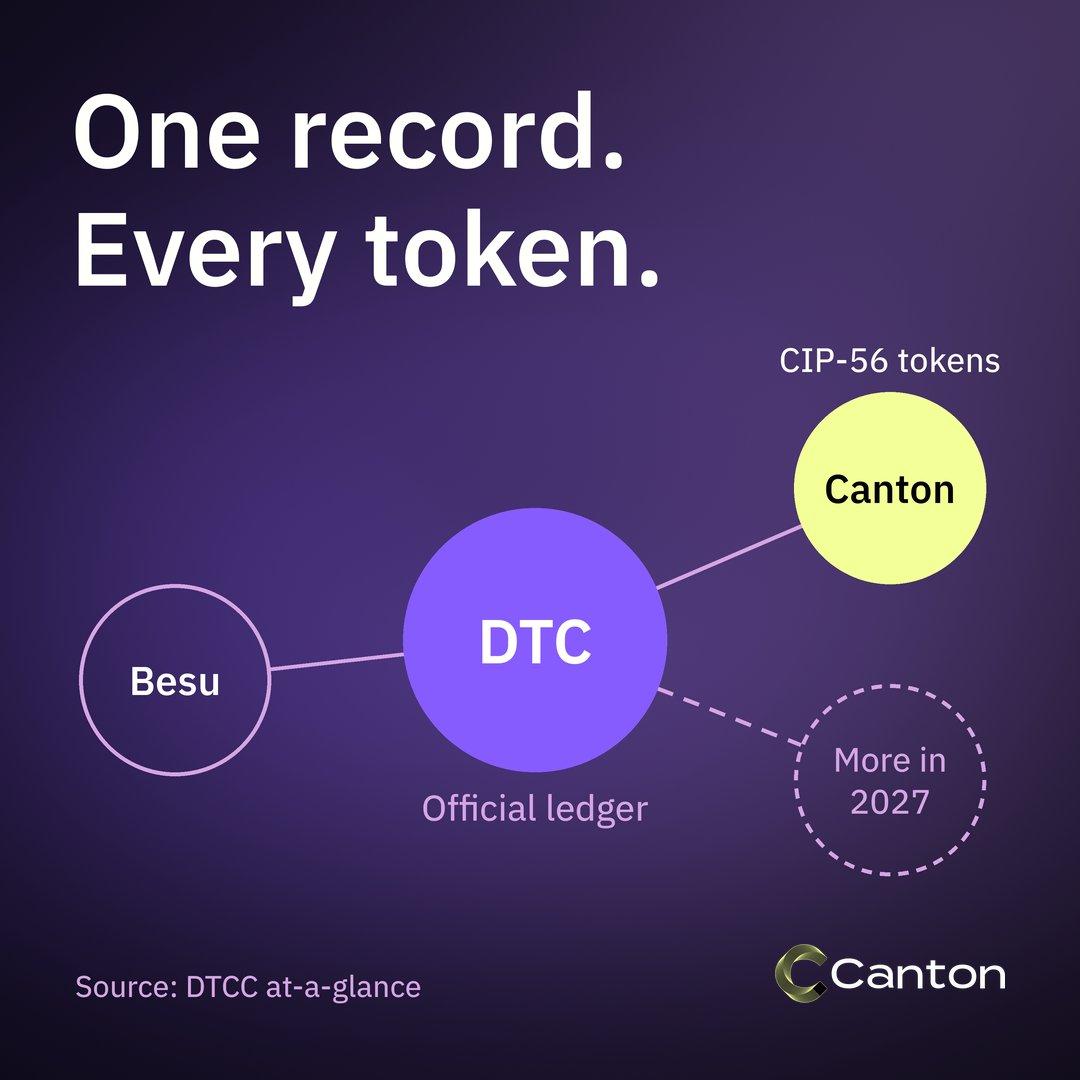
CIP-56 gives wallets and apps one set of APIs for holdings, peer-to-peer transfers and delivery versus payment across asset registries.
Connect to DTCC tokens on Canton:
Privacy that runs real markets.

Tokenized collateral stuck on one chain sits idle.
DTCC's Tokenization Service anchors every token to DTC.
Each one is backed 1:1 by a security held at DTC, and the official books and records stay with DTC.
Canton is built for durable activity.
At The Capital Summit 2026 in Korea, @YuvalRooz discusses why institutional flows hold steady, why Korea's tech-fluent consumers could adopt fast once regulation lands, and the meme coin launchpad now on the network.
Canton settled 5.6 million transactions last week.
The daily average held above 800K, with Nov 4 the busiest day at 888K.
Each party saw only the parts of the transactions they were entitled to see.
One network, one pricing model.
With CIP-0129 approved, dedicated synchronizers move off commercial licenses and pay for traffic the same way as the rest of Canton, by burning Canton Coin.

Progmat is adding Canton support for tokenized JGBs.
@Progmat_en and @DigitalAsset signed an MOU on tJGB, tokenized JGBs that keep their book-entry legal status, aimed at 24/7 settlement.
Four MUFG companies will test DvP with digital money and onchain repo.
↓ Learn more.

Mid-Week Canton Network recap from @Cantor8.
↓ Read the roundup.
https://blog.digitalasset.com/press-release/strategic-collaboration-toward-accelerating-the-on-chain-transformation
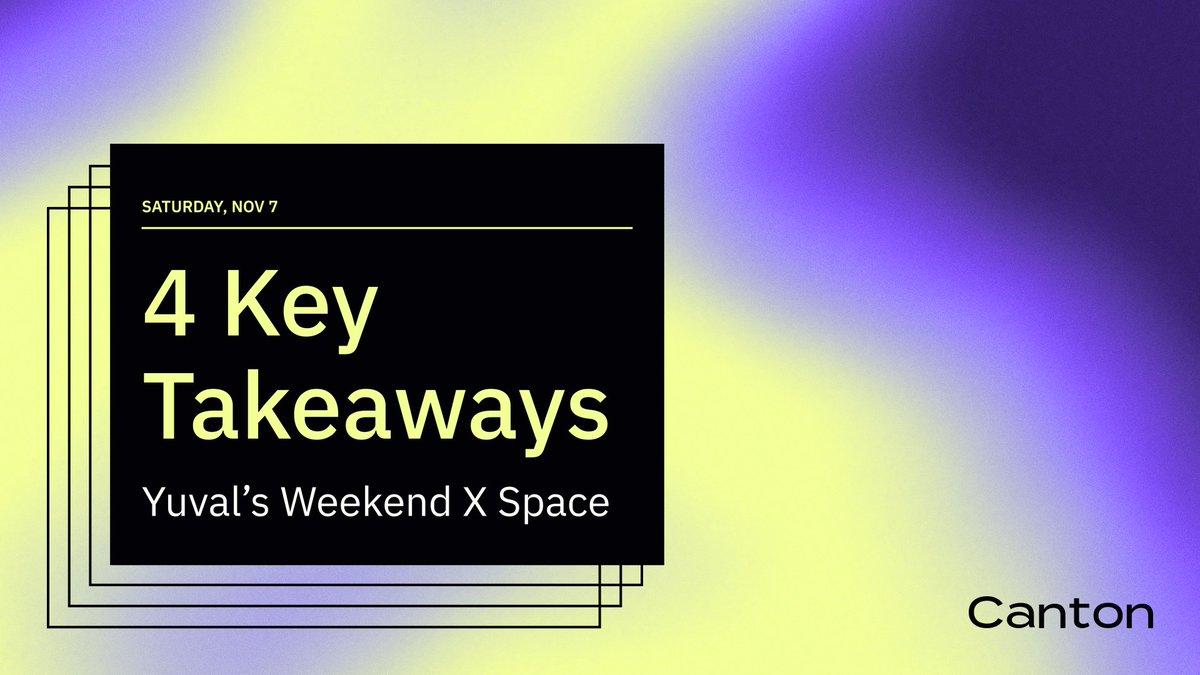
This past weekend, Yuval Rooz laid out what Canton's next steps look like.
It starts with stocks moving onchain, and each step builds on the last.
1. Real equities are coming onchain three ways. TSV trades under the SEC's Innovation Exemption. Transfer agents bring issuer-led tokenization. DTCC needs no issuer consent and is cleared for the top 1,000 U.S. equities.
2. Once stocks trade onchain, market structure decides who pays. Yuval's upcoming paper, "Front running is not payment for order flow," puts the cost of MEV and sandwich attacks above $1B. Canton has no public mempool to front-run.
3. Corporates follow, one treasurer at a time. Uber's treasury move on Canton started with one team seeing better economics.
4. From there, the asset list widens. In his words, next up is multiple players joining repo this year, uncleared derivatives and more private assets.
Ether markets on Canton are taking shape.
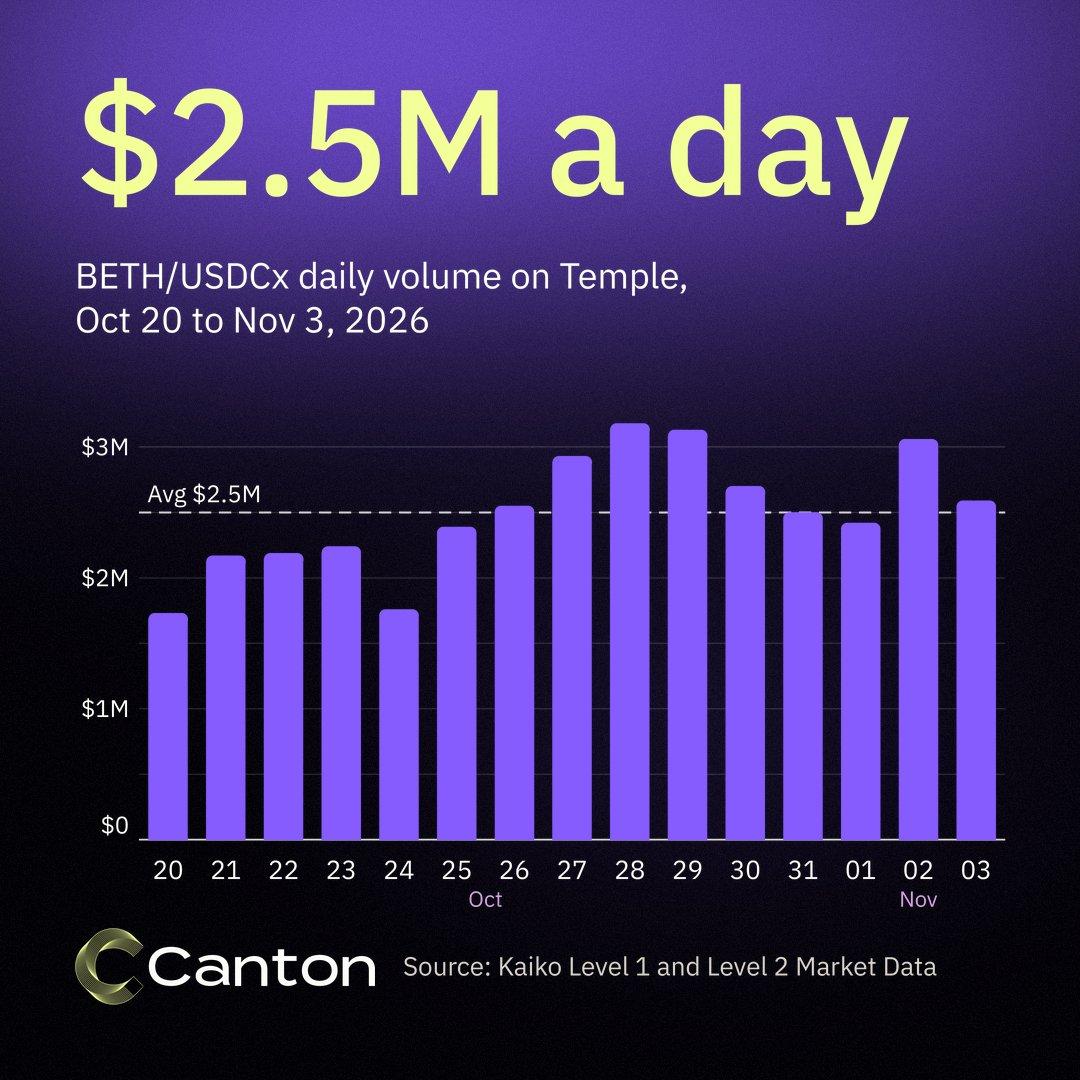
@BitSafe_Finance's BETH has traded on @Temple_NY every hour since Oct 19, weekends included, at a median 4 bps from ETH/USD on Coinbase.
It mints on CBTC's multi-party setup, so no one party controls reserves.
Source: @KaikoData.
Burn is the signal to watch after CIP-0129 goes live.
@Wesarn_real discusses with @LongViewCrypto why multi-year enterprise contracts make burn steadier and less dependent on pay-as-you-go usage, and how early adopters show up in the burn.
Canton's tokenized RWA value grew 10% in 30 days.
Per roughly $344.6B in represented assets sits on the network, an 80% share of the market.
No counterparty means no contract to sign.
@Wesarn_real discusses with @LongViewCrypto why Canton uses canton-network:native as collateral to enforce commitments, how it mirrors an enterprise buyout clause, and why larger collateral means better economics.
Canton Wallet is back online, now on a more secure validator.
Next time you sign in at approve the one-time security upgrade with your passkey.
Your address and assets stay the same. No fees, nothing is sent.
Canton is drawing Wall Street's attention.
@GoldisinMyVienz breaks down the SEC staff view of Canton Coin (canton-network:native) as a digital commodity and the public shares moving onchain.
Read more.
A week of firsts on the network.
@CantonStrategic stock settled onchain on TSV with @Tradecraftfi and @Fairmint. @SocieteGenerale took tokenized Treasuries as collateral.
CBTC went live on @Markets_EDX.
Token creation on @Supanova_app hit Canton too.
Welcome to the trenches.
ICYMI: The CIP-0129 X Space recording is up.
@DigitalAsset’s @ShaulKfir and @FiveNorthHQ’s @Neperien, the authors of CIP-0129, walked through Universal Burn, what’s changing for @CantonNetwork, and answered questions from the community.
Listen to the full recording 👇