
As the thesis around real-estate indexes on-chain became clearer, one point followed quickly:
The infrastructure choice could not be treated as an afterthought.
If the goal is to bring real-estate market exposure on-chain in a credible way, the network matters as much as the asset design.
That is because tokenized market products do not only need issuance.
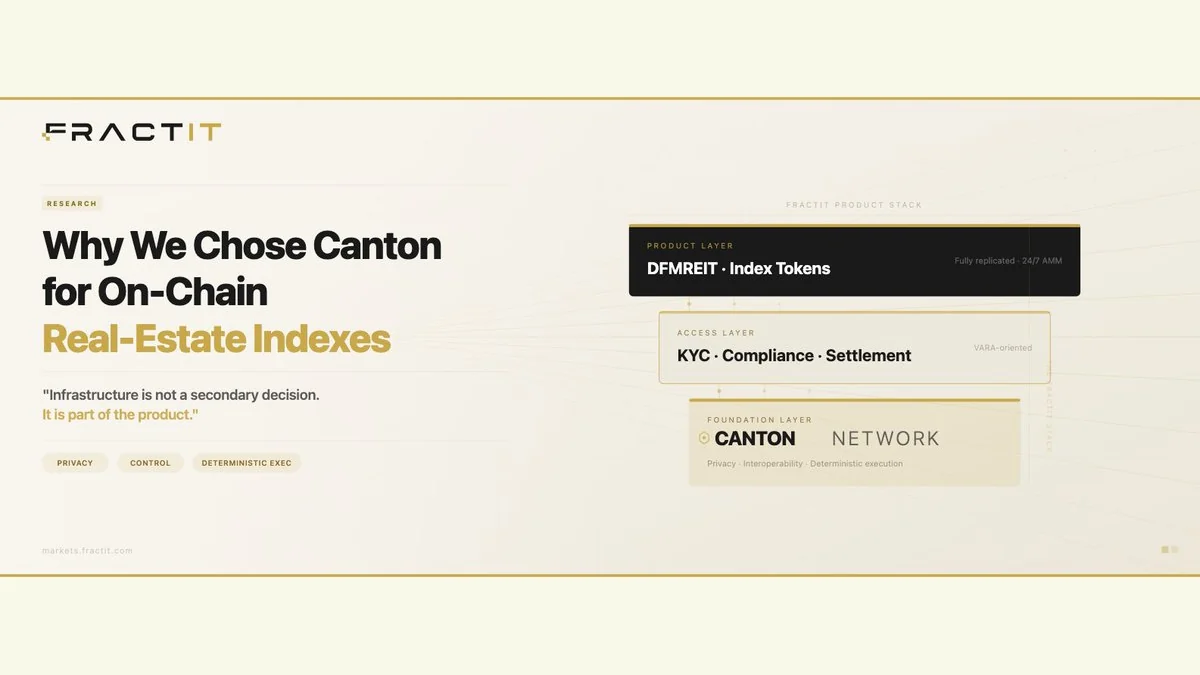
They need controlled access, reliable execution, privacy-aware workflows, and infrastructure that can support serious financial applications. Canton describes itself as a network designed for interoperable applications with privacy and control features aimed at institutional use cases.
That distinction matters in real-world assets.
In speculative markets, speed and distribution often dominate the conversation.
In real-world asset markets, the standard is higher.
Products tied to real assets require stronger alignment between market structure, compliance, settlement design, and investor trust. Fractit’s current direction involves compliant access and index-linked real-estate products on Canton rather than generic property tokenisation alone.
That is why the infrastructure decision became central.
The question was not simply where a token could be issued.
The real question was which environment best supports the kind of product Fractit is actually building. Fractit is developing a platform that brings real-estate indexes around the world on-chain through Canton-based infrastructure.
That changes the evaluation entirely.
For this category, privacy matters.
Control matters.
Deterministic execution matters.
When financial products are meant to represent structured exposure to real markets, the supporting rails have to be built with more discipline than a simple token launch requires.
That is what made Canton compelling. Canton positions its network around privacy, interoperability, and institutional-grade digital asset infrastructure, which aligns with the needs of compliant financial applications.
This is not about choosing infrastructure for branding.
It is about choosing infrastructure that fits the product.
Fractit is not building a one-off asset wrapper.
It is building toward market-level real-estate exposure on-chain, and that requires an environment that can support more than surface-level token issuance. Fractit’s product direction is centered on tokenized real-estate indexes and market access rather than isolated single-property products.
That point is easy to miss in tokenisation discussions.
A great deal of the market still talks about tokenisation as if the act of issuing the token is the product.
It is not.
For serious financial products, issuance is only one layer.
The harder layer is everything around it: access design, lifecycle controls, settlement logic, interoperability, and the credibility of the operating environment.
That is where infrastructure starts to shape the actual user experience.
It shapes who can access the product, how transactions are handled, how workflows are controlled, and how the market can expand over time.
For Fractit, that made the decision clearer.
If the objective is to make real-estate indexes investable on-chain, then the infrastructure has to support the standards that such products demand. Fractit is building for real-estate index exposure on-chain on Canton as part of that broader market-access thesis.
This is not just a technical choice.
It is a product choice.
It is a market-structure choice.
And it is part of the reason Fractit’s direction is taking shape where it is.
The first phase of tokenisation asked whether assets could move on-chain.
The next phase asks whether serious market products can be built there properly.
That is the standard Fractit is building toward.