
What Is an NFT and Where Did the Idea Come From?
NFT stands for "Non-Fungible Token." The name sounds technical, but the idea behind it is simple: a record that proves unique ownership of a digital asset.
Owning something on the internet has always been something of an illusion. You bought a song but really acquired a license. You downloaded a photo that existed on thousands of other computers. You earned an in-game item that disappeared the moment a company shut down its servers.
NFTs emerged to change that equation. Blockchain made it possible to record "this file, at this moment, belongs to this person" in a way that can't be copied, manipulated, or taken away by an intermediary. The roots of the idea go back to 2014-2017, when the first NFT projects took shape on Ethereum among small communities of artists and collectors.
2021: The Moment Digital Ownership Went Mainstream
In 2021, that idea entered the global conversation almost overnight.
Digital artist Beeple sold a piece for millions of dollars. Collections like CryptoPunks and Bored Ape Yacht Club reached prices in the hundreds of thousands of dollars. Pixel avatars flooded Twitter. The NBA, the music industry, fashion brands, and sports clubs all stepped onto the stage at once. The idea of digital ownership felt tangible for the first time: truly owning an asset, transferring it without intermediaries, creators earning a cut from every sale.
Then the wave pulled back. OpenSea volumes dropped ninety percent. The "floor is lava" joke flipped the other way. For two years, "NFT" became shorthand for one of crypto's biggest disappointments.
Institutional Finance Came to Blockchain. That Changes Everything.
Between 2024 and 2026, something happened quietly but quickly.
HSBC, JPMorgan, Goldman Sachs moved past the "we're exploring blockchain" phase. Tokenized deposits, real-time repo transactions, cross-border collateral movement; these are now running in live systems. And these institutions chose the same chain: Canton Network.
Canton currently processes $9 trillion in monthly transaction volume. Operating on infrastructure of that scale means a very different starting point for an NFT ecosystem. A liquidity base fed by real financial activity, not speculative waves.
Arkena: NFT Ecosystem Built on Canton
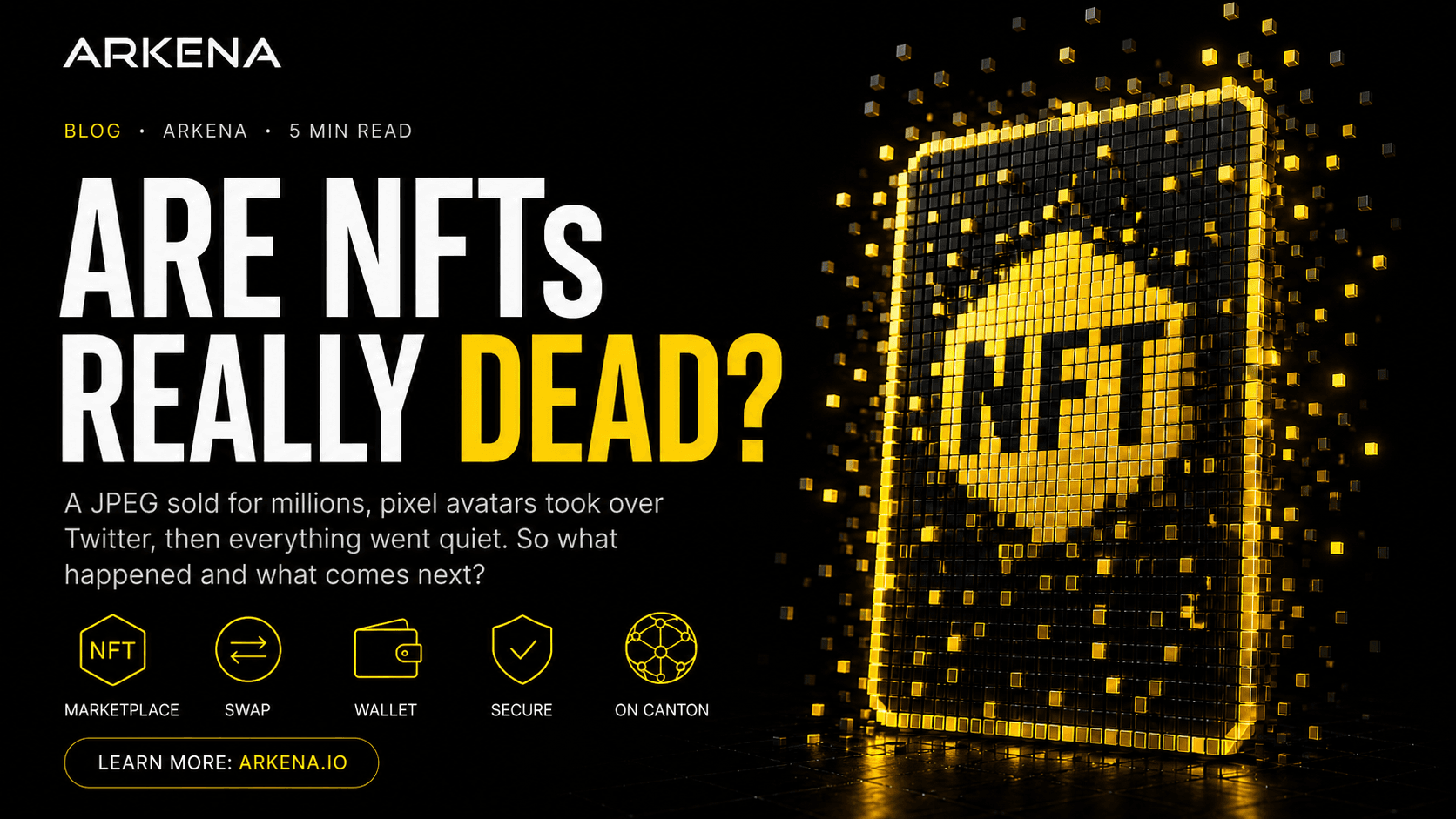
Arkena runs on Canton Network and was designed as a marketplace, a swap platform, and a Chrome extension wallet, all under one roof.
User experience is the priority this time. Buying an NFT happens in a single signature; payment and transfer settle simultaneously.The wallet setup is as straightforward as installing a browser extension.
Launching a collection comes with a guided interface: whitelist phase, public sale, price and supply management all from one place. No technical knowledge required; starting a collection from scratch has been reduced to a few steps.
The same simplicity applies on the swap side: conversion between CC and USDC happens directly within the platform. Someone interested in an NFT can complete the whole transaction without ever leaving.
The Hype Will Return, But on a Different Foundation
The 2021 wave rose on a speculative spiral, and when that spiral reversed, it came down hard.
The NFT ecosystem on Canton Network starts from different ground. Institutional liquidity is already there. The friction in the user experience has been minimized.
The idea of digital ownership never died. It was just waiting for the right infrastructure to make it work.
Learn more about Arkena: arkena.io