
While broader markets navigated volatility, April on Canton looked different: real capital, regulated participants, and production-grade use cases accelerating in lockstep with Protocol 3.5.
This recap delivers you the signals that matter most.
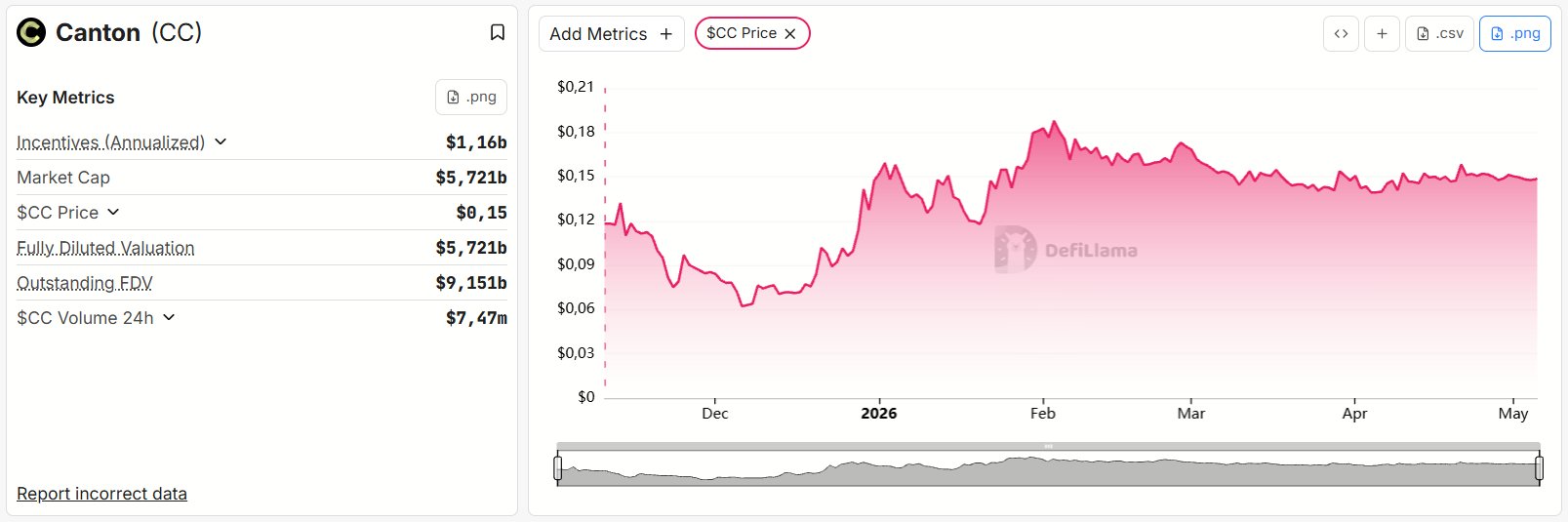 Source: https://defillama.com/protocol/canton?tokenPrice=true&unlocks=false
Big Signal
Two of the world's largest banks are now converging on the same infrastructure and that's the real story of April.
JPMorgan has been building deposit token workflows on Canton via JPM Coin for years. In April, after joining Canton as a validator, HSBC completed its own tokenized deposits pilot on Canton, and for the first time, ran its deposit tokens on a public chain. Two GSIBs, same rails, it's hard to think of another L1 that can say that.
The rest of April's institutional news reinforced the same direction:
- Hanwha Investment & Securities (part of Hanwha Group) of 50 billion KRW (~$33 million) into Canton Strategic Holdings (NASDAQ: CNTN), the publicly traded company whose core strategy is to accumulate and operate as a Super Validator on Canton Network. This follows the MOU signed by Hanwha Investment & Securities with Digital Asset and marks a major step for South Korean institutional adoption.
- @Visa added Canton to its global stablecoin settlement pilot, a program that has reached a $7 billion annualized stablecoin settlement run rate, expanding privacy-preserving payment rails with the network.
- Japanese Government Bond (JGB) collateral pilot launched with Mizuho, Nomura, JSCC (JPX Group), and Digital Asset, testing 24/7 tokenized collateral mobility and automated margining under Japanese law.
- @NorthernTrust ($18.7T AUC/A) is building custody workflows for tokenized assets on Canton.
- HQLAx secured strategic investments from Broadridge and Digital Asset, with plans to migrate its digital collateral platform fully to Canton.
Six institutions deepened their Canton commitments in April, including various markets: London, Tokyo, Seoul, and New York, moving in parallel on the same infrastructure. These moves reinforce Canton as the superior infrastructure for regulated tokenization, collateral mobility, and cross-border settlement.
Builder Signal
April's builder story has two layers: the infrastructure unlocking access, and the activity that's already flowing through it.
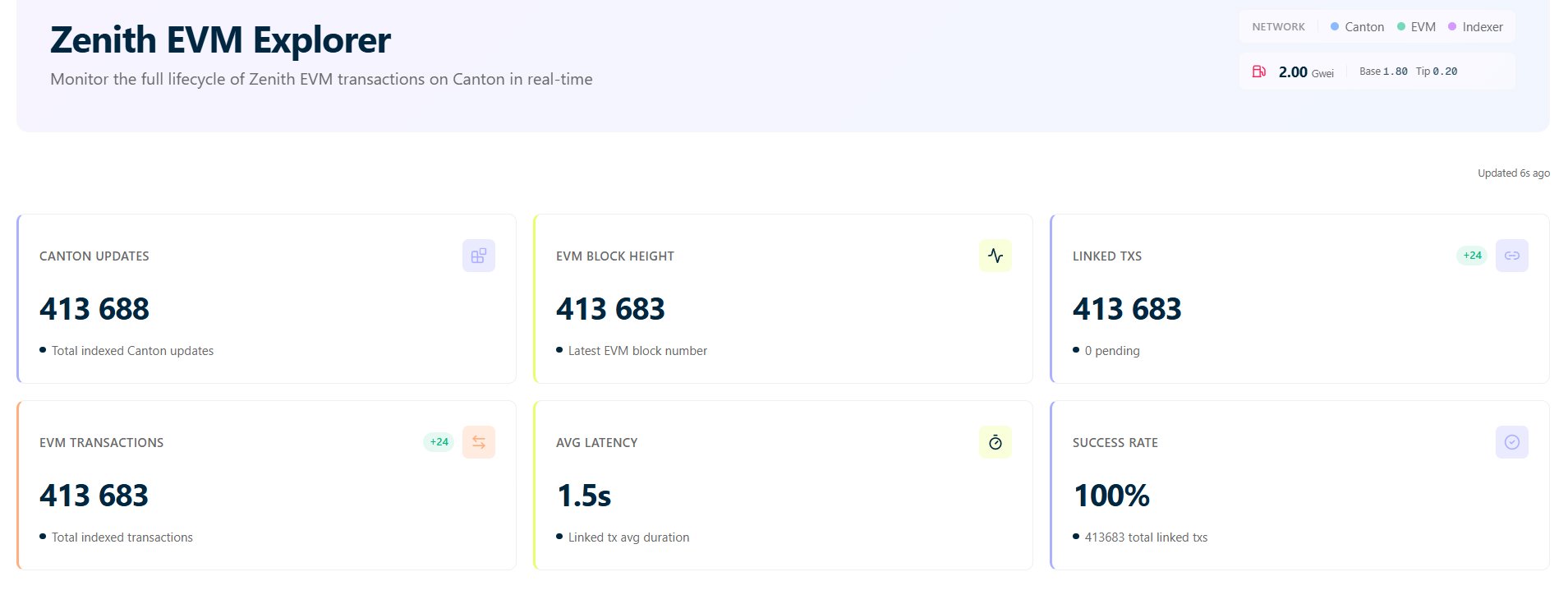
Zenith's native EVM execution layer, with SVM support coming soon, removes the DAML barrier that kept Canton out of reach for most Web3 developers. Teams building DeFi, RWAs, lending, options, and institutional tooling can now deploy unmodified Solidity using MetaMask, Foundry, and Hardhat, gaining Canton's privacy and compliance rails without changing their stack. The result is visible in the numbers: Zenith crossed 400K+ transactions in its internal EVM test environment, up from 200K in March, with a consistent average 1.5s latency on an unoptimized build.
Beyond Zenith, the broader builder ecosystem continued moving.
@Alchemy integrated for improved application connectivity. The Tokenomics Group approved five new Featured Apps: @hifibridge, @dteamtech's Transparent Scan, @edeldotfinance, @GSXnetwork, and Nest by @plumenetwork, making them eligible for $CC App Rewards tied to real usage. Those rewards now allocate 62% of activity-based incentives directly to builders and applications: a deliberate design choice that ties developer income to volume delivered, not promises made.
 Ecosystem Signal
April brought new governance participants and expanded exchange access, reinforcing the network's security and adoption.
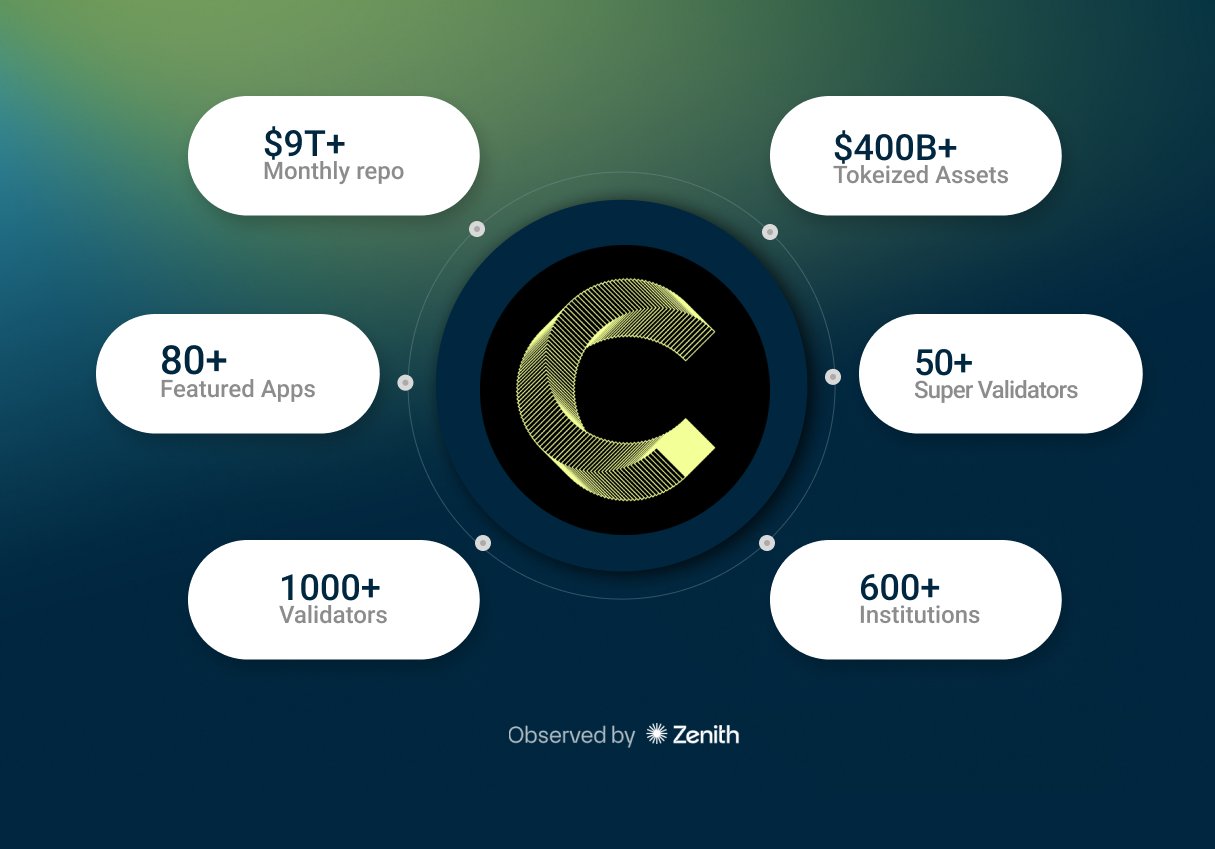
Canton surpassed 1,000+ validators, including new validators like @GOATNetwork & @Bitwise, each participating in relevant workflows while maintaining synchronized state across counterparties without global broadcast. Validators on Canton are not just securing the network but actively running pilots, custody solutions, and settlement infrastructure. HSBC, for instance, joined as a validator in March and completed a live tokenized deposits pilot in April. That's the same institution validating the network and running production workflows on it simultaneously. When the validator set includes GSIBs, custodians, and clearinghouses actively building on the infrastructure they help secure, the security model looks different from anything else in the space.
- Further Asset Management joined as Super Validator (weight 8).
- CIP-0114 approved: Introduces the Digital Asset Treasury (DAT) Super Validator Program, enabling publicly traded companies to accumulate $CC as treasury assets and offer structured exposure to investors.
- p402 protocol milestone: The world’s first private blockchain transaction executed by an AI agent settled on Canton (developed by Cambridge researcher Yash Bharti via @Cantor8 Research Program).
- @WalletConnect integration brings Canton’s privacy infrastructure to 700+ wallets, 70k+ dApps, and 55.5M users.
- @temple_ny Lightspeed upgrade went live with real-time orderbook and sub-10ms matching.
- @BitwavePlatform completed native B2B payments integration, unifying invoices, payments, and cash flow into programmable financial workflows.
- @TranscendStreet (collateral/liquidity optimization across 45+ CCPs) integrated with Canton.
- @BitGo supports Haven Digital Partners’ institutional lending platform on Canton.
- @CredShields became an official Audit Partner.
- @trize_io founder Madani Boukalba appointed to the Canton Foundation Board.
- Trakx CTIs are available via @FiveNorthHQ's Loop wallet, making diversified index exposure easily accessible to institutions and sophisticated users.
- @alpendhq beta went live, introducing private, decentralized lending and borrowing on Canton.
- @cancore_io launched mainnet and upgraded to Genesis Phase 2.
- @cantontools v2 launched, featuring an interactive ecosystem map, gamification (quests, streaks, badges), reputation system, governance viewer, and devtools hub.
- @CantonStrategic released its inaugural Q1 2026 Ecosystem Report on April 20, covering topics such as transaction growth, validator growth and institutional Initiatives.
Economic Signal
Canton demonstrated overwhelming real-world utility in April.
$CC went live on @HTX_Global, @LBankUpdates, @Official_Upbit (KRW/BTC/USDT pairs), @swissborg, @bitget (with Launchpool), @Bybit_Official EU (CC/EUR), and @cryptocom App.
The network has crossed $400M in cumulative $CC value burned, driven by transaction fees from live institutional workflows. Daily burns through the Global Synchronizer continue in the millions.
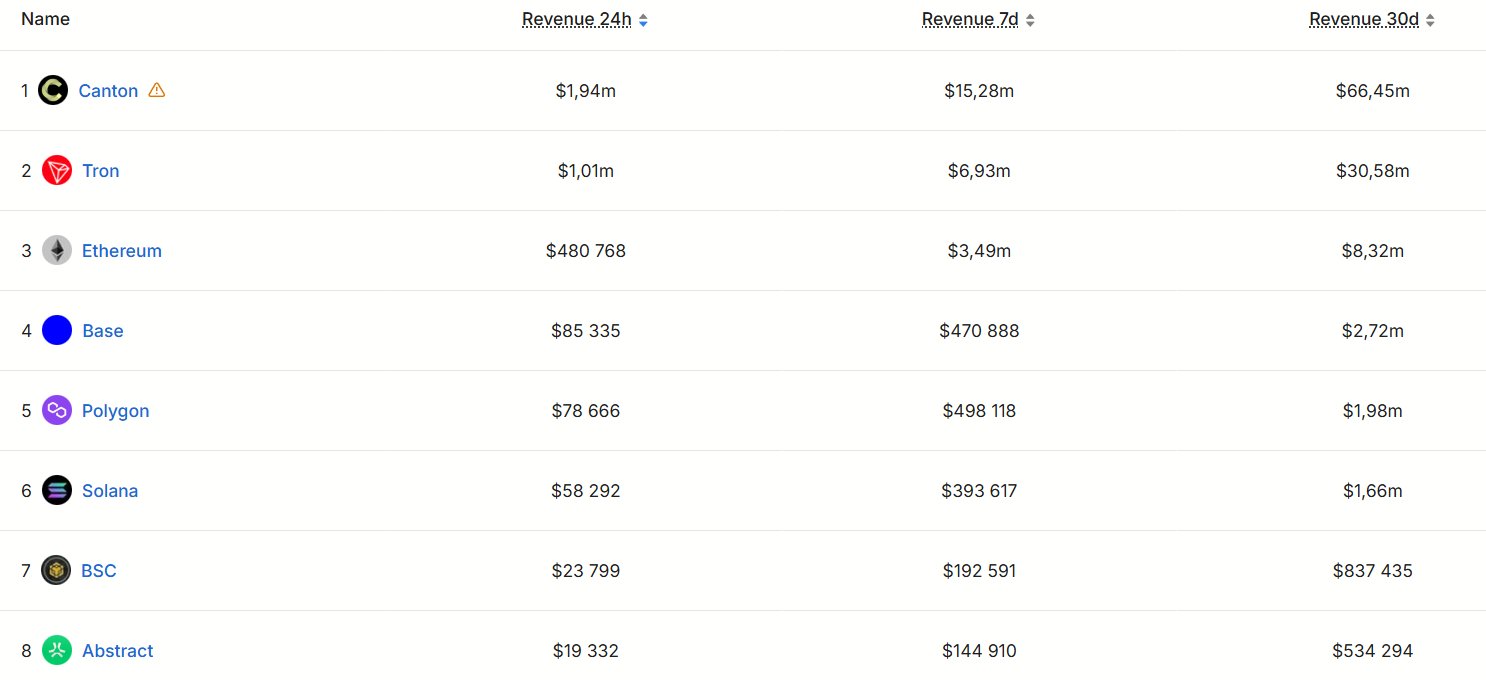
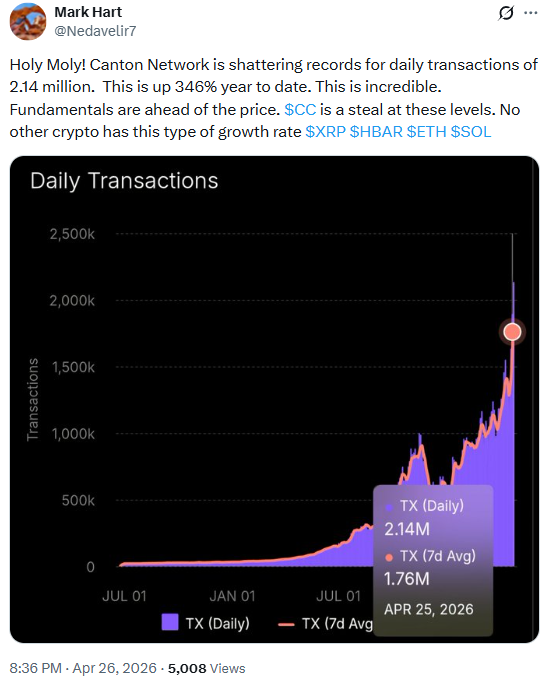
According to @DefiLlama, Canton Network is ranked #1-3 in chain revenue throughout the month, generating approximately $2M-$2.25M daily and ~$66M across 30 days, ahead of Hyperliquid and Ethereum. The data generated real debate in April and the transparency of that conversation matters as much as the data.
Zenith Co-founder & CBO @HeslinKim delivered the clearest and most detailed response to these discussions in a widely engaged thread, explaining the Burn-Mint Equilibrium (BME) design.
Next Signal
April laid stronger foundations for institutional scale and developer influx. Protocol 3.5 is approaching, bringing further scalability improvements to a network already generating $66M in monthly chain revenue. Cross-domain interoperability between private subnets is expanding and as it does, institutional volume that currently runs silently will begin routing through the Global Synchronizer, adding to burns that are already at their floor. The tokenomics debate that played out publicly in April is part of that maturation: the community is pressure-testing the design in real time, which is exactly what a system built for long-term utility should be able to withstand.
On the developer side, Zenith's EVM mainnet launch is approaching in Q4. With go-live it connects 31,800+ active Ethereum developers to the infrastructure that Visa, DTCC, Nomura, HSBC, and Northern Trust are already building on. That's the convergence the second half of 2026 is building toward two ecosystems sharing the same rails.
About Zenith:
Zenith is bringing traditional finance on-chain through Canton, extending Canton MainNet with native EVM and SVM execution environments.
As a Super Validator in Canton’s Global Synchronizer with an equivalent weight to the DTCC, Nasdaq, and Chainlink, Zenith is committed to tangible ecosystem growth through enhancing Web3 composability and simplifying accessibility for developers fueling the next phase of global, privacy-enabled financial markets.
Stay connected with Zenith at @zenithfdn and explore more fresh news on the @CantonNetwork. The future of finance is private, interoperable, and globally accessible.