
Key Takeaways
- The value of blockchain in repo is not simply faster settlement, but the ability to coordinate cash and collateral movement more precisely. Atomic settlement allows both legs of a transaction to execute together, or not at all, reducing settlement-leg risk at the point of exchange.
- Blockchain’s value additions extend beyond instant/atomic settlement.
- Canton combines blockchain advantages like atomic settlement, with key features around privacy, compliance, and interoperability, making it altogether better suited to the needs of regulated financial institutions.
- DTCC’s work with Digital Asset and Canton shows a clear progression from pilots and working-group transactions to controlled production and phased implementation.
- As tokenised Treasuries and repo activity scale, infrastructure providers like Cantor8 are positioned to help institutions build deployable infrastructure.
Context: Understanding Repo
A repo is economically a collateralised short-term loan: one party sells securities for cash today and agrees to repurchase them later at a pre-agreed price. The difference in price represents the interest on the loan. Dealers depend on these arrangements to keep their balance sheets active and support trading in Treasury and similar debt assets. According to a 2025 Federal Reserve Board note, the gross size of the U.S. repo market reached $11.9 trillion in 2024, with roughly 38% in the less transparent non-centrally cleared bilateral segment. Regulators consistently view repos as essential for temporary financing and market functioning.
The Biggest Problems with Traditional Repo
Repo arrangements are essential for financing securities and maintaining Treasury market liquidity, not just for borrowing. Despite the 2024 shift to T+1 settlement for U.S. cash securities, challenges remain beyond outdated T+2 processes. Settlement timing gaps and daily collateral allocation in tri-party deals create operational strain. Repeated unwinding of positions adds inefficiency, and reliance on temporary credit increases fragility. High-quality collateral remains difficult to mobilise across entities, jurisdictions, and platforms, particularly during periods of market stress. The four key problems that persist in traditional repo are:
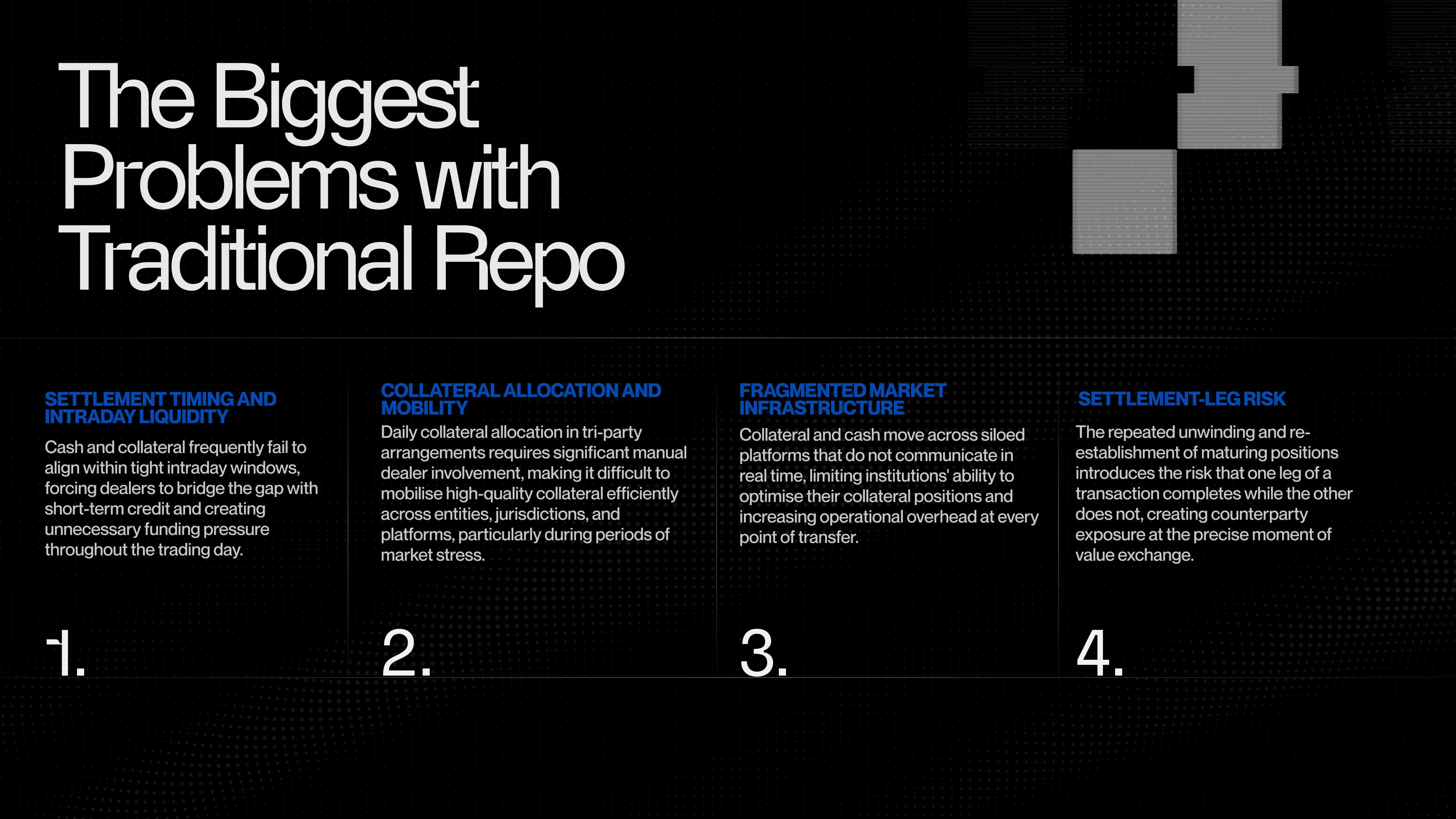
1. Settlement Timing and Intraday Liquidity
Cash and collateral frequently fail to align within tight intraday windows, forcing dealers to bridge the gap with short-term credit and creating unnecessary funding pressure throughout the trading day.
2. Collateral Allocation and Mobility
Daily collateral allocation in tri-party arrangements requires significant manual dealer involvement, making it difficult to mobilise high-quality collateral efficiently across entities, jurisdictions, and platforms, particularly during periods of market stress.
3. Fragmented Market Infrastructure
Collateral and cash move across siloed platforms that do not communicate in real time, limiting institutions' ability to optimise their collateral positions and increasing operational overhead at every point of transfer.
4. Settlement-Leg Risk
The repeated unwinding and re-establishment of maturing positions introduces the risk that one leg of a transaction completes while the other does not, creating counterparty exposure at the precise moment of value exchange.
In April 2025, DTCC announced a tokenized real-time collateral management platform, positioning blockchain to increase collateral mobility, improve capital efficiency, and connect previously siloed financial networks. While blockchain is often promoted for speed, its real value here is in addressing specific operational challenges. Canton aligns with regulated participants’ needs for confidentiality and controlled data sharing, supporting synchronized execution and secure coordination across applications.
The DTCC’s progress is best described as a sequence: initial trials, operational exchanges, and then monitored implementation.
Canton Network & Atomic Settlement
The most precise official description of atomic settlement published by the European Central Bank: In distributed ledger technology, it refers to a setup that ensures that either both legs of a transaction execute together, or neither executes at all, as close to simultaneously as possible. For repos and securities trading, this typically aligns with delivery against payment, meaning the asset transfer occurs only when funds are transferred concurrently.
Precision is essential, as broad claims about blockchain eliminating counterparty risk are often unclear. The focus should be on how atomic settlement addresses the completion phase of exchanges. Canton enforces strict information boundaries, ensuring only relevant parties access necessary details.
For example, one party may see money movement during DvP, another tracks title transfer, while system managers see neither. Even when multiple systems are involved in a unified transaction, coordination occurs without external links or delays. By default, shared records remain limited.
While atomic settlement has significant benefits, it does not match the exaggerated claims often found in promotional materials. Settlement occurs in a single step, so neither party can transfer assets without the other fulfilling its obligation, reducing default risk at the point of value transfer. However, risks related to price changes, capital access, legal frameworks, or contract renewal remain.
These exposures can arise before, after, or throughout the loan period. This is why atomic settlement should be understood as a targeted settlement improvement, not a complete removal of all repo-related risk.
DTCC and Canton: From Pilot to Rollout
The most credible way to tell the DTCC–Canton story is as a ladder of evidence.
First came broad interoperability testing. In 2024, Canton's network-wide pilot connected 45 institutions across 22 distributed applications and executed more than 350 simulated transactions, demonstrating atomic interoperability across capital markets workflows. In September 2024, DTCC and Digital Asset then completed a U.S. Treasury collateral pilot showing that tokenized Treasury “digital twins” could be created, posted against margin calls, returned, and, in a default scenario, controlled and seized through atomic transfers.
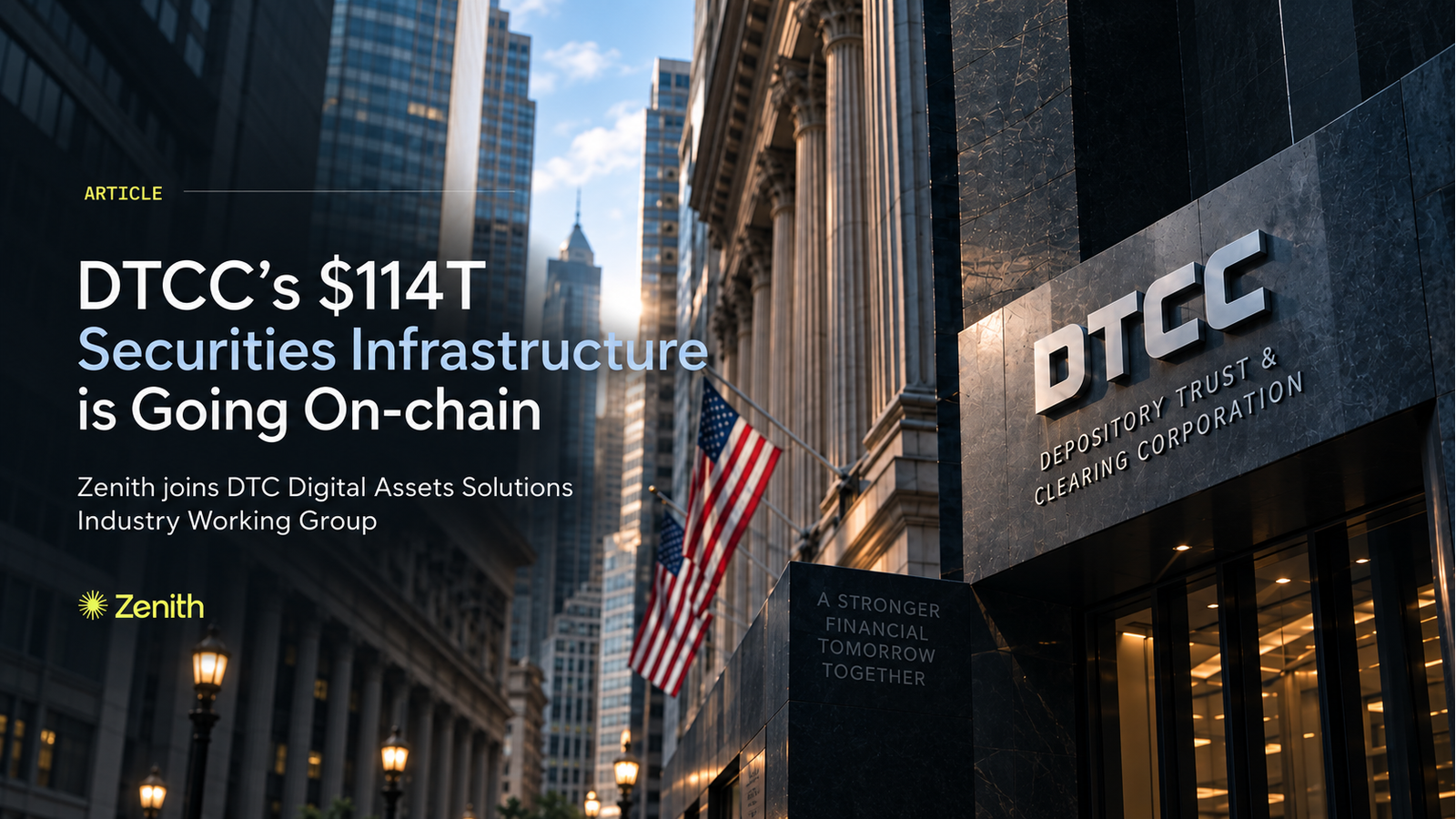
The second phase did not include tokenising DTC-custodied Treasuries on Canton, but evidence showed DTCC was integrating the collateral concept into its core systems. By April 2025, a live platform for instant collateral handling launched on AppChain, emphasizing flexible asset use as key to large-scale adoption. Importantly, DTCC’s digital asset initiatives extend beyond any single blockchain; the Treasury project under Canton is part of a broader move toward interconnected, token-based frameworks.
Stage three featured increasingly complex market trials. In August 2025, outside regular trading hours, a Digital Asset-led industry working group completed a fully on-chain U.S. Treasury financing transaction on Canton, using USDC as the cash leg and digital Treasuries as collateral. By December, operations expanded to include broader stablecoin use and instant access to reused collateral. By January 2026, activities spanned multiple currencies within a single day’s repo, using tokenised deposits from the London Stock Exchange Group and support from Euroclear and Euronext. In February 2026, the working group completed the first cross-border intraday repo using tokenised Gilts. Financial volumes were not disclosed, so these developments demonstrate operational range and scale rather than market share.
The December 2025 announcement marked the clearest step from experimentation toward implementation. DTCC and Digital Asset said they were working toward an MVP in a controlled production environment during the first half of 2026, with plans to expand the size and scope of the project based on client interest. The initiative would allow a subset of U.S. Treasury securities custodied at DTC to be minted on Canton, while preserving the entitlements, ownership rights and investor protections associated with the traditional securities.
This followed DTCC’s earlier December 2025 statement and related SEC no-action letter, which established the framework for DTC’s initial tokenisation service. DTCC says the service is expected to support initial limited production trades in July 2026, with a broader launch planned for October 2026. Importantly, the first phase remains limited: tokenized claims are not yet assigned full collateral or settlement value for DTC risk-management purposes, but they represent the start of a longer-term roadmap rather than another isolated pilot.
Current state and scale
Legacy systems continue to operate at significant scale, with transaction volumes reaching the quadrillions. In 2024, DTCC subsidiaries processed $3.7 quadrillion in securities transactions and supported $99 trillion in assets through custody and servicing. DTC manages access to 1.4 million securities, totaling $87.1 trillion in value. The Fixed Income Clearing Corporation reported average daily clearing above $9 trillion by March 2025, sometimes exceeding $10 trillion. In June 2025, DTCC noted that FICC consistently handled over $10 trillion daily in U.S. Treasury settlements, peaking at $11.4 trillion two months earlier.
Although still much smaller than traditional finance, on-chain activity has become significant. Markets Media reported that tokenized U.S. government debt exceeded $10 billion in early 2026. By March, The DESK reported that Canton was supporting around $350bn in daily U.S. Treasury and repo activity. Broadridge’s distributed ledger repo platform processed an average of $365bn in daily repo transactions in January 2026. Canton-related reporting also pointed to more than 600,000 transactions per day and a validator base above 575, indicating that the network’s institutional footprint was expanding alongside repo and Treasury activity. CoinStats’ April 2026 Canton analysis also points to the network’s institutional adoption, validator base and DTCC-related momentum.
Proportion is key: while $10 billion in tokenized government debt exists, this is small compared to the trillions in traditional U.S. Treasury holdings. Canton’s reported $350bn in daily activity remains modest compared with the $11.9tn gross size of the U.S. repo market estimated by the Federal Reserve for 2024. The goal was not to replace legacy systems, but to demonstrate that digitized assets, electronic money, and structured processes can function together under regulatory oversight.
The evidence confirms that integration is effective within these constraints.
Impact & Opportunity
A key takeaway is that expectations of fully replacing current financial systems with blockchain have diminished. The focus is now on gradual integration into existing frameworks. Legal protections are maintained, digital wallets adhere to strict standards, and standardized tokens are introduced cautiously. Platform connections are established only when they enhance asset movement, settlement efficiency, or security. The DTCC-Canton partnership is notable for its structured approach, moving tokenization from experimentation to foundational infrastructure.
Change creates opportunities for those managing market infrastructure and for those developing software. Companies that integrate issuance registries, settlement modules, validator operations, and automated DAML workflows on Canton are well-positioned, as institutional adoption depends on deployable infrastructure rather than the base network alone. Cantor8 supports this layer by building wallet infrastructure, issuance registry tools, atomic swap modules, validator operations, and DAML smart-contract workflows for enterprise use on Canton.
Resources
- New York Federal Reserve: Repo and Reverse Repo Agreements
- New York Federal Reserve: Key Mechanics of the U.S. Tri-Party Repo Market
- New York Federal Reserve: The $12 Trillion US Repo Market: Evidence from a Novel Panel of Intermediaries
- DTCC: DTCC Announces New Platform for Tokenized Real-time Collateral Management
- KPMG: T+1 Settlement
- European Central Bank: Glossary
- Chainlink: How Atomic Settlement Enables Onchain DvP
- Business Wire: The Canton Network Completes the Most Comprehensive Blockchain Pilot to Date for Tokenized Real World Assets
- Canton: DTCC and Digital Asset Complete Successful Pilot to Test Collateral and Margin Optimization through Tokenization
- Tradeweb: Digital Asset and Industry Working Group Complete Groundbreaking On-Chain US Treasury Financing on Canton Network
- Canton: The Canton Network’s Industry Working Group Demonstrates Next Phase of Onchain U.S. Treasury Financing on Canton Network
- Canton: The Canton Network’s Industry Working Group Showcases Expanded 24/7 Global Collateral Mobility on Canton Network
- Canton: Canton’s Industry Working Group Advances Cross-Border Collateral Mobility on Canton
- DTCC: DTCC Authorized to Offer New Tokenization Service, Paving the Way to Tokenized DTC-Custodied Assets
- DTCC businesses and subsidiaries (general reference): Overview
- DTCC: Record-Breaking Volumes Highlight Central Clearing’s Role in Market Stability
- Markets Media: Tokenised treasuries surpass 10bn USD
- The DESK: Tokenisation booms in repo markets
- Broadridge: Broadridge’s Distributed Ledger Repo Platform Achieves 508% Year Over Year Growth in January
- Canton: State of the Network
- CoinStats: Canton analysis