
Blockchain development is entering a completely different era. For years, developers mainly focused on public chains like Ethereum, Solana, or BNB Chain. But now, institutions are demanding something bigger — privacy, compliance, interoperability, and enterprise-grade scalability. That is exactly where the Canton Network is changing the game. Unlike conventional blockchains that expose every transaction publicly, Canton introduces a privacy-enabled infrastructure designed specifically for financial institutions and regulated environments. Major organizations including Goldman Sachs, DTCC, and Broadridge are already connected to the ecosystem, making Canton one of the most talked-about institutional blockchain frameworks in 2026.
For developers, the exciting part is this: Solidity applications can now interact with Canton through emerging EVM compatibility layers like Zenith. This development opens the door for Ethereum developers to enter institutional blockchain ecosystems without abandoning their existing tools, workflows, or smart contract expertise. Think of it like building a Formula 1 car but finally getting access to a world-class racetrack built specifically for banks and enterprise finance. Instead of learning an entirely new language from scratch, Solidity developers can adapt existing decentralized applications for institutional-grade environments.
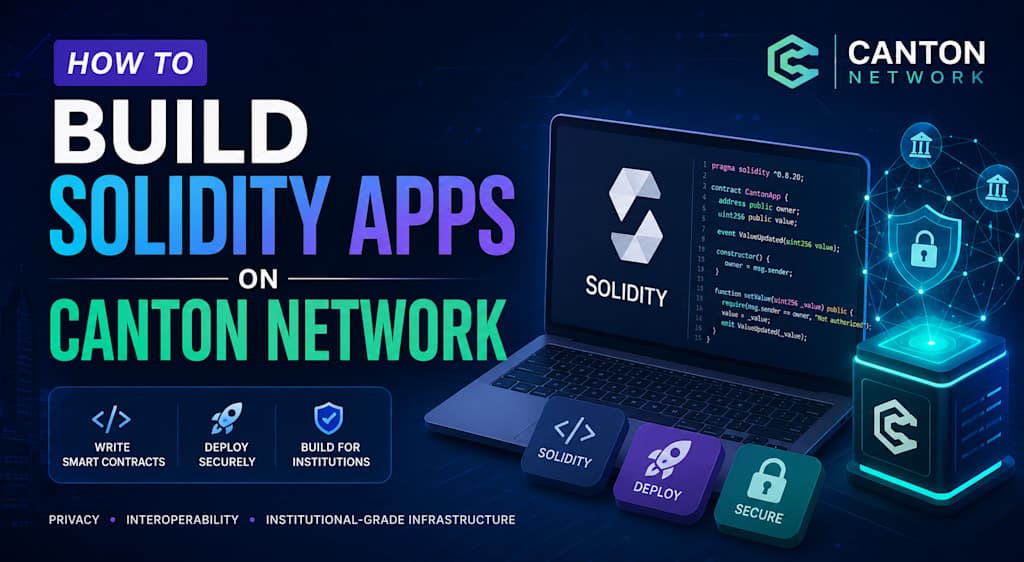
This article explores everything you need to know about building Solidity apps on Canton Network, from understanding the architecture and development stack to deploying scalable institutional applications securely. Whether you are a startup founder, Web3 engineer, or an enterprise-focused blockchain app development company, this guide will help you navigate the future of institutional blockchain development.
Understanding the Canton Network Ecosystem
What Makes Canton Different From Traditional Blockchains
Most traditional blockchains operate like a giant public billboard where every transaction is visible to everyone. Ethereum, for example, relies heavily on transparency because its ecosystem was built around open finance and decentralized verification. Canton works differently. It introduces what is called “sub-transaction privacy,” meaning only the involved participants can see the relevant portions of a transaction. This architecture becomes incredibly valuable for banks, insurance firms, trading platforms, and financial institutions that cannot expose sensitive transactional data publicly.
Canton also differs because it was designed with interoperability and compliance in mind from the beginning. Traditional public chains often struggle with regulatory requirements, while Canton embeds permissioning and governance directly into the architecture. This creates a much safer environment for real-world asset tokenization, institutional DeFi, securities settlement, and enterprise financial workflows.
Another major differentiator is the smart contract model. Canton was originally powered by DAML, a purpose-built smart contract language focused on multiparty workflows and formal verification. DAML significantly reduces common smart contract vulnerabilities such as reentrancy attacks or poorly defined permissions. However, the biggest barrier for developers was the learning curve. Millions of developers already know Solidity, but only a small segment understands DAML deeply. That gap is now being addressed through EVM integrations.
Institutional adoption is another reason Canton stands out. Reports indicate that Canton is already associated with trillions of dollars in tokenized asset activity and institutional transaction flows. That level of enterprise backing creates opportunities far beyond speculative crypto projects. Developers building on Canton are entering a market focused on regulated finance, tokenized securities, cross-border settlements, and enterprise-grade blockchain infrastructure.
Why Financial Institutions Are Choosing Canton
Financial institutions care about completely different things compared to retail crypto traders. Retail users may prioritize meme coins, staking rewards, or low transaction fees, but banks focus on security, privacy, compliance, settlement efficiency, and interoperability. Canton addresses all of these pain points effectively.
One reason institutions prefer Canton is deterministic settlement. Transactions on Canton are designed to execute atomically across interconnected applications. Imagine a bond issuance, payment transfer, and regulatory reporting process all occurring simultaneously in a single secure transaction. That level of synchronization dramatically reduces operational risks and settlement delays.
Another reason is privacy architecture. Public blockchains expose transaction histories permanently, which creates compliance and confidentiality concerns for regulated industries. Canton solves this by ensuring data visibility is restricted only to authorized parties. This becomes critical for financial workflows involving securities, insurance claims, private lending, or confidential trading agreements.
Scalability also plays a huge role. Institutions require networks capable of processing massive transaction volumes efficiently. According to recent ecosystem announcements, Canton-related infrastructure is already handling significant institutional transaction throughput. Developers building Solidity applications within this environment gain access to infrastructure designed for enterprise performance rather than speculative experimentation.
Can You Build Solidity Apps on Canton Network?
The Rise of Zenith EVM Layer
For years, one major limitation existed on Canton: developers had to work primarily with DAML. While DAML offers exceptional security and workflow capabilities, it limited adoption among traditional Ethereum developers. That situation changed with the introduction of Zenith, an EVM execution layer integrated directly with Canton Network.
Zenith essentially acts as a bridge between Ethereum’s developer ecosystem and Canton’s institutional infrastructure. Developers can deploy Solidity contracts without rewriting their applications entirely. This is a massive shift because Ethereum tooling is incredibly mature. Frameworks like Hardhat, Foundry, OpenZeppelin, and Ethers.js have become industry standards. By supporting Solidity applications, Canton suddenly becomes accessible to hundreds of thousands of Web3 developers globally.
What makes Zenith especially important is atomic interoperability. Instead of operating like a traditional blockchain bridge with fragmented liquidity and security risks, Zenith integrates directly into Canton’s transaction infrastructure. Reports suggest EVM transactions are wrapped into native Canton settlement flows and validated by Canton validators themselves.
This means developers can theoretically build decentralized exchanges, lending protocols, stablecoin systems, or tokenization platforms using Solidity while still leveraging Canton’s compliance and privacy architecture. That combination is incredibly powerful because it merges the flexibility of Ethereum development with institutional-grade infrastructure.
How Solidity Compatibility Works on Canton
The compatibility layer works by allowing Solidity contracts to run inside an EVM execution environment connected to Canton. Developers continue using familiar smart contract workflows while Canton handles privacy, governance, and enterprise integrations underneath.
Think of it like driving a sports car on a newly engineered highway system. The car remains familiar, but the infrastructure beneath it is optimized for large-scale institutional traffic. Developers still write Solidity code, deploy through Hardhat or Foundry, and interact with smart contracts using standard Ethereum tooling.
The key difference lies in how transactions settle and interact with institutional systems. Instead of existing purely on public-chain infrastructure, Canton-enabled Solidity apps can communicate with privacy-preserving financial workflows. This creates possibilities that traditional DeFi systems cannot easily achieve.
Developers can also integrate compliance layers, KYC requirements, and permissioned access controls more effectively within Canton environments. This becomes particularly useful for enterprise-grade DeFi applications where regulators require transactional accountability.
Key Components Required for Solidity App Development
Smart Contracts
Smart contracts remain the heart of every decentralized application. On Canton-integrated EVM layers, Solidity contracts can manage lending systems, token issuance, governance mechanisms, NFT ownership, or tokenized assets. Developers familiar with Ethereum can largely continue their existing development practices.
Security becomes even more important when institutional assets are involved. Poorly written Solidity contracts have historically caused billions of dollars in losses across the DeFi ecosystem. Reentrancy attacks, overflow vulnerabilities, and access control flaws continue affecting public blockchain projects.
This is why many organizations rely on a specialized smart contract development company to audit and secure their applications before deployment. Institutional blockchain applications cannot afford vulnerabilities because regulatory and financial consequences are significantly larger compared to retail DeFi projects.
Developers should prioritize modular smart contract design, formal testing, upgradeability patterns, and permission management. Using established frameworks like OpenZeppelin remains highly recommended for Solidity development on Canton-compatible environments.
Wallet Infrastructure
Wallet compatibility differs significantly within the Canton ecosystem. Traditional EVM wallets like MetaMask do not natively support Canton’s DAML infrastructure. However, EVM layers such as Zenith allow Solidity applications to interact through familiar Ethereum-compatible wallet experiences.
This hybrid environment means developers may need dual infrastructure depending on their application architecture. Institutional applications could require Canton-native wallet integrations alongside EVM-compatible interfaces. Developers should carefully design authentication flows and custody solutions based on user requirements.
Security also matters heavily here. Institutional applications frequently integrate governance workflows, multisignature approvals, and advanced custody systems. Wallet architecture must align with compliance frameworks while maintaining usability.
Node and RPC Configuration
Every Solidity application requires access to blockchain nodes through RPC endpoints. Developers deploying on Canton-compatible EVM layers need access to RPC configurations specifically designed for Zenith or associated infrastructure.
Hardhat and Foundry configurations remain largely familiar. Developers define network parameters, gas settings, and deployment scripts similarly to Ethereum development. However, additional enterprise-focused parameters may emerge depending on the infrastructure provider.
Monitoring infrastructure also becomes essential. Institutional-grade applications require uptime monitoring, audit logging, transaction tracing, and governance observability. Production deployments should never rely solely on public RPC endpoints.
Setting Up the Development Environment
Installing Hardhat and Foundry
Hardhat and Foundry remain the dominant frameworks for Solidity development. Developers entering Canton-compatible EVM environments can continue using these tools without significant workflow disruption.
Hardhat is particularly beginner-friendly and integrates well with deployment scripts, plugin ecosystems, and automated testing environments. Foundry, on the other hand, provides high-performance testing and fuzzing capabilities that many advanced Solidity developers prefer.
The installation process remains similar to Ethereum development:
Developers should also configure environment variables securely and avoid exposing private keys directly within repositories. Enterprise blockchain development requires strict DevSecOps practices, especially when institutional assets are involved.
Configuring MetaMask and RPC Endpoints
Although Canton itself is not natively compatible with MetaMask, EVM layers like Zenith allow developers to connect using familiar wallet interfaces.
The setup process generally includes:
- Adding the custom RPC endpoint
- Configuring chain IDs
- Importing test tokens
- Connecting development wallets
- Testing smart contract interactions
Developers should always separate testing wallets from production deployments. Hardware security modules, multisig infrastructure, and institutional custody integrations become increasingly important for enterprise deployments.
Writing Your First Solidity Smart Contract
Sample Smart Contract Workflow
The first Solidity app on Canton-compatible EVM layers often resembles standard Ethereum workflows. Developers create smart contracts, write deployment scripts, run local tests, and deploy to the target environment.
A simple tokenization contract might include:
- Asset issuance
- Ownership tracking
- Compliance checks
- Transfer permissions
- Governance modules
Institutional use cases usually require more sophisticated logic compared to retail DeFi projects. For example, tokenized securities may require investor accreditation verification, jurisdiction restrictions, or settlement finality checks.
This is where ethereum blockchain consulting services become valuable. Experienced consultants can help enterprises adapt existing Ethereum-based business models into institution-ready blockchain architectures optimized for Canton infrastructure.
Security Best Practices
Security cannot be treated as an afterthought. The institutional nature of Canton means applications may eventually handle tokenized real estate, securities, treasury products, or regulated financial instruments.
Developers should implement:
- Role-based access control
- Emergency pause mechanisms
- Upgradeable proxy standards
- Multisig governance
- Extensive unit and integration testing
Formal verification may also become increasingly common within institutional blockchain environments. Since Canton originated from a compliance-focused ecosystem, security expectations are considerably higher compared to experimental DeFi ecosystems.
Deploying Solidity Apps on Canton Network
Deployment Using Hardhat
Deployment workflows remain relatively familiar for Ethereum developers. Hardhat scripts can interact with EVM-compatible RPC endpoints connected to Canton infrastructure.
The deployment lifecycle generally includes:
- Contract compilation
- Network verification
- Testnet deployment
- Integration testing
- Mainnet release
Developers should automate deployment pipelines carefully. Continuous integration and continuous deployment practices help reduce operational risks significantly.
Testing and Debugging the Application
Testing is where many blockchain projects fail. Smart contracts often appear functional until unexpected edge cases emerge in production. Institutional blockchain applications require even stricter testing standards.
Developers should conduct:
- Unit testing
- Integration testing
- Load testing
- Fuzz testing
- Security auditing
Recent reports indicate Zenith processed more than 500,000 EVM transactions successfully in internal testing environments. That demonstrates strong performance potential, but application-layer testing remains the developer’s responsibility.
Integrating Institutional Features Into Solidity Apps
Compliance and Permissioning
Public DeFi systems often prioritize permissionless access, but institutional finance operates differently. Regulatory frameworks require identity verification, transaction monitoring, and reporting capabilities.
Canton’s architecture supports permissioning and privacy features natively. Developers can integrate:
- KYC verification
- Role-based transaction permissions
- Audit trails
- Regulatory reporting
- Restricted asset transfers
This creates opportunities for regulated DeFi ecosystems that traditional public chains struggle to support efficiently.
Privacy-Preserving Transactions
Privacy is one of Canton’s strongest features. Public blockchain transparency becomes problematic for enterprise finance because competitors, traders, or malicious actors can analyze transaction histories.
Canton introduces need-to-know visibility, ensuring only authorized participants access sensitive transaction data.
For developers, this opens entirely new business models involving:
- Confidential lending
- Institutional settlement systems
- Tokenized securities
- Private asset transfers
- Enterprise treasury operations
Use Cases for Solidity Apps on Canton
Tokenized Asset Platforms
Real-world asset tokenization is one of the fastest-growing blockchain sectors. Analysts project trillions of dollars in tokenized assets by the end of the decade.
Canton-compatible Solidity applications can tokenize:
- Real estate
- Bonds
- Treasury products
- Commodities
- Equity instruments
The combination of Solidity flexibility and Canton compliance infrastructure makes this sector especially attractive.
Institutional DeFi Applications
Institutional DeFi differs significantly from retail yield farming. Enterprise participants prioritize compliance, privacy, settlement guarantees, and governance oversight.
Potential applications include:
- Institutional lending markets
- Collateralized financing platforms
- Regulated liquidity pools
- Tokenized repo systems
- Cross-border settlement infrastructure
These systems could fundamentally reshape traditional financial operations over the next decade.
Common Challenges Developers Face
EVM vs DAML Architecture
One challenge developers face is understanding the philosophical differences between EVM systems and DAML-based workflows. Solidity applications typically operate in transparent shared-state environments, while DAML emphasizes privacy and participant-specific visibility.
Developers entering Canton ecosystems must think differently about authorization, data access, and workflow orchestration.
Scalability and Governance Considerations
Institutional applications require long-term governance planning. Upgrades, validator relationships, compliance frameworks, and interoperability standards all affect scalability.
Unlike experimental DeFi protocols that pivot quickly, enterprise blockchain systems often require years of operational reliability and regulatory consistency.
Future of Solidity Development on Canton Network
The future looks incredibly promising for Solidity development on Canton-compatible infrastructure. EVM integrations like Zenith are effectively removing one of the biggest barriers to institutional blockchain adoption: developer accessibility.
Instead of forcing developers to abandon familiar ecosystems, Canton is adapting itself to support Ethereum-native workflows. This strategy could dramatically accelerate institutional blockchain innovation.
Over the next few years, we will likely see:
- Enterprise DeFi expansion
- Regulated tokenization platforms
- Cross-chain institutional liquidity systems
- Privacy-preserving smart contract ecosystems
- Hybrid public-private blockchain architectures
The opportunity for developers is enormous because institutional blockchain infrastructure is still in its early stages. Building expertise now could position teams at the forefront of the next major blockchain evolution.
Conclusion
Building Solidity apps on Canton Network represents one of the most important shifts happening in blockchain development today. For years, institutional blockchain infrastructure and public-chain developer ecosystems existed separately. Canton changes that equation by enabling Ethereum developers to deploy Solidity applications within enterprise-grade environments focused on compliance, privacy, and interoperability.
The introduction of EVM-compatible infrastructure like Zenith makes Canton significantly more accessible to mainstream Web3 developers. Instead of learning entirely new programming paradigms, developers can leverage familiar Solidity tooling while tapping into institutional blockchain opportunities worth potentially trillions of dollars.
As tokenized finance, regulated DeFi, and enterprise blockchain adoption continue expanding, Canton-compatible Solidity development could become a critical skill set across the blockchain industry. Developers who understand both Ethereum tooling and institutional blockchain architecture will likely hold a major competitive advantage in the years ahead.