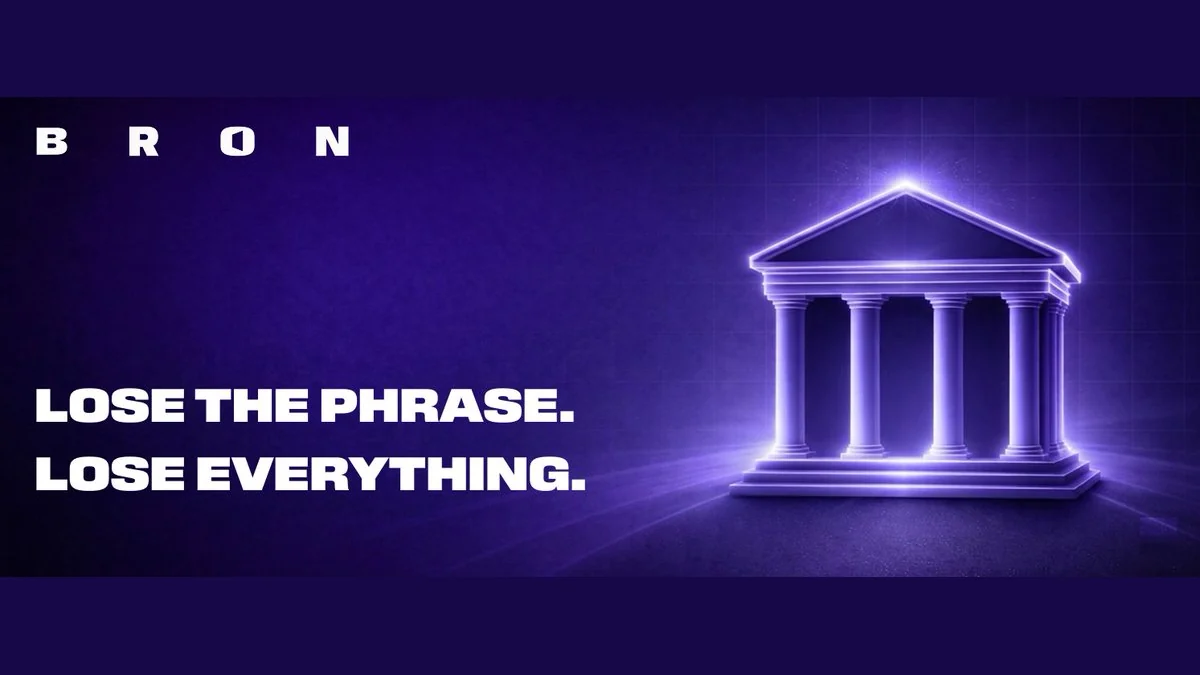

“Not your keys, not your crypto.”
This phrase is as old as the crypto industry itself and has been repeated so often that it has almost lost its meaning. Yet time and again, history proves how painfully true it remains. The industry is filled with examples: those who have been around long enough will remember the collapse of Mt. Gox; those who joined later will point to Celsius or FTX. Different eras, different narratives — but the outcome is always the same: funds lost, assets frozen, and users waiting for years, often without resolution.
The lesson seems clear. Do not store your crypto on exchanges or with custodial providers. The logical alternative is self-custody. But once you choose self-custody, a new and equally serious problem begins.
How Self-Custody Works — and Where It Breaks Down
In 99 out of 100 cases, a self-custodial wallet starts with a seed phrase.
A seed phrase (also called a recovery phrase) is usually a sequence of 12 or 24 randomly generated words. These words are not a password. They are a mathematical master key from which all your private keys — and therefore access to your assets — can be derived.
Anyone who has this phrase has full control over your crypto. Anyone who loses it loses access forever.
The moment a seed phrase appears on your screen, you are immediately faced with three requirements:
You must ensure that you never lose it.
You must ensure that no one else ever finds it.
You must ensure that, if you unexpectedly pass away, your loved ones can find it and use it correctly.
If you are paying attention, you will notice the contradiction. Requirements two and three are fundamentally at odds with each other. Yet this is the exact challenge every person entering crypto is forced to solve.
The instinctive solution for many people is simple: write it down on a piece of paper and put it in a safe. But what happens if your home burns down? The next idea is to make two copies — one at home, one in a bank safe deposit box. But what if a crisis arises? Not even a war — imagine border closures during another global pandemic, and you are locked out of the country where your documents are stored.
There are guides explaining how to store a seed phrase “properly.” Changpeng Zhao (CZ), the founder of Binance, published a detailed article outlining various strategies, from metal plates to geographically distributed backups. It is an excellent guide — for a highly technical audience.
Now imagine explaining this entire setup to your mother. And then ask yourself, with a straight face, whether this is what mass adoption of crypto is supposed to look like.
The uncomfortable truth is that there is no truly good answer. Seed phrase management is a problem so complex that it could easily serve as a graduate-level case study in process management for a group of top MBA students — and even they would likely struggle to design a solution that is both secure and feasible.
One of the most famous cases of losing a seed phrase is that of a man in the United Kingdom who accidentally threw away a hard drive containing the private keys to more than 7,000 BTC.
For over a decade, he has been fighting legal and logistical battles to search a landfill, knowing that the difference between success and failure is billions of dollars — and that failure is irreversible.
There are countless quieter stories. Early Bitcoin adopters who mined coins in the 2010s and stored keys on old laptops that were later discarded. Investors who wrote down phrases incorrectly. Families who knew that crypto existed but had no idea how to access it after a sudden death.
In crypto, there is no customer support line to call. No “forgot password” button. A lost seed phrase is not an inconvenience — it is a terminal event.
And yet, despite all of this, individual users are still expected to manage their entire financial future on a piece of paper.
Why Institutions Never Accepted This Risk
Bron was founded by the team who previously built Copper.co, a regulated institutional crypto custodian serving some of the largest financial institutions in the world.
During our time at Copper, we competed, and sometimes lost, deals to other institutional-grade providers such as Fireblocks, Anchorage, BitGo, and others. But there was one thing we never experienced: losing a deal to a wallet secured by a seed phrase.
Why? Because no institutional investor would ever admit to storing client assets on a handwritten piece of paper. It simply does not meet any reasonable standard of governance, auditability, or operational risk management.
Years ago, the institutional world settled on a different standard: Multi-Party Computation (MPC). Institutions embraced MPC not because it was trendy, but because it eliminated single points of failure. And yet, while institutions moved forward, individual users were left behind — forced to use a model that professionals had already rejected.
This gap is precisely why Bron exists.
Why MPC Is Fundamentally Better
Multi-Party Computation replaces the idea of a single private key with multiple cryptographic shards. No single device, person, or location ever holds the full key. Transactions are signed collaboratively by these shards, and the full key is never reconstructed at any point.
This approach provides several critical advantages:
- There is no seed phrase to lose or steal.
- A compromised device does not mean compromised funds.
- Security can be distributed across hardware, software, and human factors.
- Recovery can be designed without relying on fragile paper backups.
MPC has been battle-tested at the institutional level for years. It is not experimental. It is the industry standard — just one that, until recently, was unavailable to individuals. Security alone is not enough. Recovery experience matters just as much.
Non-Custodial Ownership Designed the Right Way
Bron introduces a recovery mechanism based on Guardians — trusted people that you appoint yourself. If your device is lost, damaged, or compromised, Guardians can help you restore access without ever handling your assets or learning sensitive information. Guardians cannot move funds. They cannot see balances. They cannot collude against you. Their role is limited strictly to recovery.
This model solves the impossible triangle of seed phrases:
- Your assets remain private.
- You are protected against loss.
- Your loved ones are not locked out forever.
Recovery becomes human, controlled, and understandable — without sacrificing cryptographic security.
We believe crypto is one of the most important asset classes of our time. It represents a fundamental shift in how value is stored, transferred, and governed. But for crypto to become the future of finance, it must be accessible to normal people. The entry barrier must be lowered. People should not have to fear that losing a phone, a piece of paper, or access to a safe deposit box could erase their financial future.
Bron was built to remove that fear. By combining non-custodial architecture, institutional-grade MPC security, and human-centric recovery, we aim to deliver the same standards institutions rely on — directly to individuals.
Bron is crypto without fear.
Disclaimer: This article is provided for general informational purposes only and does not constitute financial, investment, accounting, tax, or legal advice. Bron is a self-custodial software wallet. While Bron’s architecture is designed to eliminate single points of failure and reduce certain risks, the use of blockchain technology and self-custodial wallets involves inherent operational, technical, governance, and security risks, including risks related to user configuration, device compromise, social engineering, or software vulnerabilities. Users remain solely responsible for evaluating their own circumstances, security practices, and risk tolerance when using any software to manage digital assets.