
Canton Network (@CantonNetwork) has proven itself as the backbone for institutional onchain finance, processing $9T+ in monthly transaction volume while preserving k for its massive transaction volume and institutional-grade privacy and compliance. Yet a critical gap remains: the lack of rich, battle-tested programmability that has fueled Ethereum’s developer ecosystem for years. Zenith closes this gap as the canonical EVM (and soon SVM) execution layer, delivering familiar Solidity and Rust tooling with native atomic composability and synchronized finality on Canton’s rails.
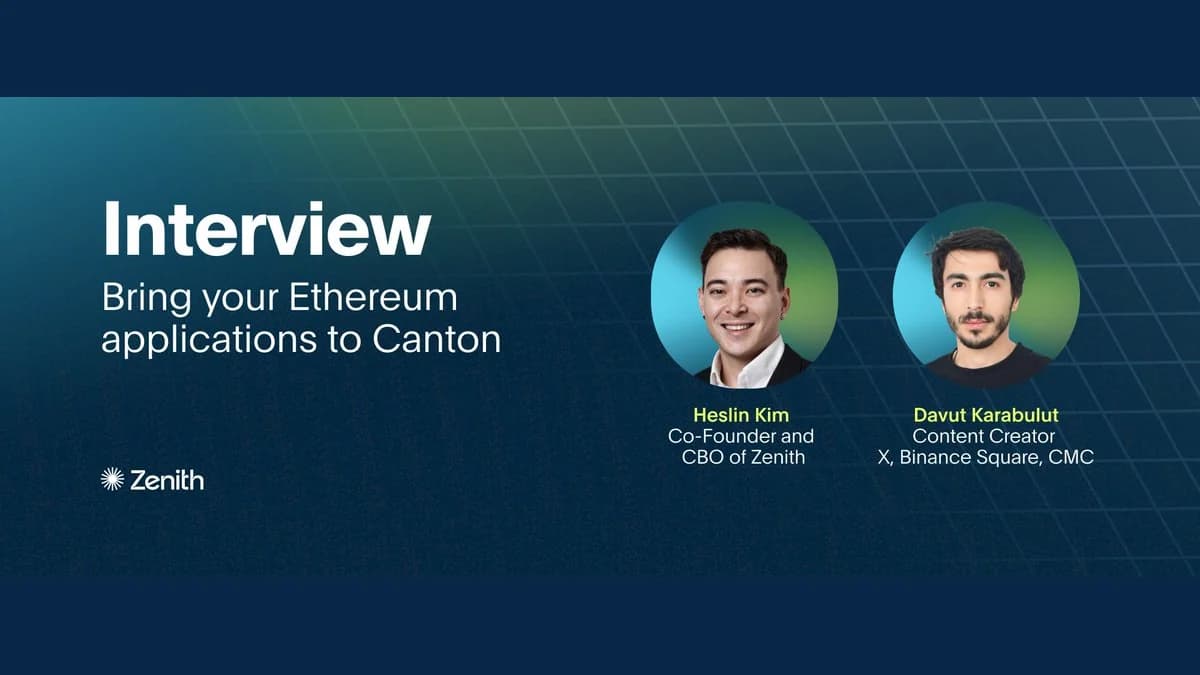
In this exclusive interview, we speak with Heslin Kim (@HeslinKim), Co-Founder and CBO at Zenith (@ZenithFdn), about how Zenith is bridging Web3 developers with institutional capital and shaping the future of programmable finance.
What is Zenith in simple terms?
Zenith is the canonical EVM/SVM execution layer that brings Ethereum (followed by Solana) applications to the Canton Network, the leading institutional blockchain designed specifically for privacy and regulatory requirements of institutional finance.
Canton was built specifically to meet institutional requirements: need-to-know privacy, institutional control points, compliance integration, and an operating model aligned with existing regulatory obligations. Zenith extends that foundation realizing Canton’s Polyglot vision, by introducing a programmable environment that allows modern blockchain applications to operate on top of those institutional rails.
In practice, this means developers can re-deploy their dApps using familiar Ethereum tooling and Solidity language, while those applications settle on infrastructure already used by global financial institutions. Added DeFi composability opens Canton’s trusted network to the world’s largest pool of Web3 developers, standards, and applications.
What problem is Zenith solving?
For years, blockchain innovation has developed along two parallel paths.
Public blockchains such as Ethereum have pioneered programmable finance from lending protocols to automated trading systems that can be deployed rapidly by developers around the world. At the same time, institutional blockchain infrastructure has evolved separately. Networks like Canton were designed to meet the strict requirements of regulated financial markets, including privacy, compliance, and secure coordination between institutions.
The challenge is that these two ecosystems have not been compatible nor understood each other's operational requirements. DeFi’s extraordinary sandbox including smart contracts, composability, AMMs, lending protocols, on-chain governance, and programmable settlement have not met the operational requirements of institutions such as contested ownership, court orders, estate administration, regulatory examinations, fiduciary duties owed to pension funds managing the retirement savings of millions of people. The question is not permissionless or permissioned, crypto or TradFi, but rather finding infrastructure primitives that solve real problems in capital markets. A hedge fund cannot have its positions visible on a public blockchain. A bank's repo book cannot be queryable by its competitors. A custodian bank with fiduciary obligations cannot delegate them to a smart contract. Canton was built specifically for these constraints, and Zenith is bringing EVM and SVM composability into Canton’s rails. Unlocking true atomic composability between EVM-based applications and Canton’s infrastructure enables developers to build applications that interact with institutional systems without requiring institutions to compromise on their regulatory or privacy requirements.
Why is this important now?
Canton has accomplished what no public blockchain has yet accomplished in capital markets. The network already processes over $9 trillion in monthly transaction volume and supports initiatives from some of the largest financial institutions in the world, including JPMorgan, DTCC, Nasdaq, and BNY. Visa was announced at DAS NYC 2026 joining Canton as a Super Validator, being the first major global payments company selected to accelerate the institutional adoption of the network. Goldman Sachs's Digital Asset Platform is natively on Canton, as well as Broadridge's DLR platform processing $280 billion in average daily trade volumes. These organizations are actively tokenizing assets, expanding digital collateral management, and bringing trillions into programmable financial infrastructure.
At the same time, the developer ecosystem that powers modern blockchain innovation has largely formed around Ethereum. Today the ecosystem includes over 31,000 active developers, nearly twice the size of the next largest blockchain developer community. In 2025 alone more than 16,000 new developers joined the ecosystem, and the network saw a record 8.7 million smart contracts deployed in a single quarter.
Zenith arrives at the moment when these two worlds are ready to converge, enabling programmable financial applications to operate directly on institutional infrastructure.
How is Zenith different from traditional L1 or L2 blockchain models?
Most execution layers are extractive by design. Activity migrates to the L2, and with it goes transaction volume, fee capture, and economic value away from the base layer that secured everything in the first place. In 2025, major L2s generated over $129 million in combined revenue and returned roughly $10 million to Ethereum mainnet. The rest stayed with sequencers.
Zenith is designed around the opposite principle. It is not a separate layer, but an execution environment that extends Canton’s composability. Every EVM transaction on Zenith is routed through Canton, executed as part of Canton's native transaction flow, and settled back to Canton. There is no value leakage. No fragmented liquidity. No separate finality mechanism sitting on top of the network.
Zenith extends what Canton can do without pulling apart what Canton already is. That distinction, extension rather than extraction, is the core architectural decision that separates Zenith from every traditional L2 model.
Who is Zenith built for?
Three groups, all converging toward the same place from different directions.
Ethereum developers who want their applications to matter beyond the existing crypto-native user base. Zenith gives them direct access to institutional infrastructure already operating at significant real-world scale, without abandoning Solidity, Hardhat, Foundry, or any of the tooling they've built their workflows around.
Financial institutions on Canton that want programmability on top of their existing settlement and custody infrastructure. With Zenith, they can tap into proven DeFi primitives - AMMs, lending, derivatives - while maintaining privacy, control, and compliance within Canton’s environment.
And the broader Web3 ecosystem from DeFi protocols to L2s that have long aimed to connect with institutional markets but never had a direct path in. Zenith is that path. Protocols like Uniswap or Pendle, and ecosystems like Base or Mantle, can operate with atomic access to RWAs, private execution for sensitive strategies, and built-in compliance without fragmentation.
What does Zenith enable that wasn’t possible before?
Before Zenith, building on Canton meant learning its proprietary language called Daml. That's not a criticism, Daml is purpose-built for institutional contracts and does that job well. But it also meant that the global developer community powering Ethereum's innovation was effectively locked out of Canton's ecosystem.
Zenith changes the access equation entirely. With Zenith developers can deploy existing Solidity and Rust applications on Canton without rewriting a single line of code. The full atomic composability with Canton's native infrastructure: tokenized assets, institutional settlement rails, privacy-preserving contracts, are available from day one. For the first time, a DeFi protocol like Aave and tokenization platform like Securitize can deploy on Canton via Zenith and atomically compose with DTCC’s tokenized assets or Nasdaq. That wasn't technically possible before Zenith.
Canton's Cantonomics model opens a massive economic window for L2s, and dApps from other chains. The network directs 62% of the total rewards pool, roughly 516 million CC per month, to featured applications that drive real usage and utility. That's a perpetual, utility-aligned incentive flywheel: the more activity and volume apps bring, the larger their share of this massive monthly distribution, rewarding long-term, durable businesses that burn CC and reduce supply. Few networks offer this direct, ongoing economic alignment for builders.
What does success for Zenith look like over the next few years?
Not vanity metrics. Not TVL figures inflated by incentive programs or DAU counts driven by airdrop farming.
Zenith has finalized early March CIP-0091 Milestone 1 and is now progressing through a permissioned testnet with the Canton Network. We are rolling out a Beta Testnet around June, onboarding selected DeFi teams, and aiming for full Mainnet iteration in Q4 of this year, coinciding with the Canton 3.6 upgrade Mainnet will unleash institutional innovation for the broadest set of Web3 participants - all without compromising what makes Canton suitable for global finance.
Success will be measured by the growth of real applications built on top of institutional infrastructure. This includes growth in the number of developers building applications on Canton Network, the variety of financial applications that emerge, and the level of activity generated by those applications.
The future vision includes expansion beyond Canton: aligning with the long-term vision of universal application composability, which could include implementing other VMs beyond EVM and SVM, like Fuel or WASM. We believe the future of L1s lies in purpose-built networks from corporate chains and institutions, as opposed to general-purpose chains that have not achieved mass adoption.
Ultimately, Zenith’s goal is to help turn institutional blockchain networks into fully programmable financial ecosystems. We are starting by bringing Canton to its Zenith.
Zth.