
Where the World Changed
For the past seventy years, the world has operated under a framework known as the legacy of the Bretton Woods system. After World War II, the United States built a global financial architecture centered on the dollar, later reinforced by the WTO, the IMF, the World Bank, NATO — an entire constellation of multilateral institutions and rules. This order was imperfect. It was biased, often exploitative, and left many people locked outside its gates. But it served one absolutely critical function: predictability.
Global capital, goods, and labor all flowed within this system's rules. Investors knew contracts would be enforced. Creditors trusted that sovereign debt carried reasonable repayment expectations. Companies could plan decade-long global supply chains because the rules weren't going to change overnight. That predictability wasn't free — it was sustained by American hegemonic power.
Crypto: A "False Order" Within the Cycle
Most people understand cryptocurrency through price. The 2017 bull run, the 2018 collapse, the 2021 peak, the FTX implosion in 2022, Bitcoin hitting new highs in 2024. This script has played out several times now — change the narrative, change the numbers, change the sentiment, but the structure stays the same.
This leads many people to one conclusion: crypto is just a cyclical speculation game. Know when to get in and out, and you profit. Don't know, and you're the exit liquidity.
That reading isn't wrong. But it only sees the surface.
Cryptocurrency markets are fundamentally an extreme amplification of reflexivity. The economist George Soros coined the concept of reflexivity: market participants' expectations themselves shape market fundamentals, and those shifting fundamentals in turn alter expectations — each reinforcing the other in a positive feedback loop, whether upward or downward.
Traditional equity markets have this quality too, but crypto amplifies it a hundredfold. The reason is simple: there's no fundamental anchor. Apple's stock price is anchored to revenue, profit, cash flow. What is Bitcoin's price anchored to? To consensus. To narrative. To the infinite recursion of "I believe that others will believe in this thing."
That's not a criticism. It's a description.
This structure means crypto cycles are not economic cycles in the ordinary sense. They are closer to the rising and falling of collective belief. When belief expands, its speed and magnitude far exceed anything fundamentals can explain. When belief contracts, the same.
This script has run several times. The most recent chapter was late 2024, when Trump's election triggered a reversal in regulatory expectations, sending Bitcoin from $35,000 on a run to an all-time high of roughly $126,000 in October 2025. Then everything collapsed within 48 hours. On October 10–11, 2025, Trump announced an additional 100% tariff on Chinese imports, and crypto experienced the largest single-day liquidation event in its history — over $19 billion in leveraged positions wiped out in less than a day. Numerous altcoins dropped 30% within 25 minutes; some fell over 70%. This wasn't merely a price decline. It was the synchronized implosion of an entire market-wide leverage system in response to a single macro headline.
But cryptocurrency isn't going away.
Here, a critical distinction must be made: crypto's cyclical volatility as a speculative asset, and blockchain's long-term penetration as financial infrastructure, are two entirely different phenomena.
The former is like tulip bulbs — it can go up tenfold in a few months and down ninety percent just as fast. The latter is like internet protocols — slow, unglamorous, producing no dramatic get-rich-quick stories, but steadily embedding itself, layer by layer, into the foundations of global payments, cross-border settlement, and digital asset ownership. Stablecoins already handle meaningful volumes of payments and remittances across emerging markets. Ethereum smart contracts already custody hundreds of billions of dollars in financial agreements. These aren't bubbles. These are infrastructure.
So the crypto story contains bubbles, technology, regulatory battles, and geopolitics. Treat it as pure speculation and you'll miss the technological value. Treat it as "the monetary revolution has arrived," and you'll pay an expensive price at the top of the cycle.
The AI Revolution: Not Everyone Is Riding the Wave
The core economic logic of AI is solving supply-side scarcity — turning what was rare into something cheap, and then concentrating the power of that cheapness in fewer hands.
Translation used to be scarce. A skilled professional translator took years to develop and charged by the word. Now, translation approaches zero cost. But this doesn't mean translation companies disappeared — it means platforms that control AI translation tools have captured the pricing power that was once distributed across tens of thousands of individual translators.
Code used to be scarce. Increasingly, it isn't. But the admission ticket to writing code has become the ability to use AI to write code — and while that ability itself isn't scarce, what is scarce is knowing what to build, and owning the platform infrastructure that makes AI work for you at scale.
The endpoint of this logic is: AI isn't eliminating work. It's transferring the value of work from laborers to the owners of platforms and infrastructure.
This is a massive redistribution — and it may be happening fast enough that labor markets can't adapt in time. The cost of AI inference dropped 280-fold in under two years. No technological transformation in history has moved at this speed.
What makes this especially unsettling is that this time, the disruption isn't hitting one profession. It's hitting the entire supply side simultaneously.
For the thesis of disorder, what does AI mean?
It means the value of vast swaths of knowledge work — work that the economy has priced and relied upon — will be repriced in an extremely short timeframe. This isn't an industry-specific problem. It's a systemic revaluation. And any large-scale revaluation of value creates winners and losers, social fracture, and political instability.
Every major technological revolution in history passed through this phase. The Luddites of the steam age smashed factory machines not because they were stupid, but because their lives were genuinely being destroyed, and reconfiguration takes time — time they didn't have. AI's speed compresses that window even further and makes the friction more severe.
War: The Return of Systemic Risk
Before February 24, 2022, most investment textbooks treated "geopolitical risk" as a footnote — a tail risk worth hedging against, but not one that should dominate decision-making.
After that date, many of those textbooks need to be rewritten.
War — or more precisely, the prospect of armed conflict between major powers returning to the main body of the probability distribution — has itself altered the foundational assumptions of global capital markets.
Specifically, it has changed two things.
First, the fragility of supply chains was fully exposed. In the months after Russia invaded Ukraine, global wheat prices surged 60%, fertilizer prices doubled, and Europe's energy crisis made millions of people viscerally aware that global supply chains can, in fact, break.
Second, the politicization of the monetary system accelerated. When the United States froze Russia's sovereign foreign exchange reserves, it marked the first time a sovereign nation's foreign reserves were unilaterally frozen by Western financial infrastructure. After that event, central banks around the world quietly began asking themselves: are our dollar-denominated assets as reliable as we thought?
The answer was reflected in action. Central banks began systematically elevating gold from a marginal holding to a strategic core. Between 2024 and 2025, central banks collectively purchased over 1,000 tons of gold per year — double the average pace of the previous decade.
This isn't doom-saying. War is not the global norm; conflicts have boundaries and mechanisms for resolution. But the threat of war has altered the decision-making logic of every actor in the system, and that shift is durable. It won't evaporate with a ceasefire agreement.
Changes in decision-making logic are harder to quantify than direct physical destruction — and harder to hedge against.
What Three Forces Converging Actually Means
Now put all three things together.
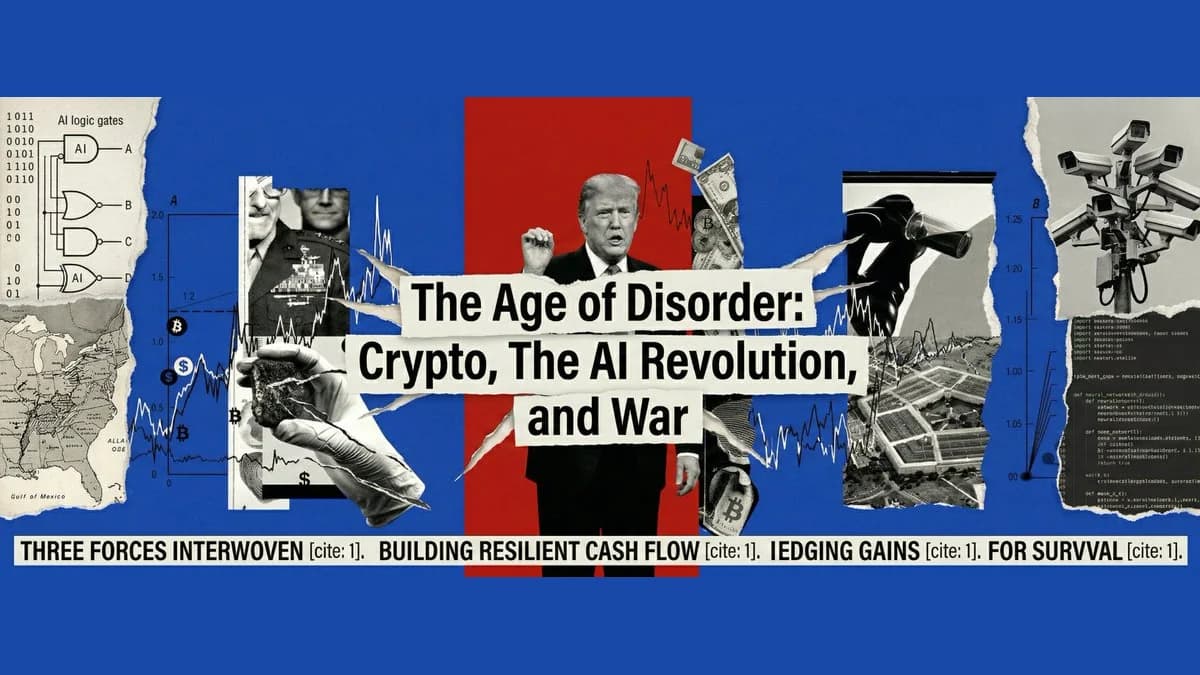
The crypto cycle represents the erosion of the old monetary order. The AI revolution represents the disruption of the old productive order. War represents the loosening of the old security order.
These three things are happening simultaneously — not by coincidence, and not entirely independently. They share a common backdrop: the "long peace" constructed by the Bretton Woods legacy is coming to an end.
That order rested on three premises: the unassailable centrality of the dollar in international settlement; the economic logic of global division of labor; and the shared understanding that armed conflict between major powers is prohibitively costly. Cryptocurrency is challenging the first premise. AI is restructuring the second — by shifting productive power from labor-intensive toward capital-and-compute-intensive models, it's rewriting the comparative advantage logic of global division of labor. War is shattering the third.
When all three premises crack simultaneously, what follows?
Uncertainty stops being an exceptional condition and becomes the new baseline operating system.
Note: I am not saying "the end of the world." Uncertainty and collapse are different things. A more precise framing: we are transitioning from a world of high predictability and low volatility to one of low predictability and high volatility. And most people's asset allocation, career planning, and everyday decision-making were designed around the assumptions of the first world.
Here, a few honest qualifications are required — otherwise this analytical framework collapses into "everything is falling apart," which is no different from "this is our era of national destiny." Both are emotion, not analysis.
First, the evolution of order is not the disappearance of order. The Bretton Woods system formally collapsed in 1971, but the world didn't descend into permanent chaos. It transitioned to a new order centered on the petrodollar. Every ending of an old order has a new order growing in its place — it's just that during the transition, the rules are unclear and volatility is higher. We are probably in the middle of one such extended transition right now.
Second, AI's productivity dividend is real. Rising uncertainty doesn't mean the economy stops growing. In fact, AI-driven efficiency gains may generate genuine wealth creation in certain sectors. The question isn't whether the pie is growing — it's who gets a larger slice, and whose share is shrinking.
Third, war is not infinitely expansionary. Nuclear deterrence remains operative. The cost constraints on direct major-power conflict are still real. War raises the ceiling of uncertainty; it doesn't turn all risk into realized catastrophe.
But even if uncertainty merely increases, even if volatility merely rises, the implications for personal financial planning are already fundamental.
Where Does the Ordinary Person Stand in an Age of Disorder?
It's easy to discuss disorder as a conceptual framework. The harder question is: so what do I actually do?
Many of our clients have made a great deal of money in cryptocurrency. They are smart, hardworking, perceptive. But when I ask them seriously — "where does your sense of financial security come from?" — the answer is almost always: from the next cycle. From winning again.
This is a very particular psychological state: money made from volatility conditions you to believe that volatility is your friend.
But volatility is neutral. It creates opportunities for you — and for everyone else. Being able to exit near the 2021 top means your judgment was good, or your luck was good, or both. But systemic disorder means the timing, magnitude, and direction of the next move are harder to predict than at any previous point in history. Uncertainty isn't just opportunity. It cuts both ways.
Let me tell a story that has repeated itself throughout history.
In 1920s Germany, the country experienced the most severe hyperinflation in human history. By 1923, prices were doubling every few days. People pushed wheelbarrows full of banknotes to buy bread. In that inflationary chaos, some people preserved their wealth by holding foreign-currency assets. Others protected themselves by stockpiling tangible goods.
But the people who ultimately came out well weren't those who had made the right bet on inflation. They were the people who had relatively stable cash flows — regardless of whether the environment was inflationary or deflationary. Because extreme volatility eventually ends, and after it ends, people with stable income streams are in a far better position than people with large paper fortunes they cannot liquidate.
This isn't an argument against taking risks. It's an observation: in high-volatility environments, stable, repeatable returns are systematically undervalued.
Hedged Returns: The Most Boring Answer, and the Most Important One
I want to introduce a concept that typically only comes up in tedious risk management courses: hedged return.
In financial parlance, hedged return has a specific meaning — net return after reducing volatility through hedging instruments. But I want to use a broader definition here: cash flows or asset appreciation that can be generated across a range of market environments.
Why does this matter especially in an age of disorder?
Because the most direct economic consequence of disorder is the disappearance of the risk premium from single concentrated bets.
In an orderly world, betting on a sector, a stock, an asset class — the risk is calculable, and can be diluted through diversification. In a disordered world, correlations have a habit of converging precisely when crisis hits: everything falls together, every hedge you thought you had fails simultaneously. In those few weeks of March 2020, gold, bonds, equities, and Bitcoin all crashed in unison. That wasn't an anomaly. That's what extreme volatility looks like.
In this environment, what has real value isn't the asset that appreciates the most. It's the thing that still generates cash flow after the volatility has blown through every predictive model you had.
What does this look like concretely?
First, cash flow over paper appreciation. The monthly rent from a rental apartment doesn't disappear because Bitcoin fell 50%. The profit from a small business with stable customers doesn't go to zero because the Fed raises rates. Paper wealth inflates and evaporates with the cycle. Cash flow is the anchor.
Second, skills hedge better than assets. A genuinely rare skill that you've spent real time mastering tends to hold its value across different economic environments far better than any single asset class. This isn't an argument against investing. It's a recognition that in an era where AI is repricing the value of skills at an unprecedented rate, actively managing your "skill hedge" is as important as managing your financial hedge — maybe more so.
Third, scale can be risk, not just protection. In crypto markets, the person who made $100 million doesn't necessarily live better than the person who made $10 million — liquidity constraints are real. In a disordered world, being able to move quickly is worth more than being very large.
But I have to offer a sharp counterargument to "hedged returns matter": the cost of hedging is giving up upside.
If crypto runs another ten times in the next cycle, if some AI stock goes up fifty times in three years, the person who chose to hedge watches all of that happen while their own portfolio shows only modest growth. That psychological cost is real. Don't underestimate it. Many people support hedging "in principle" but abandon it the moment they watch others get rich.
So the question isn't "is hedging better than not hedging?" The real question is: what level of volatility can you actually tolerate? What kind of failure does your life structure allow you to absorb?
Someone with no dependents and a high-paying job as a safety net can take significantly larger speculative risks. Someone with a mortgage, aging parents to support, and children to put through school — if a single bad bet eliminates their buffer, the cost isn't just financial. It's the collapse of an entire life structure.
That's not conservatism. That's an honest assessment of your actual constraints.
Our Perspective
AllDefi comes out of a hedge fund background. Many of our clients are first-generation immigrants from countries across the developed world — people navigating between two worlds. Parents in China, a mortgage in Silicon Valley. When they hear about a "crypto opportunity," the calculation running in their head is: "If I win, I can pay off the mortgage early. If I lose, I don't know how I face my family."
That's not an investment logic problem. That's a life structure problem.
When I say that stable hedged returns are critically important, I'm not saying you should put everything in low-yield savings accounts and wait for the apocalypse. I'm saying:
In an era where a crypto cycle, an AI shock, and a war threat are all operating simultaneously, systemic risk covers the monetary, productive, and security dimensions all at once — for the first time in modern history. This means the margin for error on concentrated bets is smaller than it has ever been. What you need isn't to stop taking risks. It's to take risks while maintaining a baseline structure that keeps you in the game even when the worst happens.
When Norway's oil boom arrived, the Norwegians set up their sovereign wealth fund with deliberate restraint — not because they weren't greedy, but because they understood: prosperity is cyclical, and life is continuous. You need the money from the good years to sustain you through the bad ones.
The greatest trap in an age of disorder isn't missing out. It's thinking you've finally figured out the direction — going all in — and then losing the capacity to start over when the next unforeseeable shock arrives.
The game isn't over. Crypto will have another cycle. AI will continue to reshape the economy. Geopolitics will continue to surprise us.
But the people who keep sitting at the table aren't the ones who called every hand correctly. They're the ones who, after every loss, still had chips left to play.
Stable, hedged returns are tomorrow's chips.