
What Canton Network Integration Means for Uphold
Uphold's decision to integrate Canton Network's native asset, $CC, and participate in the Canton Network ecosystem, is a strategically material development that extends well beyond a routine token listing. It places Uphold at the vanguard of a fundamental restructuring of global financial infrastructure and creates a differentiated value proposition for both institutional and retail clients.
Strategic Rationale
The Canton Network is not a speculative Layer-1 competing for retail mindshare. It is the settlement and tokenization backbone being built by the world's most systemically important financial institutions. By integrating Canton Network, Uphold is establishing a direct channel to the institutions and assets that will define the next decade of capital markets.
This creates three distinct strategic advantages:
- Institutional Gateway Positioning: As DTCC, J.P. Morgan, Euroclear, and Northern Trust deepen their Canton commitments, Uphold's integration positions it as a recognized gateway for institutions and their clients seeking liquid access to the Canton ecosystem. Few retail-accessible platforms carry this positioning today.
- Regulatory Credibility: Canton Network was purpose-built with regulatory compliance as a foundational design principle. Its configurable privacy, DAML-enforced controls and institutional governance model reflect a network architected to meet the requirements of the world's most regulated financial institutions, a credibility signal that matters to institutional partners evaluating Canton as a long-term settlement and tokenization rail.
- Brand & Narrative Alignment: Canton's privacy-by-design architecture, DAML-enforced compliance, and institutional validator network align tightly with Uphold's existing positioning as a compliance-orientated, transparency-first digital asset platform. The integration deepens thematic coherence in Uphold's product suite and narrative.
Canton Network: Fundamental Report
What Is Canton Network?
Launched in May 2023 by Digital Asset Holdings, a New York-based fintech founded in 2014, the Canton Network is a public, privacy-enabled blockchain purpose-built for institutional financial markets. Unlike general-purpose Layer-1 networks, Canton was architected from the ground up to satisfy the privacy, compliance, and throughput requirements of regulated financial institutions. Its underlying smart-contract language, DAML (Digital Asset Modeling Language), enforces privacy at the protocol level: counterparties see only the data they are entitled to see, and every transaction is cryptographically verifiable without exposing commercially sensitive information to the broader network.
The network's composability model allows independently governed sub-networks (e.g., a bank's custody ledger, an exchange's settlement layer, a clearing house's margin engine) to interoperate seamlessly, enabling atomic settlement across institutions without requiring a shared central administrator. This design directly addresses the structural friction that has historically prevented full tokenization of capital markets.
Network Scale & Institutional Ecosystem
As of May 2026, Canton has reached scale few institutional blockchains have achieved:
- Transaction Volume: $9+ trillion in monthly tokenized transaction volume, per Canton Network
- Validator Network: 575+ active validator nodes operated by globally regulated financial institutions
- Bank Penetration: Major global financial institutions are active participants, including Goldman Sachs, J.P. Morgan, BNP Paribas, Citadel Securities, Bank of America, HSBC, BNY Mellon, Societe Generale, and Tradeweb Markets
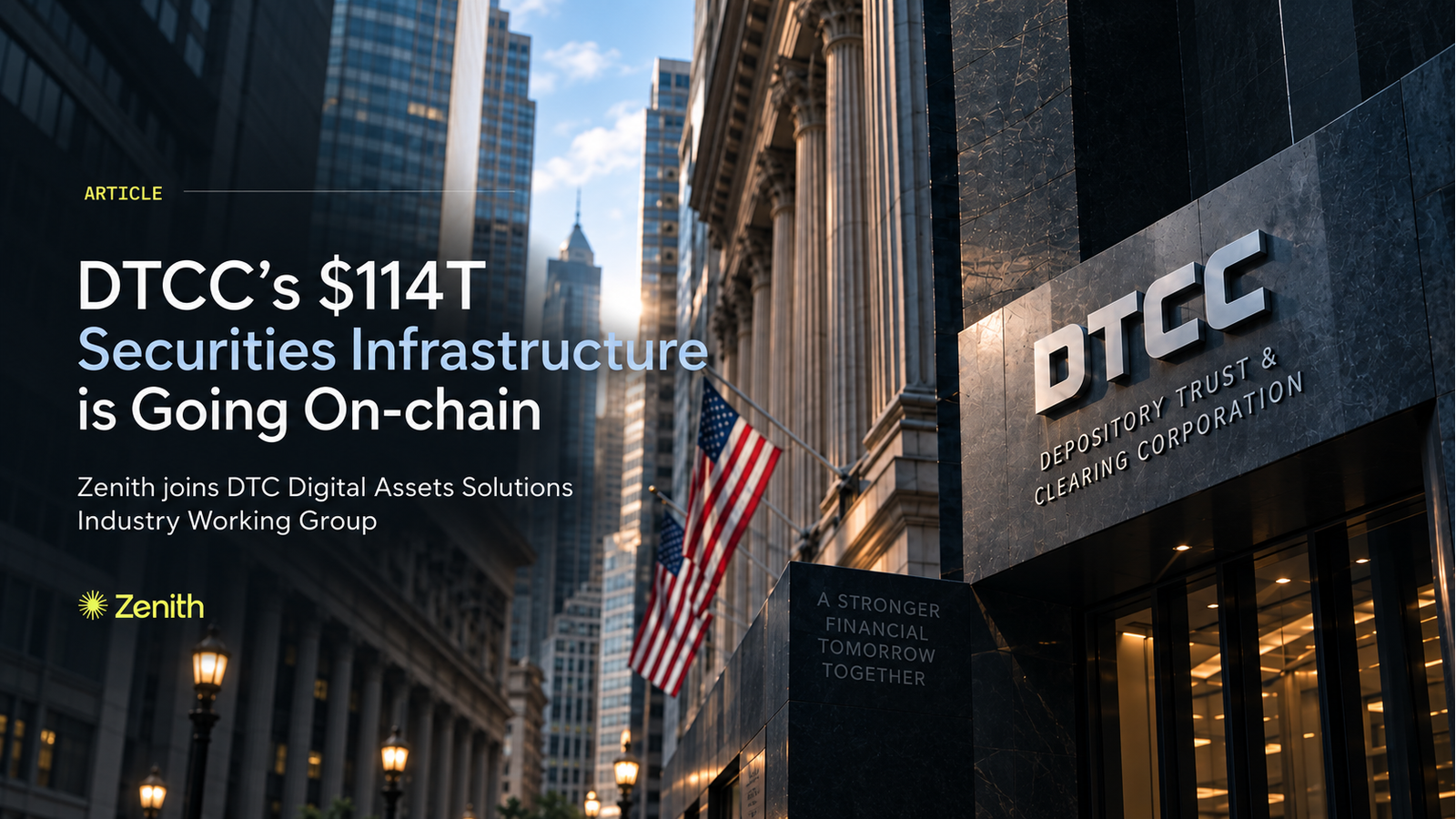
- Market Infrastructure: DTCC, Nasdaq, Broadridge, Tradeweb, and Visa serve as Super Validators, while Euroclear serves as co-chair of the Canton Foundation alongside DTCC, and Northern Trust participates as a strategic partner.
- Broad Ecosystem Growth: Canton's ecosystem spans 100+ projects across consumer, infrastructure and DeFi verticals, including wallets, custody, payments, liquidity and tokenized assets — demonstrating that Canton's reach extends well beyond its institutional roots, with broad adoption across retail, developer and DeFi communities, reinforcing its position as the institutional blockchain infrastructure layer of choice for global capital markets.
One of the most significant recent milestones is the DTCC and Digital Asset partnership, announced December 2025, to tokenize DTC-custodied U.S. Treasury securities on Canton. DTCC has since updated its timeline, with initial limited production trades now targeted for July 2026 and a full service launch planned for October 2026. DTCC and Euroclear have jointly assumed co-chair roles at the Canton Foundation, signaling deep institutional commitment. Concurrently, J.P. Morgan's Kinexys division announced the phased integration of JPM Coin as a native deposit token on Canton throughout 2026, enabling near-instant settlement in bank-grade digital dollars directly on-chain. Northern Trust has formally entered into an agreement with Digital Asset to build institutional custody capabilities for tokenized financial assets on Canton, extending its asset servicing model into on-chain market structures and further validating the network's custody-grade security model.
Technical Milestones & Protocol Upgrades
The Canton engineering roadmap has maintained a rapid cadence of upgrades, each targeted at reducing barriers for institutional onboarding and expanding the network's utility:
- Canton 3.3 (June 2025): Simplified smart-contract upgrade workflows and expanded developer APIs, materially reducing the cost of deploying and maintaining DAML applications
- Canton 3.4 (December 2025): Performance and throughput enhancements shipped during peak demand growth, enabling the network to handle accelerating institutional volume without latency degradation
- Chainlink Oracle Integration (February 2026): Real-time pricing and asset verification feeds integrated via Chainlink's decentralized oracle network, enabling on-chain mark-to-market valuations for tokenized assets
- LayerZero Integration (March 2026): Cross-chain messaging enabled across 165+ public blockchains through LayerZero, allowing institutions to route tokenized assets into DeFi ecosystems while maintaining regulatory compliance
- Digital Asset Holdings Raise (May 2026): Canton Network developer Digital Asset Holdings is in advanced discussions to raise roughly $300 million at a $2 billion valuation, led by a16z crypto, the sector's largest dedicated crypto fund, according to Bloomberg. The round has not yet closed but is expected to finalize in the coming weeks, and would mark the largest single funding round in Digital Asset's history.
- Developer Experience Upgrade (May 2026): Canton Network consolidated its developer documentation into a single entry point at canton.network, introducing role-based learning paths, open source contribution frameworks and built-in AI tooling, streamlining the path from exploration to production deployment and lowering the barrier for institutional and independent developers building on the network.
Canton $CC — Token Economics
$CC Use Cases within the Ecosystem
CC is the native utility token of the Canton Network, and its design reflects the network's institutional DNA. Unlike most Layer-1 tokens, CC operates under a burn-mint equilibrium model where usage fees paid by institutions are burned, and new coins are continuously minted and awarded to network participants based on verified activity. This creates a direct feedback loop between network utility and token value. As transaction volume grows, fee burn accelerates, creating deflationary pressure on circulating supply.
Beyond fee payment, $CC serves several distinct functions within the Canton ecosystem:
- Network Fees: $CC is used to pay application and infrastructure fees on the Global Synchronizer, the backbone of the Canton Network
- Validator Rewards: Super Validators, Validators and Application Providers earn $CC for contributing to network security, access and utility
- Governance Participation: CC holders and validators can participate in protocol governance, influencing network upgrades and parameters
- Ecosystem Incentives: Application developers are rewarded in $CC based on the activity their applications generate, directly tying builder incentives to real usage
- Cross-Chain Utility: Following the LayerZero integration in March 2026, $CC and Canton-native assets can now be routed across 165+ public blockchains, expanding the token's utility beyond the Canton Network itself
There was no pre-mine and no venture capital allocation at Genesis. Every $CC token in existence has been earned through network participation. The halving schedule reduces emissions over time, with a double reduction event in January 2026 cutting total issuance per block by 50%. By the early 2030s, Super Validator emissions will constitute a minimal fraction of total supply, as the burn-mint equilibrium and halving schedule progressively reduce new issuance, creating sustained deflationary pressure on circulating supply over time.
Token Distribution & Reward Split
Canton's distribution model is deliberately skewed toward application builders rather than infrastructure operators. Rewards are split across three groups: Super Validators, who operate the Global Synchronizer; Validators, who provide network access; and Application Providers, who build and maintain applications on the network. Application Providers receive approximately 50% of minting rewards, directly incentivising real utility creation and aligning long-term token value with ecosystem growth.
The Double Reduction Event
The January 2026 double reduction went beyond a simple emissions cut. It simultaneously restructured the reward split, reducing the Super Validator share from 48% to 20% and progressively shifting incentives toward application developers as the network matures. A further reduction is scheduled approximately three years from this event, dropping the Super Validator share from 20% to 10%.
Burn Mechanics in Practice
The burn-mint equilibrium operates as a self-correcting supply mechanism. When demand is high and CC's price is low relative to usage costs, burn accelerates and supply growth slows or turns deflationary. When activity is lower, burn slows and supply expands modestly to sustain participation incentives. For institutional participants, this provides a more transparent and utility-driven value proposition than fixed issuance schedules, with supply a direct function of real economic activity on the network.
Canton Network $CC Market Snapshot
▫️Market Cap: ~$5.75 Billion USD
▫️Network Rank: #17 by Market Cap
▫️Price Range (3M): $0.148 – $0.188
*Figures as of May 19, 2026
Competitive Positioning – Forward Catalysts and What Would Change the Bull or Bear Case
The race to become the premier compliant digital asset platform for tokenized real-world assets is intensifying. Institutions are no longer evaluating whether to move on-chain, but which infrastructure to trust with their most critical financial workflows. Canton Network's architecture, combining configurable privacy, deterministic finality and atomic composability, is increasingly emerging as the answer. Its growing ecosystem of 100+ projects, $9+ trillion in monthly transaction volume and validator network operated by globally regulated financial institutions signals that Canton is becoming the chosen rail for institutions entering the digital asset space. While other platforms are pursuing compliance as a feature, Canton was built with it as a foundation, and the world's most systemically important financial institutions are taking notice.
Uphold's $CC integration is an early-mover advantage that, if leveraged with institutional partnership development and RWA product expansion, could define Uphold's position in the $30+ trillion addressable market for tokenized financial assets over the next decade.
$CC is available on Uphold Ascent and, as of this week's integration, can now be used natively within the Canton Network ecosystem, extending its utility beyond the Uphold platform. Uphold has listed $CC on its platform and earns trading fees from transactions in this asset. Please email your sales representative if you have any questions or would like to set up a meeting with the Uphold research team.
Disclaimer
Uphold provides sales and trading services exclusively to institutional investors and is high risk in nature. The digital assets discussed within the reports are highly volatile and may result in partial or permanent loss of your investment. Before investing, please carefully consider your investment objectives, level of experience and risk appetite. It is important that you consult with your own advisors as to the legal, tax and financial implications of your investments. Any report or commentary generated or distributed by Uphold is intended solely for the use of institutional investors. The contents of this communication, including any attachments, is confidential, privileged or otherwise protected. Any notes are intended solely for the use of the institutional investor or institutional entity to which they are addressed. If you are not the intended recipient, please do not read, copy, forward and/or use or disclose the contents of this communication.
Not Investment advice. You should conduct your own research before investing. Investment in digital assets can be complex making it hard to understand the risks associated with the investment. The performance of digital assets can be highly volatile. Do not invest unless you are prepared to lose all the money you invest. You should not expect to be protected should something go wrong with the investment and Government insurance schemes such as FSCS in the UK explicitly do not apply to digital assets. There is no guarantee that investments in cryptoassets can be easily sold at any given time. The ability to sell a cryptoasset depends on various factors, including the supply and demand in the market at that time.