
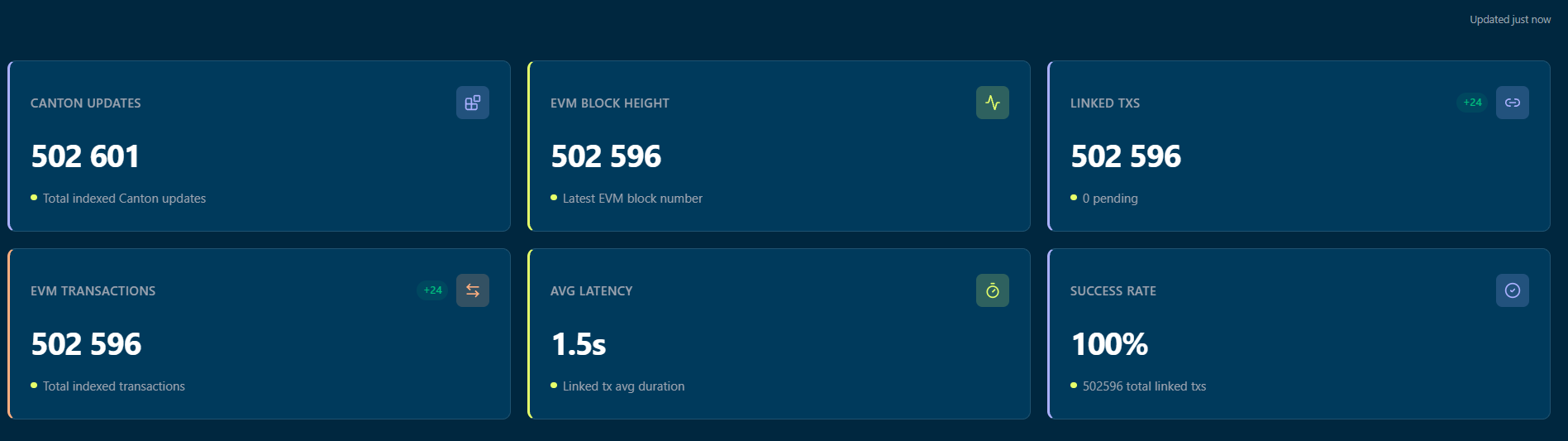
Zenith’s internal test environment has processed more than 500,000 EVM transactions through Canton Network, reaching the mark with a 100% success rate and 1.5-second average latency on an unoptimized stack.
The headline number is useful. The architecture behind it is the real story.
Every transaction was routed through Canton. The Canton and EVM legs committed together inside the same consensus mechanism, with no timelocks, no temporary exposure window and no bridge assumptions.
That is the core of Zenith’s design: EVM execution that runs through Canton itself, rather than sitting on a separate chain and sending state commitments back later.
Zenith’s internal setup includes a multi-node Canton test network with the full transaction flow between Canton and Zenith EVM already implemented. A synchronizer handles message passing, transaction ordering and consensus. Two Canton participant nodes re-execute transactions end to end, while a Canton observer validates activity independently.
Each transaction follows the same path. It is submitted through Canton consensus, validated by participant nodes through re-execution of the external_call() primitive, and settled with the new EVM state root posted back to Canton. If a validator reaches a different result, the transaction is rejected.
That design is what Zenith means by consensus-level atomicity. The Canton leg and the EVM leg commit together, or they do not commit at all.
It is also what separates Zenith from many execution-layer models. Traditional L2s and rollups process activity on isolated systems and later post state commitments back to a base layer. Zenith routes EVM transactions through Canton’s Global Synchronizer as if they were transactions on Canton MainNet.
Zenith says every EVM transaction burns $CC, keeping value within the network as usage scales.
For developers, the pitch is simple. Canton has historically been built around Daml, a smart contract language designed for institutional financial contracts. Zenith adds a fully Ethereum-compatible EVM environment, giving Solidity developers a familiar route into Canton.
That means existing Solidity applications can be deployed with a single RPC endpoint change and become atomically composable with institutional assets already moving on the network.
Zenith is currently progressing through a permissioned test environment, with selected DeFi teams onboarding ahead of public testnet access. Mainnet is targeted for Q4 2026, alongside the Canton 3.6 network upgrade.
The team also has a direct role in Canton governance. Zenith operates as a Tier-1 Super Validator and participates across several Canton Foundation committees, including technical operations, tokenomics, accountability and marketing.
When mainnet goes live, applications deployed on Zenith are expected to be able to access Canton’s $CC App Rewards framework, under which featured applications receive 62% of the total rewards pool based on the transaction activity they drive or are used in.
For Canton, Zenith is not just about EVM compatibility. It is about bringing Ethereum-style applications into Canton’s settlement environment without giving up Canton’s consensus-level guarantees.
The live transaction explorer is available here: