
Canton once paid validators because their nodes were online. That model was useful while the network still needed infrastructure. It is not useful if the goal is a market whose traffic is paid for.
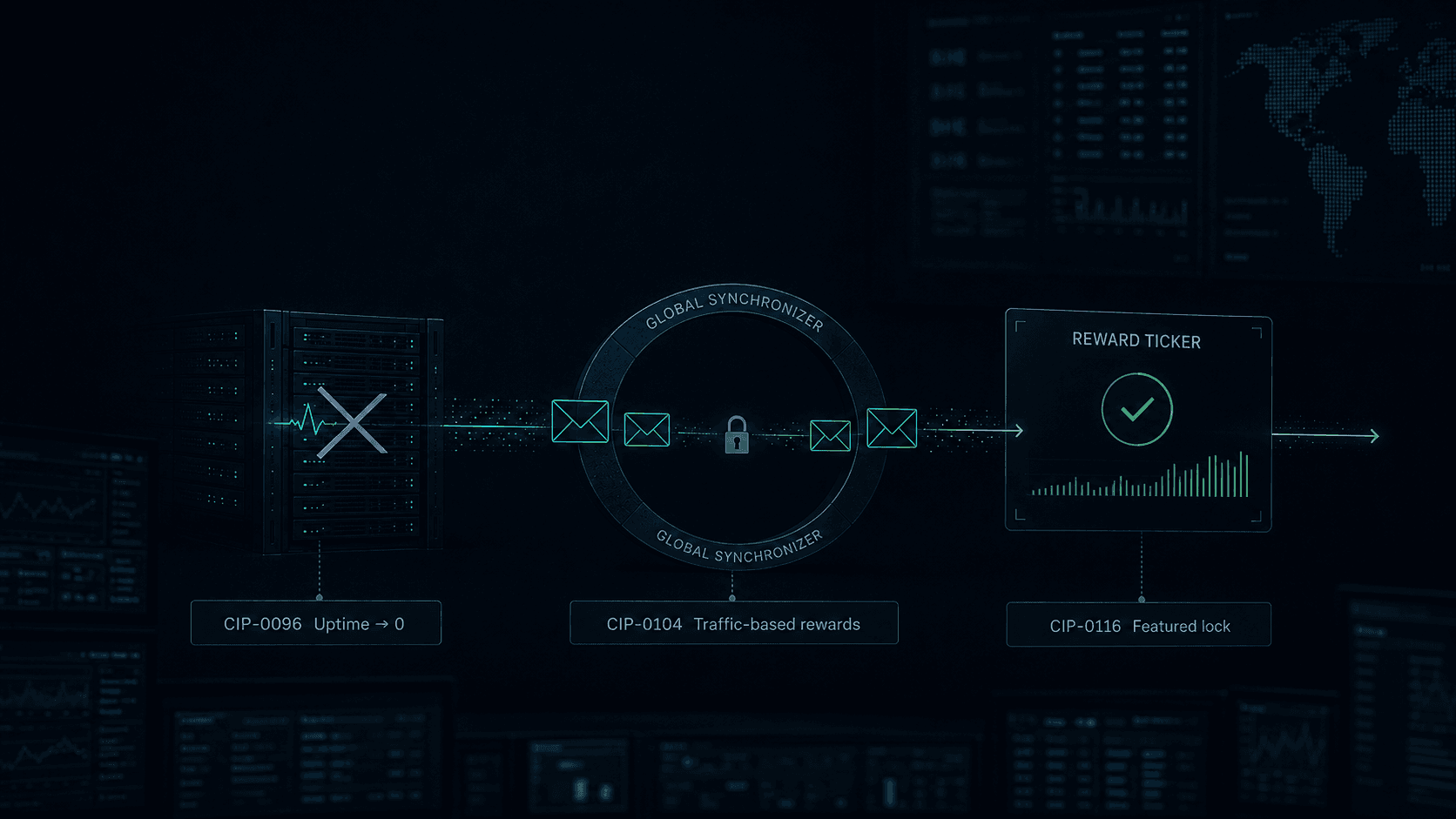
Two changes closed that gap. CIP-0096 turned off the liveness faucet on 30 April 2026. CIP-0104, effective 18 August 2026, calculates featured app rewards from traffic costs that actually occur on the Global Synchronizer.
These are not UI updates. They change who is allowed to mint Canton Coin.
CIP-0096: uptime no longer produces CC
CIP-0096 reduced optValidatorFaucetCap in stages, then to zero on 30 April 2026. The schedule in the specification is roughly $5 → $3.33 → $2.50 → $0.60 → $0.
Source: CIP-0096 · Canton Foundation, 3 May 2026
The widely circulated “70 percent” figure needs a narrow reading. It is an estimate of the liveness share inside the validator pool in late 2025, not 70 percent of all network issuance. After 30 April, the liveness cap = $0. Validators can still receive coupons from activity: traffic purchased and burned through their nodes.
The meaning is simple. A server that is on, without clients paying for traffic, no longer receives a protocol subsidy.
CIP-0104: app rewards follow traffic, not self-reporting
Before CIP-0104, a featured app created a FeaturedAppActivityMarker on-ledger. That marker could reflect real work. It could also be gamed.
CIP-0104 moves the calculation off-ledger, per round, from sequencer traffic summaries. The official docs summarize it as follows:
Old trigger: a marker in the same transaction
New trigger: traffic cost measured by the sequencer
New contract: RewardCouponV2 (one coupon per party per round, not one contract per transaction)
Timing: computed after the round closes, not instantly
Source: Traffic-Based App Rewards · Canton Network, 19 August 2026
Editorial summary (not a spec quotation):
ActivityWeight_p = sum of trafficCost(tx) for transactions where p is the featured provider
The Scan app on each SV sums weights per party, applies the appRewardCouponThreshold, builds a Merkle commitment, then a supermajority of SVs confirms the root. Coupons can be minted through the Splice / AmuletRules flow.
What changes economically: issuance to apps sits closer to traffic burn. Issuance to Super Validators and the Development Fund remains outside that usage loop. Closing the gap between mint and burn still requires product demand, not markers.
CIP-0116: featured apps must lock CC
App rewards flow only to parties with Featured App status. CIP-0116, approved 20 May 2026, adds a lock requirement:
Non-issuer: 5,000,000 CC per PartyId
Asset issuer: 25,000,000 CC per PartyId
60-day unlock (daily vesting)
Below the threshold: featured status is lost
Source: CIP-0116 · Canton Foundation, 22 May 2026
The locked CC does not have to be owned by the application operator. The CIP only requires that CC be identifiable and locked against the relevant PartyId. That has already produced a locking-as-a-service market. Skin in the game remains; what changed is who supplies the locked capital.
What it means, without a speculative table
Validators. The business shifts from “keep uptime” to “have a flow that burns traffic.” Hardware without utility is no longer subsidized by a faucet.
App developers. Rewards are harder to farm with markers. Entering the featured pool requires governance plus a 5 million or 25 million CC lock per PartyId. The incentive points toward apps that actually generate paid transactions.
Tokenomics readers. The issuance split in this phase featured apps receiving the largest share, then SVs and development is an allocation curve, not a result of CIP-0104. CIP-0104 changes how the app share is measured. The August 2026 burn offset is still around two-thirds of mint; the network is not at 100 percent equilibrium. Price and market cap move daily; do not hard-code those figures in the article without linking a dashboard on the publication date. Check Lighthouse or CC View.
What is deliberately not included here: a ranking of “who received how much CC per 24 hours,” Broadridge volumes in the trillions, and JPM/DTCC production status. Those figures need a separate explorer or press release. Mixing them into an article about the reward mechanism weakens the argument.
Conclusion
CIP-0096 ends payment for nodes that are merely alive. CIP-0104 ends payment for apps that merely claim to be active. CIP-0116 adds a cost to remaining in the featured pool.
The philosophy is consistent with Canton’s burn-mint design: mint CC close to paid usage. Whether that is already “fair” depends on whether the traffic being measured is real economic activity, not a manufactured loop. The protocol now measures traffic. It does not automatically judge the motive behind that traffic.
For education. Not investment advice. The mechanism refers to CIPs and docs as of 27 August 2
026; market figures should be attached from a dashboard on the upload date.