
Collateral Is Infrastructure: What $CC’s New Role on Canborsa Means
When people talk about token utility, the conversation usually goes straight to the obvious things: payments, fees, governance, incentives, or access.
Collateral rarely gets the same attention.
But in financial markets, collateral is infrastructure. It is what allows capital to support a position.
That makes Canborsa’s latest update more interesting than simply adding another use case to Canton Coin ($CC).
$CC can now be used directly as collateral across Canborsa’s RWA and crypto perpetual markets.
And that changes how the asset can participate in the trading ecosystem.
The extra step that disappeared
Imagine holding $CC and deciding you want to open a perpetual position.
If $CC could not be used directly as collateral, there was an extra step between holding the asset and trading:
$CC → convert to another collateral asset → open the position
That conversion creates friction.
It means the asset you already hold cannot immediately serve the role you need it to serve.
With Canborsa’s new collateral support, that middle step can be removed.
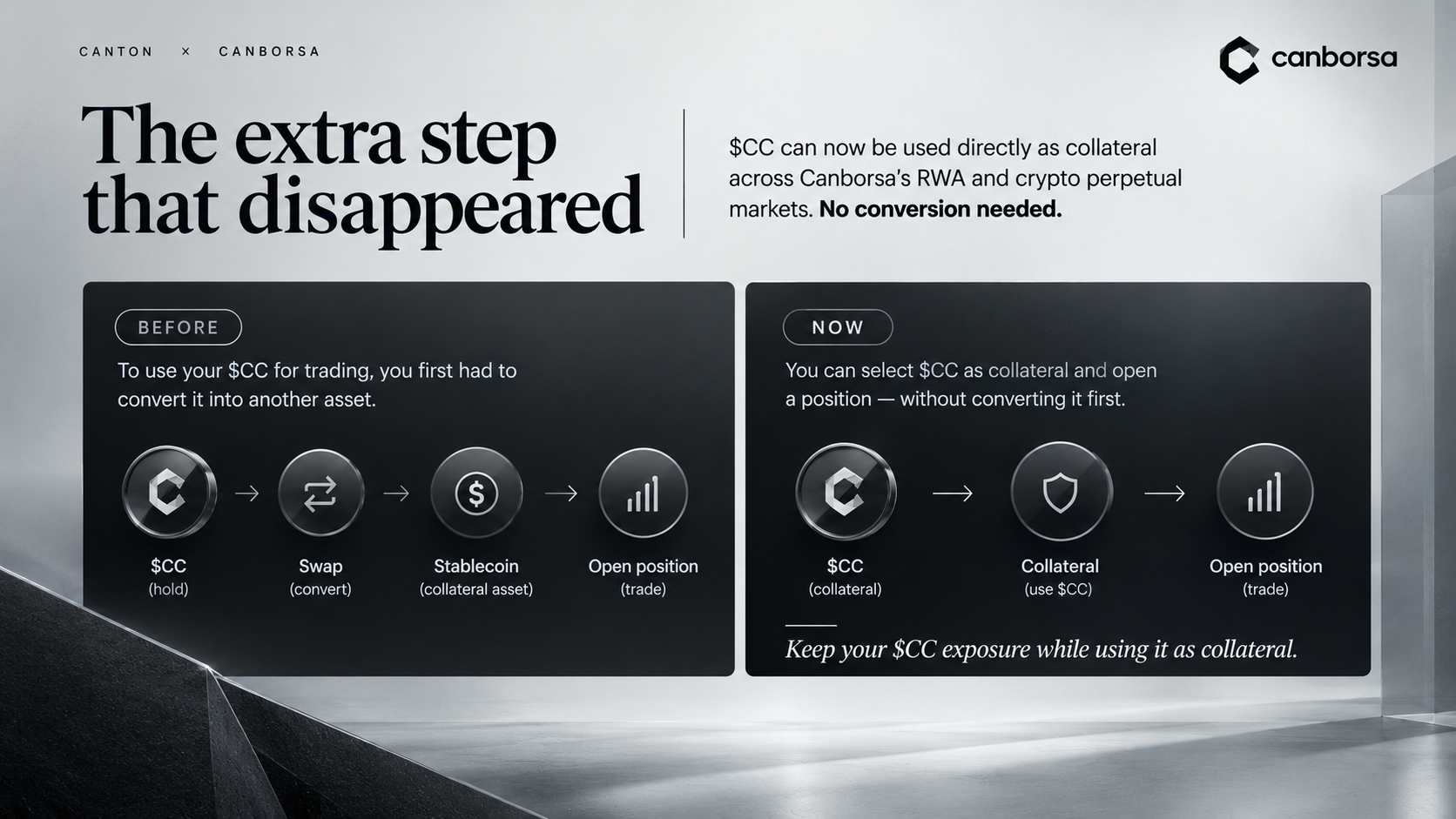
A $CC holder can select $CC as collateral and use it to support a perpetual position rather than first converting it into a stablecoin. Canborsa says holders can maintain their underlying $CC exposure while doing so.
The change may look small from a product interface.
At the infrastructure level, it is more interesting.
Why collateral matters
Collateral determines which assets can participate directly in a trading system.
An asset that can only be held has one kind of utility.
An asset that can also serve as collateral can participate in another layer of financial activity.
That distinction matters for $CC because Canborsa isn't built around one isolated crypto market.
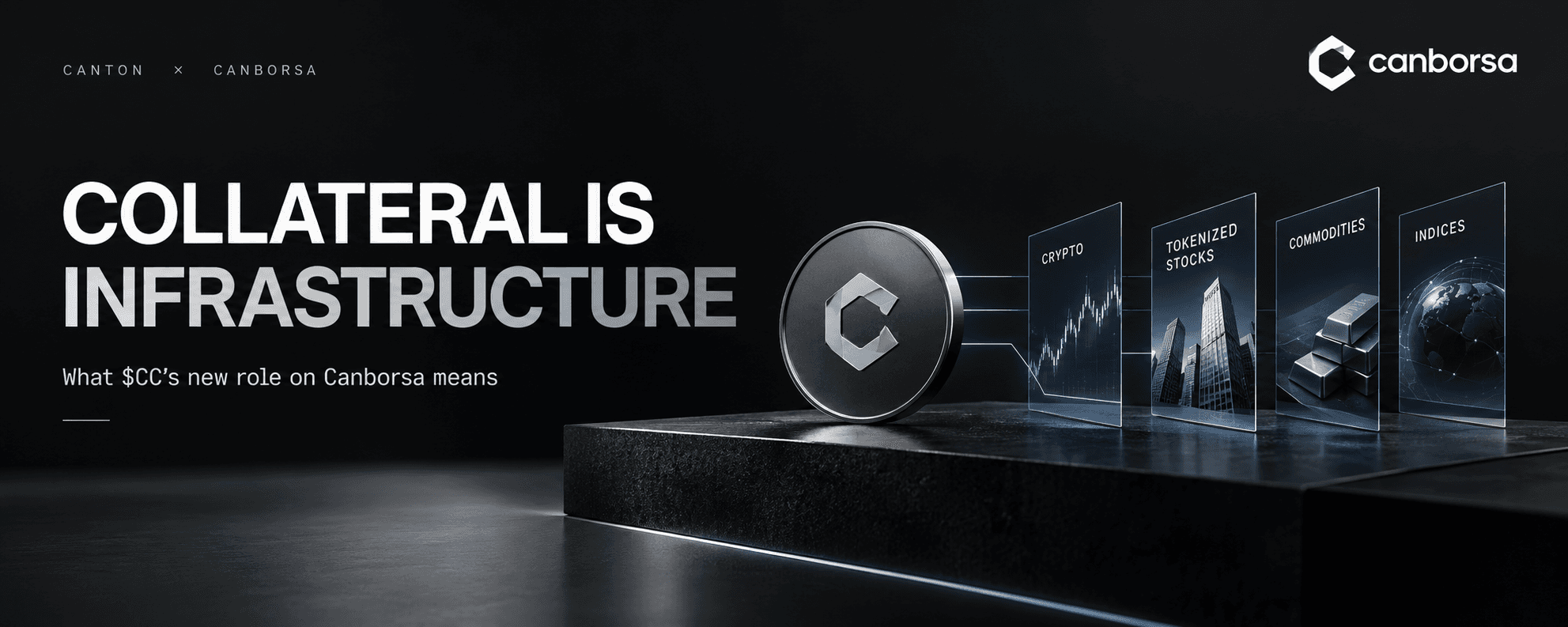
Canborsa describes its platform as a multichain perpetual DEX covering both crypto and real world asset markets, including tokenized stocks, commodities and indices.
So the update isn't simply:
“$CC can now be used to trade one more pair.”
The broader change is:
“$CC can now function as collateral within a venue offering multiple types of perpetual markets.”
That gives Canton’s native asset a more active role within the trading infrastructure being built around it.
From asset exposure to capital flexibility
There is an important distinction here.
Using $CC as collateral does not mean the holder has to give up their underlying $CC exposure.
That is precisely what makes the feature useful.
Instead of choosing between keeping $CC and converting it before trading, a holder can use the asset itself as collateral for a perpetual position, subject to the relevant market's requirements and risks.
The result is a shorter path between holding an asset and using that asset as capital.
That is a more meaningful form of utility than simply adding another place where a token can be displayed or transferred.
Why the RWA angle matters
The other part of the story is where that collateral can be used.
Canborsa brings crypto and RWA perpetual markets into the same trading environment. 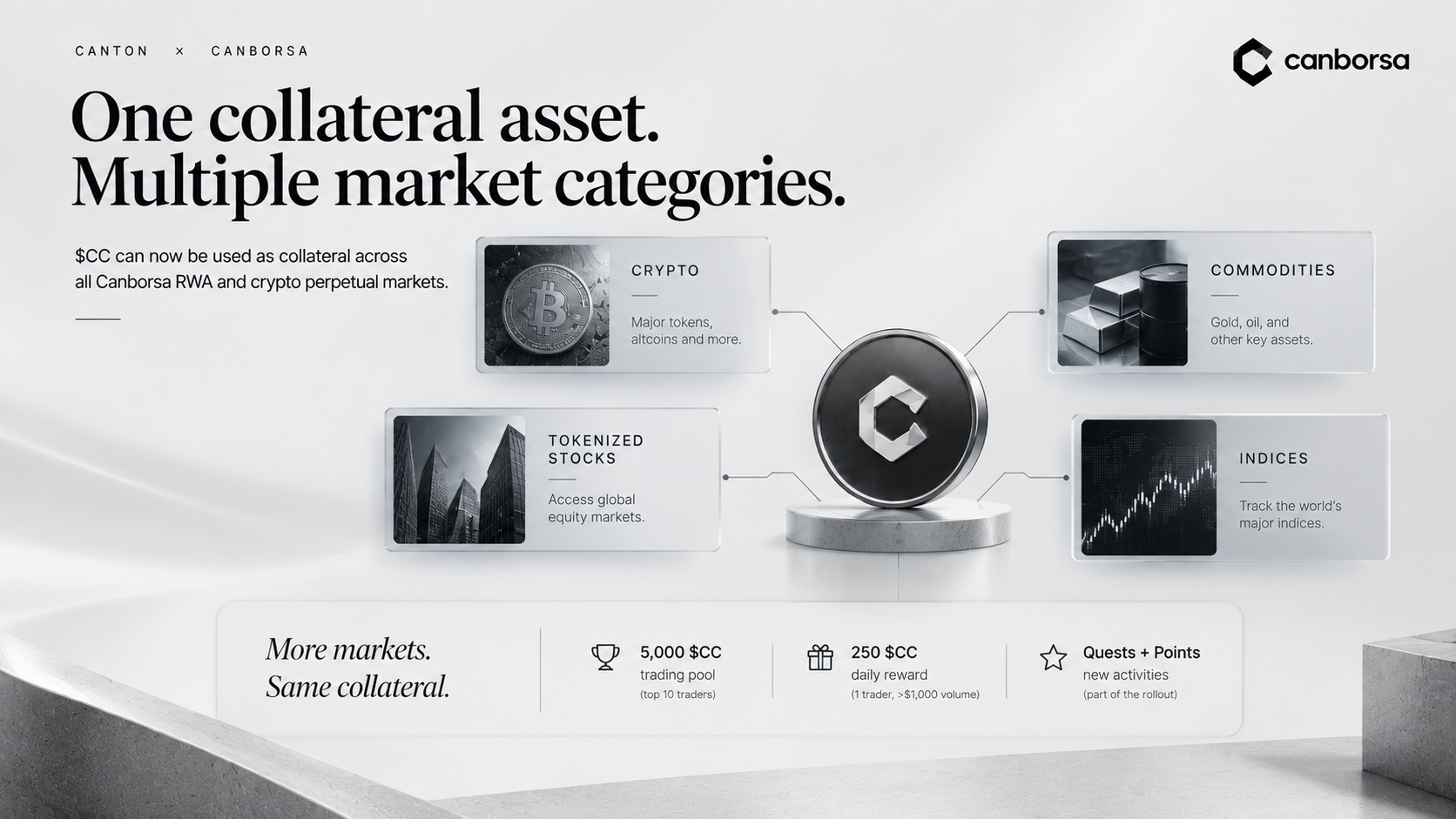
Its platform offers access to markets involving crypto, tokenized stocks, commodities and indices, with markets specific leverage and collateral options.
That means the usefulness of $CC collateral isn't confined to a single crypto narrative.
As more financial assets become available onchain, the ability to use an ecosystem's native asset within those markets becomes increasingly relevant.
The important question isn't simply whether an asset exists onchain.
It is whether that asset can interact naturally with the financial applications being built around it.
Canborsa is adding one of those connections.
Canborsa is also putting incentives behind the launch
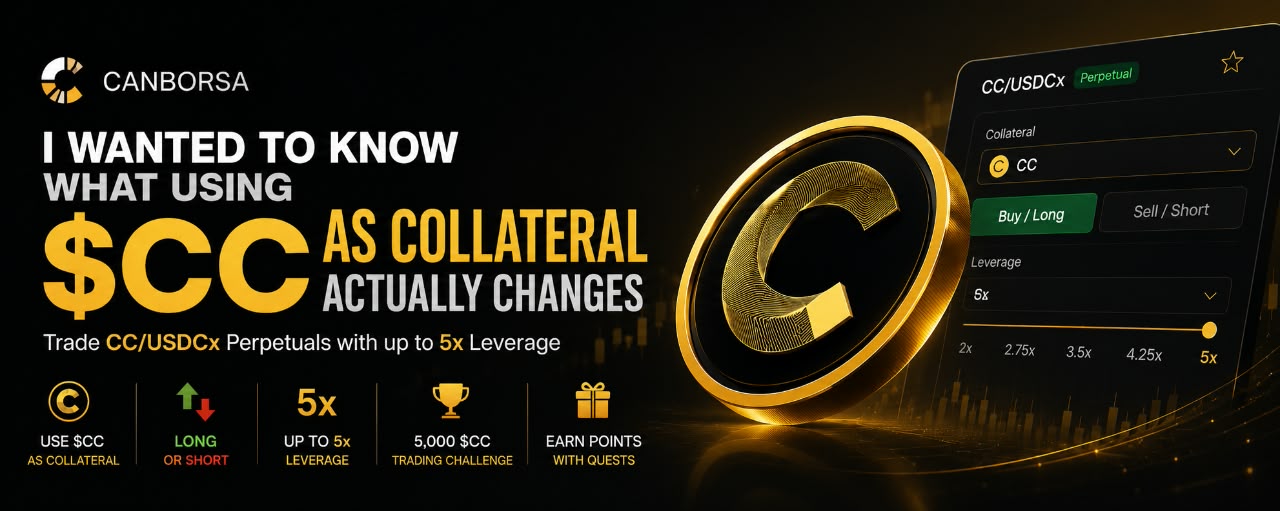
The collateral update comes with a 14-day trading competition.
The top 10 traders by volume will receive a share of a 5,000 $CC pool, with 500 $CC going to each winner.
There is also a daily reward: one randomly selected trader who records more than $1,000 in volume can receive 250 $CC.
New quests with points are part of the rollout as well.
Those incentives give traders another reason to explore the new functionality, but they are secondary to the underlying product change.
The more fundamental development is that $CC itself can now participate in the collateral layer of Canborsa's markets.
The bigger picture
Ecosystems become more useful when their native assets can move naturally through the applications built around them.
The progression is simple:
hold the asset → use the asset → build around the asset
Every time another unnecessary conversion is removed, the distance between those stages gets shorter.
That doesn't guarantee adoption, trading volume, or price appreciation.
Perpetual trading remains a leveraged activity with real risks, and collateral availability varies by market.
But it does create a new possibility for $CC holders:
the asset they already hold can now serve as collateral for activity across Canborsa's available perpetual markets.
That is what makes this update worth paying attention to.
Not because collateral is a flashy feature.
But because infrastructure often becomes valuable precisely when it removes friction that users previously accepted as normal.
Canborsa has now removed one of those steps for $CC.
Explore the new setup: https://go.canborsa.com/paH
X: @Canborsa_DEX