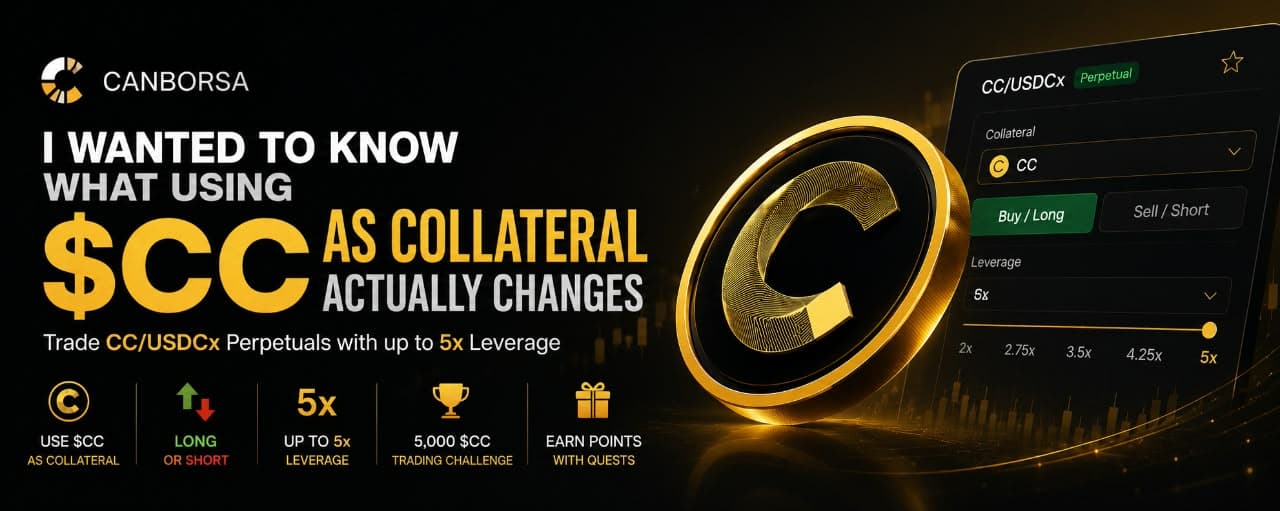

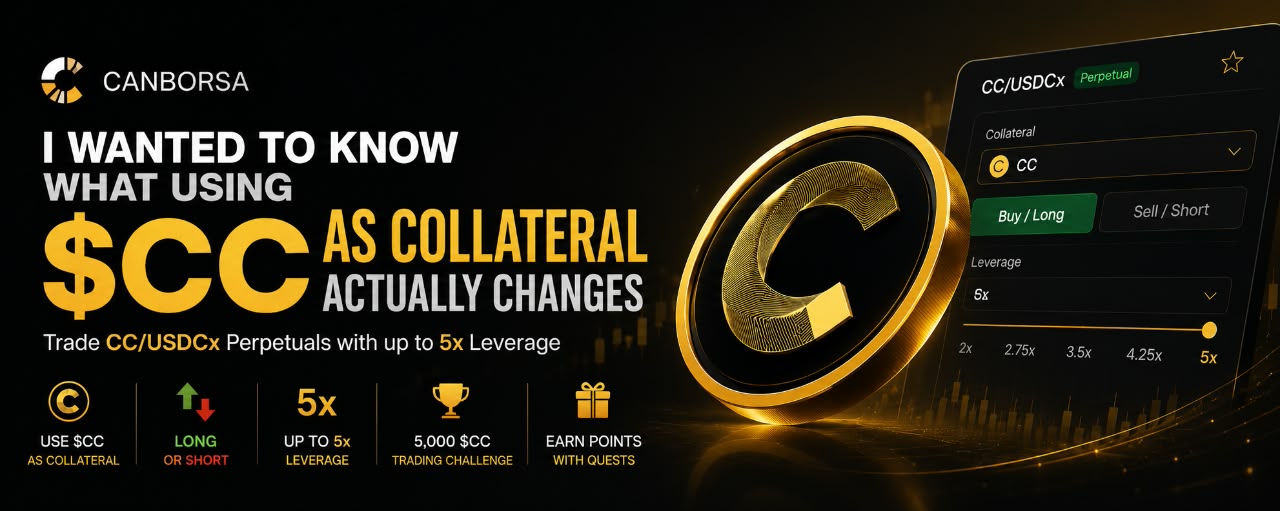
I Wanted to Know What Using $CC as Collateral Actually Changes
I saw @Canborsa_DEX announce that Canton Coin can now be used directly as collateral for perpetual trading.
At first, I thought it was just another trading feature.
But then I looked at it from the perspective of someone who already holds $CC.
If you already have Canton Coin and want to trade its perpetual market, why should you have to swap it into a stablecoin before opening a position?
That was the part I wanted to understand.
So I went into Canborsa to see what the experience actually looks like.
1.0 THE EXTRA STEP I WAS THINKING ABOUT
If you hold $CC and want to trade a perpetual, you need collateral.
And if that collateral has to be a stablecoin, there is an extra step:
Swap $CC → Get the stablecoin → Come back → Open the position
It's not impossible, but it adds friction.
Canborsa is now changing that for Canton Coin holders.
You can use $CC itself as collateral for the CC/USDCx perpetual market.
That immediately made the launch more interesting to me.
Instead of moving away from the asset you already hold, you can keep your $CC exposure while using it in the trading process.
2.0 SO, WHAT ACTUALLY CHANGED?
The basic idea is pretty simple.
1. Hold Canton Coin
2. Select $CC as your collateral
3. Choose the CC/USDCx perpetual market
4. Choose Long or Short
5. Trade with up to 5x leverage
That's the main change.
You don't have to swap your $CC into a stablecoin first just to open a position.
And once I looked at the actual interface, the setup was pretty straightforward.
3.0 I WANTED TO SEE HOW SIMPLE IT WAS
This is where the actual interface made the difference.
The trading setup lets you work with CC, while giving you the option to go long or short and use a leverage range of 2x to 5x.
So the flow is basically:
Hold $CC → Choose $CC as collateral → Select CC/USDCx → Choose your direction → Set your position
What stood out to me is how direct it feels.
You're not thinking:
"How do I turn my $CC into something else first?"
You're thinking:
"I already hold $CC, and I can use it here."
That's a small change in the interface, but it removes an unnecessary step.
4.0 THEN THERE'S THE LONG OR SHORT PART
Once you're in the CC/USDCx market, you have two basic directions.
If you think Canton Coin is going higher, you can go Long.
If you think it's going lower, you can go Short.
The market supports up to 5x leverage.
Of course, leverage isn't free money.
It increases your exposure, which also means losses can increase faster if the market moves against you.
So for me, the interesting part isn't simply the 5x number.
It's the combination of:
$CC as collateral + Long/Short trading + keeping your $CC exposure
That makes the experience more direct for someone who already holds Canton Coin.
5.0 THE PART THAT ACTUALLY STOOD OUT TO ME
The more I thought about this launch, the more I realized that the biggest improvement isn't necessarily the leverage.
It's the removal of friction.
If your goal is to trade $CC, having to first convert your $CC into a stablecoin creates an unnecessary step.
Now, Canborsa lets the asset itself become part of the process.
You hold $CC.
You select it as collateral.
You trade the CC/USDCx perpetual.
And you can keep your $CC exposure while doing it.
That's a much cleaner flow.
6.0 THIS FITS INTO THE BIGGER CANBORSA IDEA
The $CC launch also makes more sense when you look at what Canborsa is building overall.
Canborsa is a crypto and RWA perpetual DEX designed to bring different markets into one non-custodial trading environment.
The platform combines wallet functionality, swaps and perpetual trading, while supporting markets across crypto and tokenized real-world assets.
That includes:
Tokenized equities
Commodities
Indices
Major crypto assets
Canborsa calls this AllFi: bringing traditional assets and crypto-native markets together in one financial environment with 24/7 access.
So the ability to use $CC directly as collateral feels like another step toward that bigger idea.
Instead of treating an asset as something you simply hold, the platform is making it easier to use that asset within a broader trading environment.
7.0 THEN I SAW THE TRADING CHALLENGE
There was another part of the launch that caught my attention.
Canborsa is running a 5,000 $CC Trading Challenge around the CC/USDCx market.
The challenge runs for 2 weeks, and the 10 most active traders, based on volume and number of trades, will share the 5,000 $CC reward pool.
So there's now another reason for active $CC traders to explore the new market.
8.0 THERE ARE NEW QUESTS TOO
Canborsa also introduced quests around the new CC perpetual market.
Open a CC/USDCx position → 2,500 points
Trade CC/USDCx → 250 points for every $100 in volume
I found this interesting because it gives users another reason to interact with the new market rather than simply knowing that the feature exists.
And I could actually see the CC perpetual quest inside the platform.
9.0 WHAT THIS MEANS FOR $CC HOLDERS
After looking through everything, I think the easiest way to explain the change is this:
You don't have to leave your $CC behind just because you want to trade its perpetual market.
You can:
Hold Canton Coin
Use $CC as collateral
Trade the CC/USDCx pair
Go Long or Short
Use up to 5x leverage
And keep your $CC exposure while doing it.
That's the part that matters most to me.
It's not a complicated new concept.
It's simply a more direct connection between the asset you're holding and the market you're trying to trade.
10.0 THE QUESTION I STARTED WITH
I started this by asking myself:
What actually changes when $CC becomes collateral?
After looking at the platform, my answer is pretty simple.
The process becomes more direct.
Instead of:
Hold $CC → Swap to stablecoin → Find the market → Trade
You can now think about it as:
Hold $CC → Use $CC as collateral → Trade CC/USDCx
That removes one of the unnecessary steps between holding Canton Coin and actually using it.
The 5,000 $CC Trading Challenge and the new quests are additional reasons for the community to explore what's now available.
But the bigger change is simple:
The asset you're holding can now work as the collateral for the trade itself.
And I think that's what makes this launch interesting.
11.0 WHERE TO TRY IT
If you hold $CC and want to see the setup for yourself, open the CC/USDCx market on Canborsa and check out the collateral and trading options.
Just remember that perpetuals and leverage carry real risk, so understand the mechanics before trading.
Trade CC/USDCx on Canborsa:
https://app.canborsa.com/trade/cc/usdcx?collateral=cc
@Canborsa_DEX
Your $CC doesn't just have to sit in your wallet.
Now, it can be part of how you trade it.