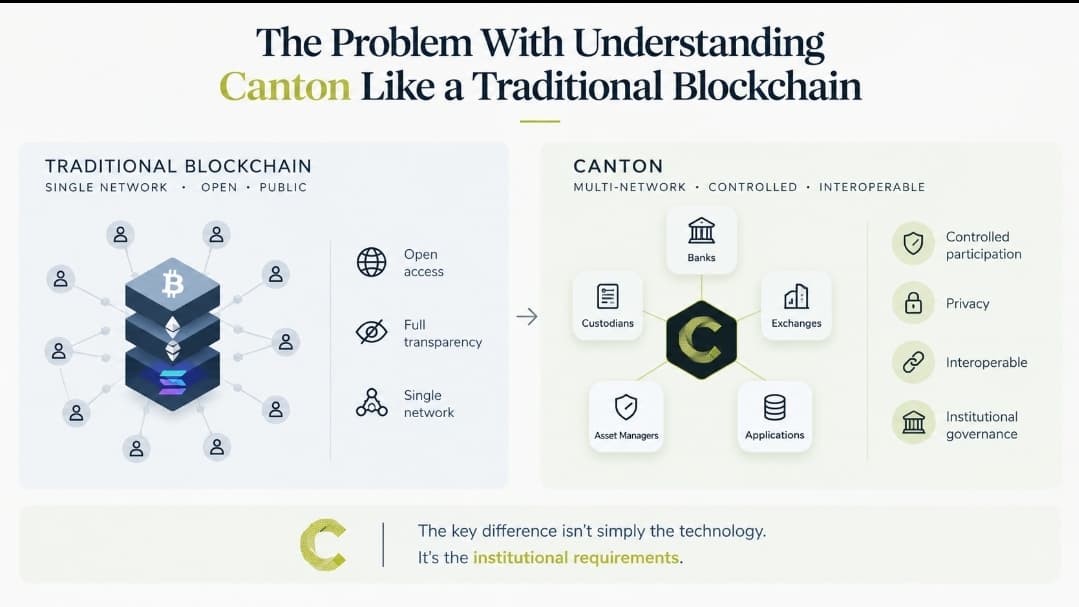

The Problem With Understanding Canton Like a Traditional Blockchain
If someone has spent the last few years learning about Bitcoin, Ethereum or Solana, it is natural to use those networks as the mental model for understanding every new blockchain.
That can create a problem when looking at Canton.
The question is not simply whether Canton is another blockchain with different technology. The more important question is whether institutional financial markets have requirements that lead to a different way of designing blockchain infrastructure.
Financial institutions do not operate under exactly the same conditions as retail crypto users. A bank, securities depository, asset manager, exchange, custodian or other financial-market institution may need to know exactly who can participate in a transaction, which parties can see sensitive information, how assets are controlled, how transactions interact with existing systems, and who is responsible for the infrastructure.
These are not theoretical concerns.
Financial regulators and international financial institutions have identified privacy, governance, interoperability, scalability and integration with existing financial infrastructure as important considerations for the use of distributed-ledger technology in financial markets.
So perhaps the better question is:
What happens when blockchain infrastructure is designed around the requirements of financial institutions rather than around the assumptions of a general-purpose public blockchain?
Canton provides an interesting case through which to investigate that question.
The Institutional Problem Comes First
It is easy to begin a discussion about Canton by listing its technology.
That would miss the bigger issue.
The underlying challenge is that financial markets are already highly interconnected, but their infrastructure remains fragmented.
A securities transaction can involve issuers, investors, custodians, brokers, exchanges, clearing systems, settlement systems and banks. These participants may operate different systems with different data structures, permissions and processes.
Distributed-ledger technology is being explored partly because it could bring processes such as messaging, reconciliation and settlement closer together.
But creating a tokenized financial system introduces another problem:
How do different institutions and systems interact without sacrificing the controls that financial institutions require?
A completely open network can provide broad interoperability, but financial institutions may not want every market participant to see every transaction or piece of financial information.
A completely private network can provide greater control, but separate private networks can become isolated silos.
This creates a difficult balance.
Financial institutions may want controlled participation, privacy, identifiable counterparties, institutional governance and regulatory compliance, while also wanting interoperability, shared infrastructure, atomic settlement and access to wider markets.
The problem therefore is not simply whether blockchain should be public or private.
The more important question is how these different requirements can coexist.
The Problem Is Not Simply Public Versus Private
This is where the conventional blockchain mental model starts to become insufficient.
The discussion is often framed as:
Public blockchain = open and interoperable
versus
Private blockchain = controlled and confidential.
Financial institutions may need elements of both.
They may need to restrict who participates in a transaction while still allowing that transaction to interact with another financial application.
They may need sensitive information to remain private while still allowing the relevant parties to verify and settle a transaction.
They may need individual applications and institutions to retain control while still being able to interact with other systems.
This is important because simply putting every financial institution onto one shared blockchain does not automatically solve the problems of financial infrastructure.
Canton approaches this differently.
Its architecture is based around a network of interconnected applications and participants. Individual applications can maintain their own privacy, permissions and governance while participating in a wider interoperable environment.
The important question, however, is not whether this sounds better.
The question is:
Does this architecture actually address the requirements identified by financial institutions and financial-market infrastructure?
That is something the evidence has to establish.
Why Privacy Means Something Different in Financial Markets
Privacy is particularly important here.
In a retail crypto context, transparency can be a feature.
But imagine a financial institution executing a large securities transaction.
It may not want every participant in a network to know what it owns, what it is buying, who its counterparty is, how much collateral it holds or what financing transaction it is conducting.
That does not necessarily mean the transaction should be invisible.
It means different participants may need different levels of information.
The relevant question becomes:
Who needs to know what, and when?
Canton's architecture is designed around this type of selective visibility. Transactions can be visible to the parties that need them while information that is not relevant to other participants does not need to be globally exposed.
This is an important distinction from the mental model many people develop from public blockchains.
However, privacy introduces an important research limitation.
If institutional transactions are intentionally not visible to everyone, outsiders may have less information with which to independently measure adoption, transaction composition and economic activity.
That means privacy can be an institutional requirement while simultaneously making independent ecosystem analysis more difficult.
This is a trade-off worth keeping in view.
Interoperability Is the Other Half of the Problem
Privacy alone would not be enough.
If every bank simply creates its own private blockchain, the financial system could end up with a collection of digital silos.
This is already a concern in institutional distributed-ledger experiments. Fragmentation and limited interoperability can create additional costs when investors and issuers need to connect to multiple platforms.
The institutional blockchain problem is therefore not:
How do we put financial assets on a blockchain?
It is increasingly:
How do we allow different financial applications and institutions to interact while preserving their independent controls?
Canton's architecture is designed around this problem.
Its interoperability infrastructure is intended to allow transactions to move across independent applications while preserving the privacy and control requirements of those applications.
Again, this is a design objective.
Whether it produces meaningful benefits at institutional scale is something that needs to be evaluated through actual use.
This Helps Explain Why Applications Matter
This is where the role of applications becomes particularly interesting.
Canton is not simply treating applications as interfaces sitting on top of a blockchain.
Applications have an important role in the network's economic model.
Canton's reward system provides economic incentives to different participants in the network, including application providers and infrastructure participants. The current model also links application rewards to the activity generated by applications.
This raises a more interesting question than simply asking:
Why does Canton reward Featured Apps?
The better question is:
Can an application-based incentive model align economic rewards with the actual utility applications create for the network?
There is a potential benefit.
If applications generate genuine financial activity, rewarding the application providers could give developers an economic reason to continue operating, maintaining and improving those applications.
But there is also a potential weakness.
Transaction activity is not automatically the same thing as economic value.
An application could theoretically generate large amounts of activity without creating proportionally meaningful financial utility.
Therefore, activity-based incentives should be examined rather than automatically treated as evidence of adoption or value creation.
This distinction becomes particularly important when evaluating Canton.
What Does the Institution Actually Get?
This may be the most important question in the entire research.
If Canton is being used for institutional finance, we should not simply count the number of applications or transactions.
We should ask what problem the institution is actually solving.
Is it reducing reconciliation?
Is it improving settlement?
Is it allowing assets and cash to interact more efficiently?
Is it reducing operational friction?
Is it improving collateral mobility?
Is it enabling transactions that were previously difficult to coordinate?
Is it providing interoperability between financial applications that previously operated separately?
The answer will probably differ from one application to another.
That is why examining individual institutional use cases is more useful than simply counting announcements.
Institutional Adoption Is Not the Same as an Announcement
There is another distinction that is important when researching Canton.
An institution announcing a partnership is not the same as an institution running a production application.
A pilot is not the same as production.
Production is not necessarily the same as large-scale economic adoption.
And transaction activity is not automatically proof that an application is economically valuable.
For example, DTCC has publicly described work involving tokenized securities and Canton as part of its broader effort to bring tokenization into production financial workflows.
Broadridge has also operated institutional repo infrastructure using distributed-ledger technology on Canton.
These examples are more informative than simple partnership announcements because they allow us to examine actual financial workflows.
But even successful production applications do not prove that the entire Canton model has solved institutional finance.
They demonstrate something narrower:
Certain institutional financial workflows can operate using this type of infrastructure.
That distinction matters.
Canton May Require a Different Way of Measuring Adoption
This leads to another interesting problem.
The metrics commonly used to evaluate public blockchains may not be sufficient for an institutional financial network.
For a public blockchain, people may look at:
- active addresses
- transactions
- fees
- TVL
- token price
- trading volume
But an institutional financial network may require additional questions:
- Which institutions are actually using the infrastructure?
- Which applications are in production?
- What financial workflows are being processed?
- How much value is being settled?
- How frequently are institutions using the applications?
- Are the applications replacing existing processes or simply adding another layer?
- Are transactions economically meaningful?
- Are users returning because the infrastructure provides genuine utility?
Some of these measurements are difficult to obtain publicly, especially when privacy is an intentional feature of the network.
That means Canton may have an unusual research problem:
The same privacy that can make the network attractive to financial institutions can make external measurement of institutional activity more difficult.
That should be acknowledged rather than ignored.
The Bigger Question Behind Canton's Economic Model
The role of applications and rewards raises a broader question about how institutional blockchain networks should create economic incentives.
Traditional financial infrastructure does not necessarily operate around the same token-based incentive model used by public blockchains.
Canton introduces an economic system in which network participants and applications can receive rewards associated with network activity.
The intended relationship can be viewed roughly as:
Users and institutions use applications
↓
Applications generate network activity
↓
Network activity creates economic value
↓
Participants receive incentives
↓
Applications have stronger reasons to remain useful and active
But this is a hypothesis about how the incentive mechanism is supposed to function.
The research question is whether the real ecosystem demonstrates that relationship.
Does application activity correspond to genuine financial utility?
Do incentives encourage long-term development?
Do they benefit only application providers, or do they also create value for users and other network participants?
Can the system discourage activity that exists mainly to capture rewards?
These questions deserve more attention than simply reporting the size of the rewards being distributed.
So, Is Canton Actually Different?
The evidence so far suggests that the difference is not simply that Canton uses different technology.
The more meaningful difference is the set of requirements its architecture is attempting to satisfy.
Institutional financial markets require privacy, controlled participation, governance, interoperability and integration with existing financial infrastructure.
Traditional public-blockchain models were not necessarily designed around all of those requirements.
Canton is therefore interesting because it attempts to combine institutional control and privacy with interoperability between independent applications and networks.
But that does not automatically make the model successful.
The real test is whether institutions can use it to solve meaningful financial problems at production scale, whether different applications can interact effectively, and whether the economic incentives produce sustainable utility rather than activity for its own sake.
What We Still Don't Know
This is perhaps the most important part of the research.
There is evidence that institutional organizations are experimenting with and deploying tokenized financial workflows.
There is evidence that Canton is being used in some of these workflows.
There is evidence that its architecture was designed around institutional requirements.
There is also evidence that Canton has created an incentive structure that gives applications an important economic role.
But several questions remain open.
How much Canton activity represents genuine institutional financial activity?
How much represents crypto-native activity?
How much of the reported activity represents unique economic transactions rather than repeated operational activity?
Do application rewards produce sustainable applications?
How much value do users receive from the applications?
How effectively can independent applications interoperate at scale?
And most importantly:
Does the Canton model solve problems that institutions could not solve as effectively through conventional financial infrastructure or other distributed-ledger models?
Those are harder questions than measuring transactions or counting partnerships.
They are also the questions that matter.
Conclusion
Perhaps the biggest mistake in understanding Canton is trying to place it into a category created by other blockchains.
Bitcoin, Ethereum, Solana and other networks were built around different problems, assumptions and trade-offs. There is no reason to assume that every blockchain designed for a different environment should be evaluated using exactly the same framework.
Canton is particularly interesting because its design is closely connected to the requirements of institutional financial markets.
That shifts the question.
Instead of asking:
“How does Canton compare with other blockchains?”
we should ask:
“What does financial infrastructure require from a distributed network, and does Canton actually provide those requirements in a useful way?”
That is the question worth researching.
And answering it requires looking beyond technology.
It requires looking at the institutions using the infrastructure, the applications serving them, the financial workflows being created, the economic incentives supporting those applications, and the measurable evidence of actual use.
Canton should therefore not simply be understood as another blockchain.
But neither should that statement be accepted simply because Canton says so.
The evidence has to decide.
References
- Bank for International Settlements (BIS): Creating the Future of Finance: A Journey of Innovation and Collaboration
https://www.bis.org/speeches/20251120-creating-future-finance-journey-innovation-and-collaboration
- Canton Network: Canton Network White Paper
https://www.canton.network/hubfs/Canton/Canton%20Network%20-%20White%20Paper.pdf
- Bank for International Settlements (BIS): Tokenisation in Financial Services: Pathways to Scale
https://www.bis.org/speeches/20241104-tokenisation-financial-services-pathways-scale
- Bank for International Settlements (BIS): The Next-Generation Monetary and Financial System
https://www.bis.org/publications/aer-2025/next-generation-monetary-financial-system
- Canton Network: Global Synchronizer
https://www.canton.network/global-synchronizer
- European Central Bank (ECB): Exploratory Work on New Technologies for Wholesale Central Bank Money Settlement
https://www.ecb.europa.eu/press/pubbydate/2025/html/ecb.exploratoryworknewtechnologies202506.en.html
- Canton Network: Earn With Every Transaction: Continuous Transaction-Based Revenue for Apps and Assets on Canton
https://www.canton.network/blog/earn-with-every-transaction-continuous-transaction-based-revenue-for-apps-and-assets-on-canton
- Depository Trust & Clearing Corporation (DTCC): DTCC and Digital Asset Partner to Tokenize DTC-Custodied U.S. Treasury Securities
https://www.dtcc.com/press-releases/2025/dtcc-and-digital-asset-partner-to-tokenize-dtc-custodied-us-treasury-securities
- Depository Trust & Clearing Corporation (DTCC): DTCC Turns Tokenization Into Reality
https://www.dtcc.com/press-releases/2026/dtcc-turns-tokenization-into-reality
- Broadridge: DLR Transacts $1 Trillion a Month
https://www.broadridge.com/insights/dlr-transacts-1-trillion-a-month
- Financial Stability Board (FSB): The Financial Stability Implications of Tokenisation
https://www.fsb.org/2024/10/the-financial-stability-implications-of-tokenisation/
- Bank for International Settlements (BIS): Financial Stability Implications of Tokenisation: Executive Summary
https://www.bis.org/publications/fsi-summary-financial-stability-implications-tokenisation-executive-summary