
TUNDE
Trying my best to increase my usefulness to the world
All Content by TUNDE
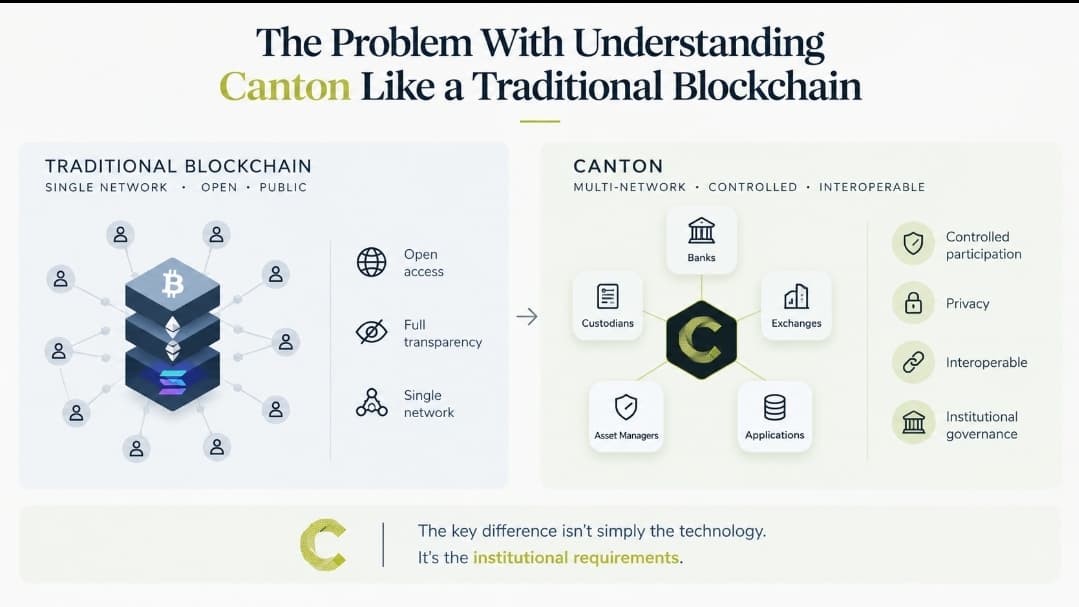
The Problem With Understanding Canton Like a Traditional Blockchain
This research examines why understanding Canton through the same assumptions used for traditional public blockchains can lead to a different interpretation of its architecture and purpose. It looks at the requirements of institutional financial markets, including privacy, controlled participation, interoperability, settlement, and governance, and examines whether Canton’s network design and emerging institutional use cases address those requirements in practice.

At what point does holding $CC become using $CC?
Canborsa now lets $CC holders use their tokens directly as collateral to trade CC/USDCx perpetuals, without first converting to stablecoins. The post explores the capital flexibility this creates, the additional risk involved, and what it could mean for $CC’s wider utility across Canton.

Miss One Day, Miss a Lot
Canton moves fast, and CantonNews helps you catch up on the projects, partnerships, and updates you might have missed.

Why I’m Starting to Use Cauri
Cauri’s zero fees are useful now, but its bigger potential is becoming easier to use across more Canton apps.

CANTON 1.0.22: Minting Delegations
Canton's Minting Delegations let beneficiaries authorize another party to handle specific reward operations without giving them unrestricted control over their assets. The permissions are limited, configurable, and can expire or be withdrawn.

CANTON 1.0.21: GDPR Data Minimization
Canton minimizes data exposure by only sharing information with relevant parties and supporting historical data pruning, giving organizations better privacy and control.

Loop wallet security audit Series 4
Trust Mapping and Attack Surface Analysis help auditors understand trusted relationships and identify possible entry points attackers could exploit, making it easier to focus security testing on the areas that carry the most risk.

This Is What Community Feels Like
20 CC turned into 10 gifts, a little chaos, and a lot of generosity. What started as trying Askardex Gift became a reminder that the best part of a community is actually interacting, sharing and supporting each other.

From Compliance Locks to Canton’s Credit Layer
Cashen has now locked 300M+ CC across 40+ active deals at roughly 5.2% average rates. What began as a solution for Featured Apps needing locked CC is evolving toward something bigger: broader lending and repo-style markets, potentially using tokenized Treasuries and equities as collateral. The milestone matters, but the bigger story is Cashen’s potential evolution into credit infrastructure for the Canton ecosystem.

The Evolution of CanPay: From Red Packets to Agentic Payments
CanPay started with a simple primitive: making it easy to package and transfer value. Now, that same infrastructure is evolving toward a world where AI agents can execute payments and interact with other agents on behalf of humans. The bigger story is the evolution from human-driven payments to agent-driven transactions, powered by Canton’s privacy and settlement infrastructure.

CANTON 1.0.19: Explicit Choice Authorization
Canton requires specific parties to explicitly and cryptographically authorize smart contract choices before they can be proposed. This makes approvals clear, reduces unintended actions, and creates stronger accountability across workflows.

Loop wallet security audit series 3
Threat Modeling is the first step in a professional security audit. Before reviewing code, auditors identify what needs protection, who might attack it, and where the highest risks are. This helps them focus on the most critical areas because you can't protect what you don't fully understand. Next: Trust Mapping.

Loop wallet security audit series 2
Security audits aren't just about finding bugs. Auditors first understand how the wallet works, identify potential attack paths, and use techniques like Threat Modeling, Code Review, Penetration Testing, and Remediation Verification to test its security. A real audit challenges assumptionsnot just code.

CANTON 1.0.17: Dynamic Domain Routing
Canton's Dynamic Domain Routing allows a single participant node to connect to multiple synchronization domains at the same time. This reduces infrastructure requirements and simplifies operations across multiple private blockchain networks.

CANTON 1.0.16: Self-Healing Nodes
Canton's self-healing nodes can securely reconstruct their Active Contract Set (ACS) after a failure, allowing participant nodes to recover and resume normal operations with minimal manual intervention. This improves disaster recovery and operational resilience.

Why did loop undergo an independent security audit?
Series 1 explores why Loop underwent an independent security audit despite already being the first native wallet on the Canton Network. It explains that trust alone isn't enough security must be independently verified. The post introduces the purpose of security audits, why Five North commissioned Verified by Humans to assess Loop Wallet, the critical systems reviewed, and why continuous testing and improvement are essential to building a secure wallet.
Understanding CanPay's Agent-to-Agent Transaction
A GPT AI agent reportedly sent a 2 CPAY red packet to a Claude AI agent on Canton. The amount isn't what matters, the key point is that two AI systems exchanged value autonomously. It's an early glimpse of how AI agents could coordinate, transact, and collaborate in the future.

CANTON 1.0.15: Targeted Re-Encryption
Canton's targeted re-encryption lets participant nodes update encryption keys for active contract data without migrating or re-indexing the entire database. This enables continuous security and compliance while keeping the immutable transaction history intact.
A Closer Look at Loop Wallet's Security Audit
An overview of Loop Wallet's independent security audit, highlighting the audit scope, methodology, authentication, vault security, transaction signing, user privacy, and other key security areas. This is the first in a series breaking down how modern wallet security is built.

CANTON 1.0.14: Encrypted Settlement Failures
Canton encrypts transaction rejection reasons so only the relevant stakeholders can see why a transaction failed. This prevents sensitive operational information from being exposed to competitors or the public.

CANTON 1.0.13: Zero-Fork Versioning
Canton's Zero-Fork Versioning allows participant nodes running different minor protocol versions to coexist and execute the same smart contracts. This enables seamless software upgrades without hard forks, chain splits, or network disruption.

CANTON 1.0.12: Cryptographic Non-Repudiation
Canton's cryptographic non-repudiation requires every transaction to be explicitly authorized by all required parties before it's finalized. This creates verifiable proof of consent, making transactions legally enforceable and preventing participants from later denying they approved them.

CANTON 1.0.11: Pruning without Amnesia
Canton's native ledger pruning lets participants remove archived contract history from their local databases once it's no longer active. This reduces storage requirements and infrastructure costs while preserving the validity of the ledger's current state.

Introducing CantonNews Bounties & Offers
Finding creators isn't the problem. Connecting them with the right projects is. @CantonNews is solving that with Bounties & Offers. Projects can launch bounties or send direct offers. Creators can discover opportunities, publish content, and earn CC. The first bounty is live with a 500 CC reward pool, with 5 creators earning 100 CC each. Explore it on the CantonNews Community page.