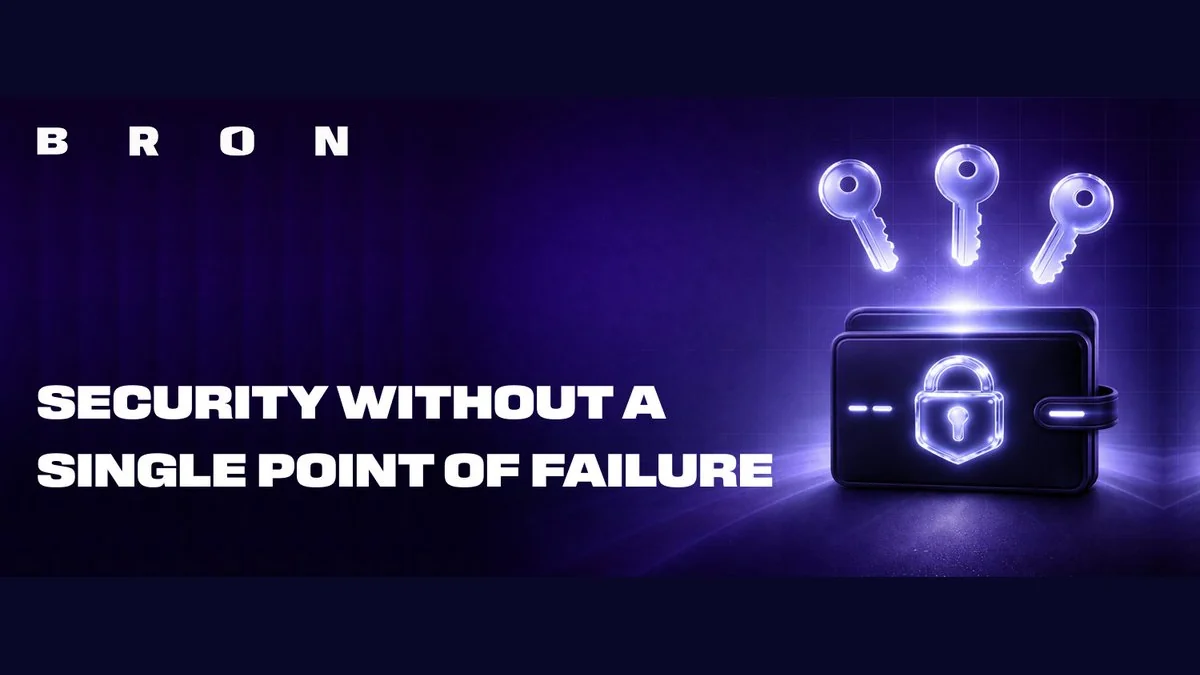

In the world of digital assets, the mantra "not your keys, not your coins" has long forced a difficult choice: accept the technical burden of managing a seed phrase or trust a central exchange. Bron introduces a better path. By utilizing Multi-Party Computation (MPC) and a partnership with Qrypt as a Trusted Third Party (TTP), Bron delivers institutional-grade security that remains accessible to the individual.
What is MPC in Bron?
Multi-Party Computation (MPC) is a cryptographic protocol that allows multiple parties to jointly compute a function while keeping their individual inputs private. In the Bron ecosystem, MPC replaces the traditional single private key with distributed shards. Instead of a single master key that lives on a piece of paper or a single device, the ability to sign a transaction is split into three distinct components. One shard is held on your personal device and protected by biometrics, another is held on Bron’s secure cloud infrastructure, and a third recovery shard is held by an independent third party.
Why the Shift is Necessary
The primary goal of this architecture is to eliminate the "single point of failure." Traditional wallets suffer from a binary risk: if you lose a 12-word seed phrase, your funds are gone; if an attacker steals it, they own your assets. Bron's MPC model makes the wallet "seedless." Losing your phone only means losing one shard. Because any transaction requires a threshold of two shards to execute, the remaining two (Bron and the TTP) can be used to mathematically "re-shard" and restore access without the assets ever being at risk. This brings the high-level security architecture used by banks to families and long-term holders.
The Mechanics of Collaborative Signing
Bron operates on a 2-of-3 threshold signature scheme. When you initiate a transfer, your device performs a partial mathematical signature and communicates with Bron’s server, which contributes its own partial signature. Through the magic of MPC, these pieces are combined into a single, valid signature that the blockchain recognizes. Crucially, the full private key never exists in its entirety during this process. It is never assembled in memory, meaning there is no "master key" for a hacker to snatch from your device or Bron's servers.
Qrypt as the Trusted Third Party (TTP)
A critical piece of the Bron architecture is the involvement of Qrypt, which serves as the independent Trusted Third Party. Qrypt's role is to ensure that the recovery process is not only secure but "quantum-proof." While MPC protects against today's hackers, Qrypt provides the high-quality entropy (randomness) needed to generate these shards in a way that future quantum computers cannot predict.
It is important to note that as the TTP, Qrypt never signs transactions. Their role is strictly limited to the recovery and inheritance flows. Contractually, the TTP works for you, the user, not for Bron. They are legally and technically prohibited from acting on a request from Bron to move funds or reconstruct a key. This "separation of powers" is what ensures that even if Bron Labs were compromised or coerced, they could never collaborate with the TTP to take your funds.
Qrypt itself represents a leap forward in cryptographic security. By using quantum-generated randomness, they eliminate the "flawed randomness" that has led to many high-profile crypto thefts. Their technology allows for the generation of identical keys at different endpoints without ever "transmitting" them over the internet, effectively making the data invisible to eavesdroppers. By acting as the TTP, Qrypt ensures your digital legacy is protected by the laws of physics, not just a promise.