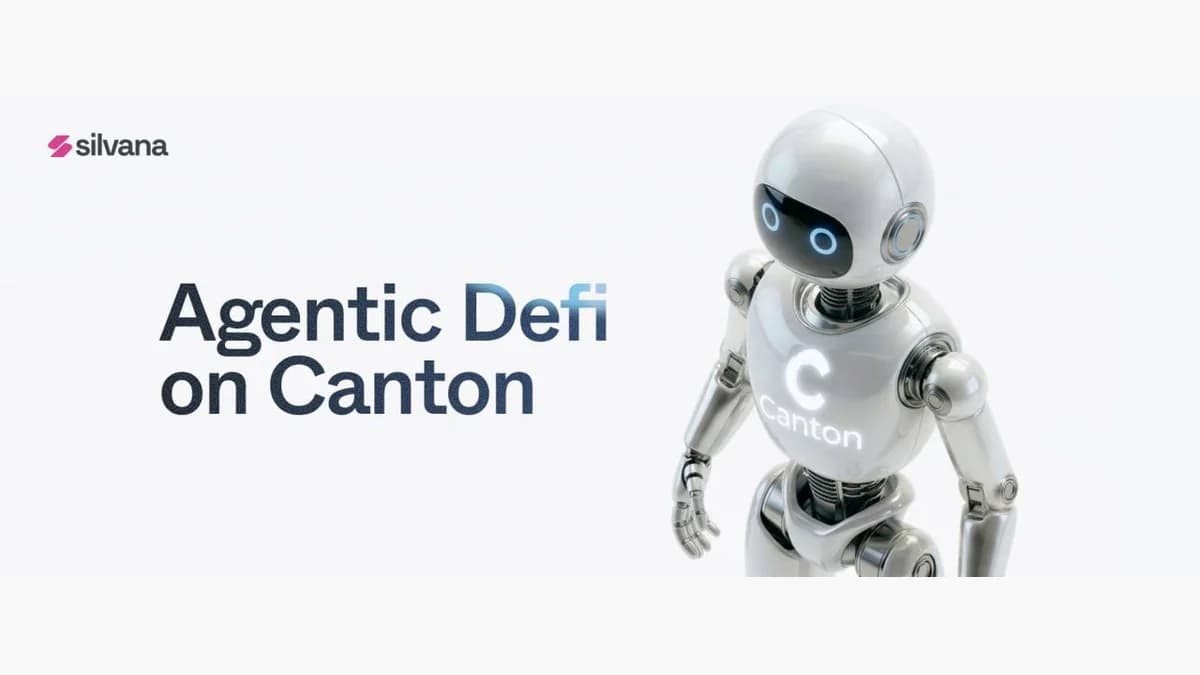

Canton Network was designed for one thing most blockchains were not - real financial infrastructure.
Privacy by default. Atomic settlement. Institutional-grade governance.
Multiple apps and service providers already operate on the network, spanning tokenized assets, payments, repo, and derivatives.
But there’s a clear gap.
A native execution layer where autonomous agents can trade, settle, and prove activity without exposing their intent to the network.
That’s what Silvana is building.
The Current Problem With DeFi
Most DeFi protocols were designed for transparent, pool-based environments.
AMMs, public mempools, visible orderflow.
That architecture works for permissionless access but not for serious capital deployment.
Public orderflow leaks intent while visible liquidity attracts extraction. Pool-based pricing introduces slippage, impermanent loss, and manipulation surface.
These are not edge cases, but the default experience for anyone trading with size on public infrastructure.
Canton solves the privacy and settlement side.
Contracts are only visible to involved parties, transactions settle atomically or roll back and data stays fragmented across validators.
But a settlement layer alone is not a trading layer. Canton needs execution infrastructure that matches its architecture.
Private, deterministic, and built for agents.
Agentic Over Automatic
Automation means scripts that run when triggered.
Agentic means autonomous programs that place orders, react to market events, manage settlement flows, and generate proofs - all without human intervention at each step.
In traditional DeFi, bots interact with public smart contracts. They read mempools, compete in gas auctions and front-run each other.
Agentic DeFi on Canton will look different.
Agents will operate off-chain in a private environment, submit orders into a private orderbook, subscribe to real-time streams and react programmatically.
All without seeing each other's strategies.
This will be a fundamental shift.
What Silvana Is Building
Silvana Book is building agentic architecture designed for Canton.
Currently, three agent types exist.
- Trading Agents place, cancel, and update orders.
- Proving Agents generate zero-knowledge proofs for every orderbook operation.
- Settlement Agents execute Delivery-versus-Payment on Canton.
But that's just the beginning.
Multiple agent types will soon exist, all coexisting within Silvana's agentic ecosystem on Canton and fulfilling different core functions.
What This Means For Canton
Canton's architecture was built for multi-party, privacy-preserving workflows - exactly the kind of environment where agentic execution thrives.
An agent could execute a trade on Silvana and have the resulting settlement feed directly into a collateral workflow on another Canton app.
Canton's synchronizer model means institutions choose their own governance and operational setup, something which Silvana's non-custodial design also fits.
For Canton to become the operating system for tokenized finance, it needs more than settlement rails.
It needs private execution infrastructure where agents can operate at speed, settle with certainty, and prove everything that matters without exposing intent.
The Agentic DeFi Hub
We're building the execution layer that Canton's ecosystem of institutions, native protocols, market makers, and AI agent builders need to operate natively on the network.
- A private orderbook for strategy-safe execution.
- Agent SDKs.
- Streaming APIs for autonomous operation.
- An Agent Marketplace.
- ZK proofs for compliance without transparency trade-offs.
- Atomic DvP for settlement finality.
- Non-custodial architecture for full asset control.
That is what an Agentic DeFi Hub looks like on institutional infrastructure.
Not louder or faster, but structurally better.
This is just the beginning for Silvana.