
The real alpha is not in tokens. It is in who controls settlement, visibility and execution.
The real evolution of crypto is not convergence. It is separation into interoperable financial layers. Most people are still looking in the wrong place. The biggest shift in finance is not happening in public discourse. It is happening in settlement architecture.
For years, the assumption was simple, tokens, market cycles and incremental DeFi upgrades would define the future of on-chain finance.
That framing is already outdated, the real transformation is not at the asset layer. It is at the level of what can be seen, what can be settled and what can safely interact with regulated systems.
A new structure is forming. Institutional settlement systems and permissionless execution environments are no longer competing narratives. They are becoming distinct but interoperable layers of the same stack.
Within that shift, execution systems like OneSwap become more important than they appear.
1. Crypto’s original assumption and its blind spot
Crypto started with a clear thesis. Transparent, decentralized systems would replace opaque financial infrastructure. That thesis drove a decade of innovation but it also created a blind spot.
Because institutional finance does not run on transparency. It runs on constraint.
- selective disclosure
- regulated access
- legal accountability
- controlled exposure
These are not preferences, they are structural requirements. This is where the divergence began, crypto optimized for openness and traditional finance optimized for control. They did not converge. They separated.
2. Why early DeFi could not cross the boundary
DeFi introduced powerful primitives:
- permissionless composability
- self-custody
- automated liquidity
- transparent settlement
These reshaped financial experimentation. But they do not extend cleanly into real-world systems.
Institutional environments cannot operate with:
- global visibility of positions
- uncontrolled counterparty exposure
- permanently exposed capital flows
- compliance added after execution
This was not a technical failure. It was an architectural mismatch. DeFi scaled. Integration did not. Not rejection. Misalignment.
3. Settlement is the actual foundation
Most analysis focuses on execution. Trading, liquidity, UX. That misses the point. Execution is visible. Settlement is decisive. Finance is not built on execution. It is built on settlement.
Settlement defines:
- ownership
- finality
- visibility
- embedded compliance
Traditional systems centralize and regulate it. Crypto made it globally transparent. Neither model alone works for a system that must support both institutional and permissionless environments. The requirement is new. Settlement must become modular. Structured visibility. Structured control.
Not fully transparent. Not fully opaque. Designed.
4. Structured settlement is already emerging
This is where the Canton Network comes in. Not as a competitor to public chains. As a different model.
It introduces a system where:
- data is shared only among relevant participants
- visibility is scoped, not global
- compliance is embedded at the network level
- institutional workflows remain intact
This is not about being more or less decentralized, it is structurally different. It aligns with how real financial markets already operate at scale.
5. Execution is no longer independent
Once settlement changes, execution changes with it. This is the part most people miss. Execution is no longer standalone.
It must now operate across environments where:
- visibility is constrained
- counterparties are partially hidden
- liquidity is fragmented
- rules vary by context
This changes the role of DeFi. Execution is no longer just about efficiency. It is about coordination. Coordination across systems with different rules, different visibility, and different constraints.
Most existing DeFi infrastructure was not designed for this.
6. OneSwap and execution in a fragmented system
OneSwapcc sits directly inside this transition, not as another DEX competing on liquidity or speed. That framing is too small, and it is an execution layer built for non-uniform settlement environments.
That changes how execution works:
Respect boundaries - Execution cannot assume global state or universal visibility.
Handle constrained liquidity - Market formation happens without exposing full participant data.
Adapt to contextual finality - Settlement outcomes depend on structured rules, not broadcast assumptions.
Liquidity is no longer universally visible. State is no longer globally shared. Outcomes are no longer uniform.
OneSwap does not replicate existing DeFi models. It adapts execution to a new settlement reality.
7. The financial system is splitting into layers
The idea that everything will converge into one system is breaking down.
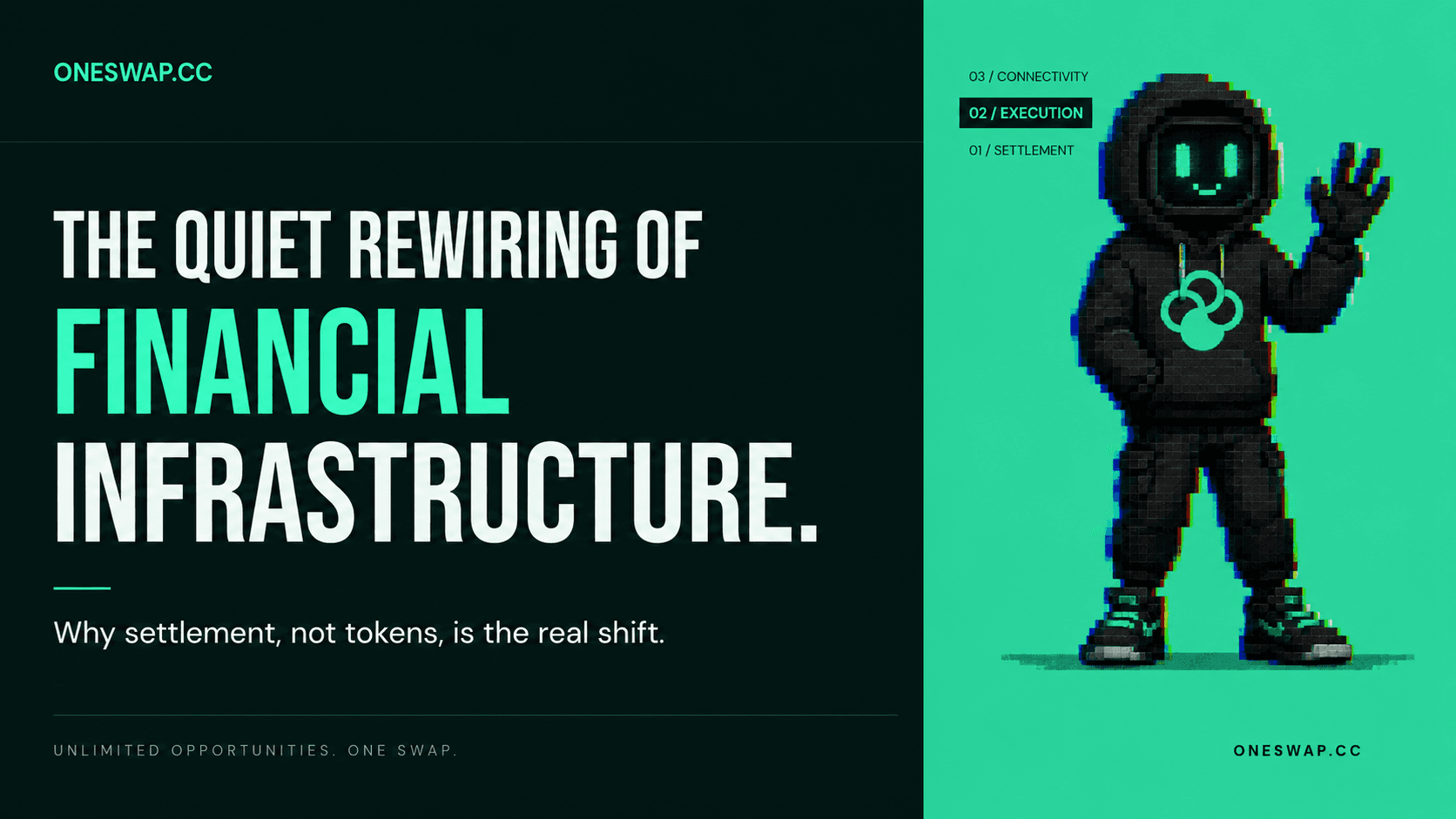
What is emerging instead is layered architecture:
Settlement Layer - Compliance, visibility control, legal finality
Execution Layer - Liquidity, composability, price discovery
Connectivity Layer - Interoperability, bridging, coordination
Each layer optimizes for a different constraint set. Force them together, and they fail. Separate them, and they scale. The future is not convergence.
It is separation with structured interaction.
8. What actually changes
This shift is structural.
For institutions:
- controlled exposure with programmability
- compliance built into infrastructure
- reduced operational risk
For DeFi:
- access to real financial assets
- integration with settlement systems
- expansion beyond isolated liquidity
Execution systems no longer operate freely, they operate within boundaries defined by settlement. This is where systems like OneSwap matter. Not as endpoints of liquidity but as execution interfaces between layers. The most important transformation in financial infrastructure is not about tokens or narratives.
It is about how systems define:
- visibility
- settlement
- composability boundaries
The @CantonNetwork represents structured, compliant settlement. Permissionless systems represent open execution. Between them is not competition, it is architecture. And in that architecture, execution systems like OneSwap become critical. Not because they dominate today, but because they define how financial activity moves across systems that were never designed to interact. The future of finance is not one chain. It is layered.
And it is already forming and you can access it on oneswap.cc