
The more real-estate tokenisation is studied, the clearer one conclusion becomes: putting an asset on-chain is not the same as making a market investable.
That distinction matters because access to a single property and access to a real-estate market are fundamentally different products.
A tokenised apartment, office, or building can provide exposure to one asset. That may improve divisibility, broaden participation, and modernize how ownership is represented and transferred.
But single-asset exposure remains exactly that: single-asset exposure.
It reflects one location, one sponsor, one structure, and one local cycle. It can be useful for certain investors, but it does not solve the broader problem of market access.
That is where the category begins to evolve.
As capital markets mature, investors tend to move beyond isolated assets and toward instruments that make allocation simpler. They look for benchmarks, baskets, and products that offer cleaner exposure to a market rather than forcing each position to be built one asset at a time.
Real estate should not be treated differently.
If tokenisation is going to matter at market scale, it must do more than create digital wrappers around individual properties. It must make real-estate exposure more legible, more structured, and more investable.
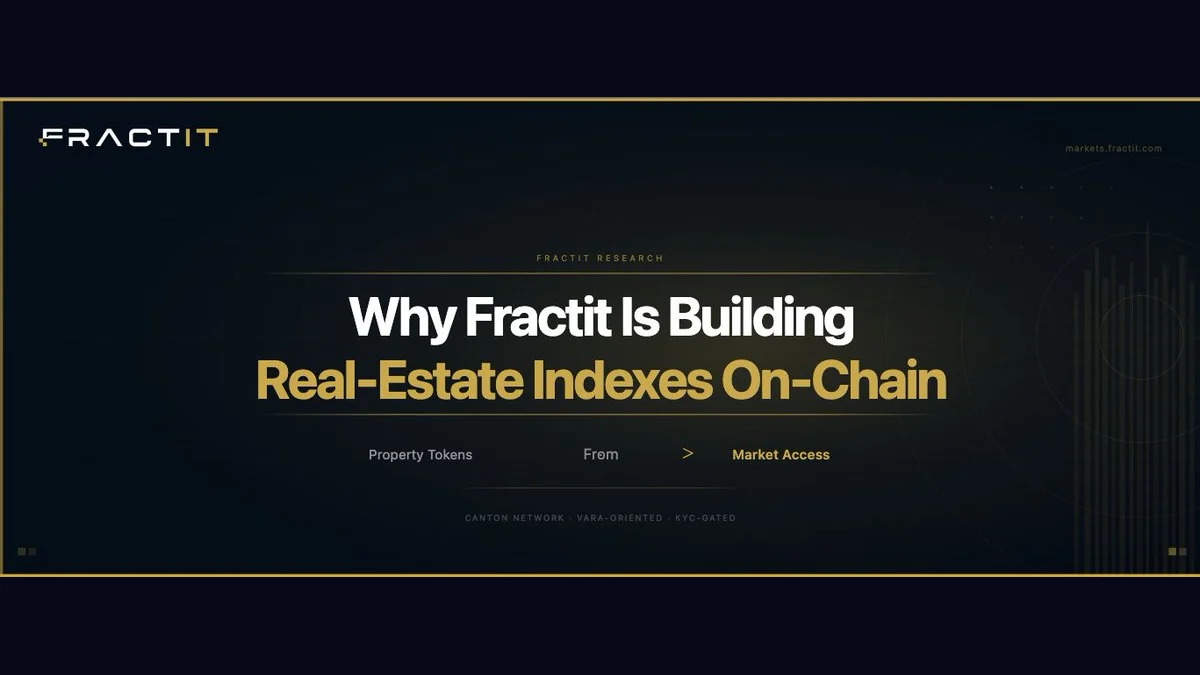
That is the idea that shaped Fractit’s next step. Fractit is moving from broader real-estate tokenisation toward building a platform on Canton that brings real-estate indexes around the world on-chain.
This shift is not about packaging. It is about product design.
A single tokenised property allows participation in one deal. An index-linked product allows participation in a market thesis.
That difference is important.
Most investors are not trying to assemble real-estate exposure building by building. They are trying to express a view on a city, a segment, a region, or a broader market trend. They want a cleaner instrument for allocation, comparison, and portfolio construction.
Indexes help solve that.
They convert fragmented underlying exposure into a more usable form. They create a reference point. They make the asset class easier to understand, easier to allocate to, and easier to position within a portfolio.
That is why index-based exposure represents a meaningful next layer for this category.
At Fractit, the conviction is that the next phase of real-estate tokenisation should not stop at tokenised property access. It should move toward on-chain access to real-estate markets themselves through index-linked products.
Building this properly requires more than a token standard.
It requires infrastructure that can support credible issuance, controlled access, privacy-aware workflows, and institutional-grade execution. Canton is designed as a network for interoperable applications with privacy and control features aimed at institutional use cases, which makes it relevant for compliant digital asset products.
That is why Fractit’s direction is taking shape on Canton. Fractit is building toward real-estate index exposure on-chain through a model structured for real market access rather than isolated asset tokenisation alone.
This is not a rejection of single-property tokenisation. It is a recognition of its limits.
Single assets may open the door.
But market-level products are what make an asset class easier to access, easier to interpret, and more practical to allocate capital into.
That is the shift underway.
The first phase of real-estate tokenisation focused on whether assets could be represented on-chain. The next phase is about whether markets themselves can become investable on-chain in a credible way.
That is the problem Fractit is building toward solving.