Fractit
On-chain real estate index markets for regulated investors.
Fractit brings real estate index exposure on-chain through Canton, starting with Dubai-focused markets designed around fully replicated exposure, KYC-gated access, transparent NAV, privacy-preserving execution, and atomic settlement.
Background
Fractit is building for an asset class that has always been desirable but difficult to access cleanly: real estate index exposure. Traditional real estate products can be slow, fragmented, and operationally heavy, while many tokenized alternatives rely on synthetic structures that do not satisfy more serious investors.
The project approaches the problem from the market-structure side. Instead of making tokenization the headline, Fractit focuses on the ingredients that make an index product credible: underlying constituent exposure, custody, compliance checks, transparent valuation, and a settlement rail that can support regulated participation.
Key Benefits
Fractit is designed to make tokenized real estate feel more like a professional market product than a speculative wrapper.
- Fully replicated index exposure anchored to underlying real estate-related constituents
- KYC-gated access and whitelist controls for eligible participants
- Transparent NAV logic so investors can understand how the product is valued
- Atomic settlement on Canton, reducing counterparty and timing risk
- A structure that can scale from one regional index into a broader family of real estate markets
Why Canton
Real estate index markets need more than token issuance. They need privacy for participants, access controls for compliance, and verifiable settlement for every movement of value. Canton gives Fractit a way to combine those requirements without forcing every market participant into a public, globally visible transaction trail.
That is especially important for institutional-style products. Investors and counterparties can get the assurance of a shared ledger while only exposing the information each party is entitled to see. For Fractit, that means the compliance layer is not bolted on after the fact; it can be built into how the market operates.
What Makes It Unique
Fractit's strongest distinction is its emphasis on real index design. It is not simply putting a real estate theme on-chain. The product is framed around full replication, custody, valuation transparency, and controlled access, which makes the tokenized market more legible to investors who already understand index products.
The regional focus also gives the project a sharper identity. Starting with Dubai real estate creates a clear market narrative, while the same structure can be extended into other high-interest property markets as demand grows.
What's Included
Market Structure
Fractit's profile centers on how real estate index exposure can move onto Canton without losing the controls professional investors expect. The core themes are constituent backing, NAV transparency, KYC, custody, and settlement reliability.
User Experience
The investor journey is built around discovering a market, understanding the index mechanics, subscribing or trading through controlled access, and redeeming through a workflow that keeps settlement and compliance connected.
Risk and Considerations
Fractit creates market exposure rather than fixed-income yield. Outcomes depend on the underlying market, liquidity, valuation, fees, and eligibility requirements.
Behind the Scenes
The project reads like it was designed backwards from institutional requirements. Custody, compliance, whitelist management, and valuation are treated as first-class parts of the product rather than afterthoughts.
That matters because tokenized real estate has often been held back by weak secondary markets and unclear investor protections. Fractit's challenge is not only to tokenize exposure, but to make the entire market workflow credible enough for regulated participants.
Impact
Fractit gives Canton a concrete real-world asset use case that is easy to understand: a private, compliant, on-chain market for real estate index exposure. If it works, it can show that Canton is not only useful for settlement between institutions, but also for building new market products that need privacy and control from day one.
Looking Ahead
The natural roadmap is a wider index universe. Dubai gives Fractit a strong first market, while additional regional real estate indices could turn the project into a broader on-chain marketplace for property-linked exposure.
- More regional real estate index products
- Deeper liquidity around live markets
- More investor education around tokenized index structure
- Continued work on compliant access and settlement workflows
From the Insights Hub
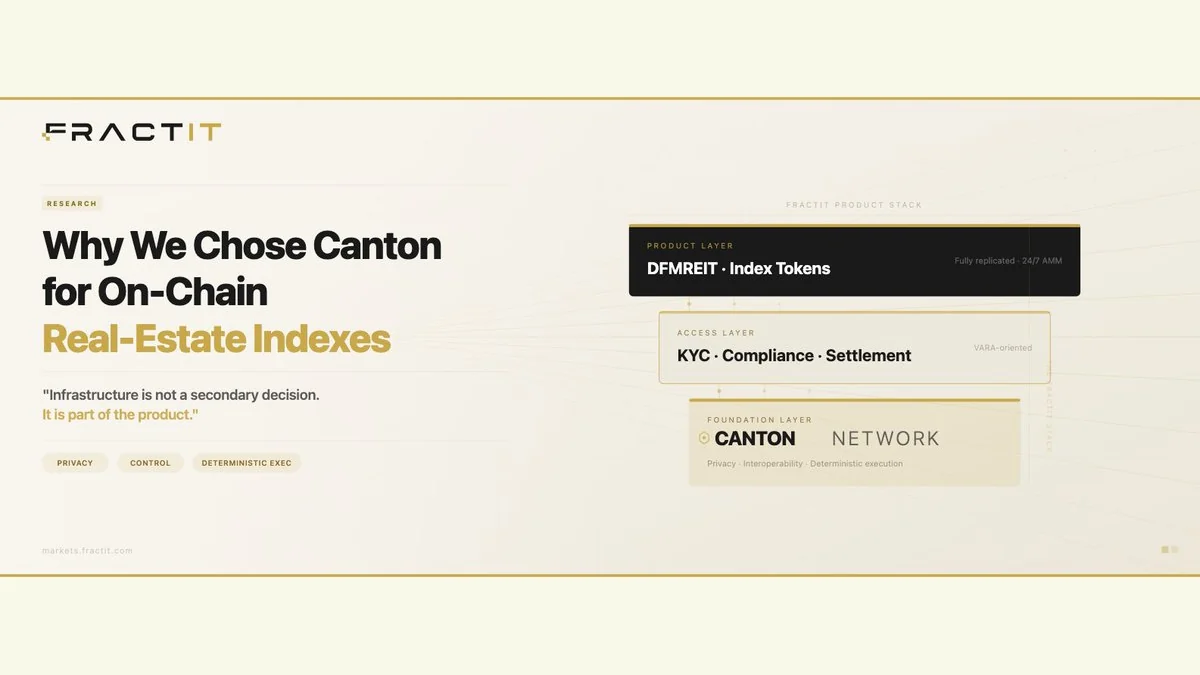
Why We Chose Canton for On-Chain Real-Estate Indexes
As the thesis around real-estate indexes on-chain became clearer, one point followed quickly: The infrastructure choice could not be treated as an afterthought. If the goal is to bring real-estate
Why Fractit Is Building Real-Estate Indexes On-Chain
The more real-estate tokenisation is studied, the clearer one conclusion becomes: putting an asset on-chain is not the same as making a market investable. That distinction matters because access to a
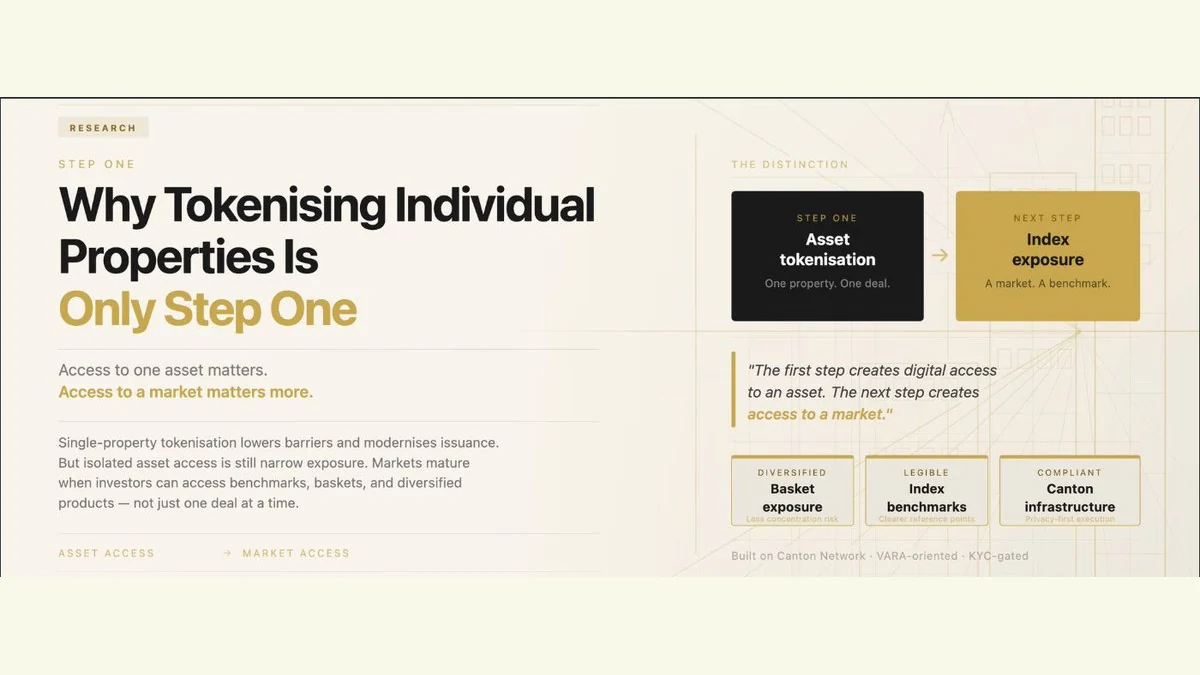
Why Tokenising Individual Properties Is Only Step One
Access to one asset matters. Access to a market matters more. Single-property tokenisation is an important starting point for real-estate markets on-chain. It can lower entry barriers, make ownership
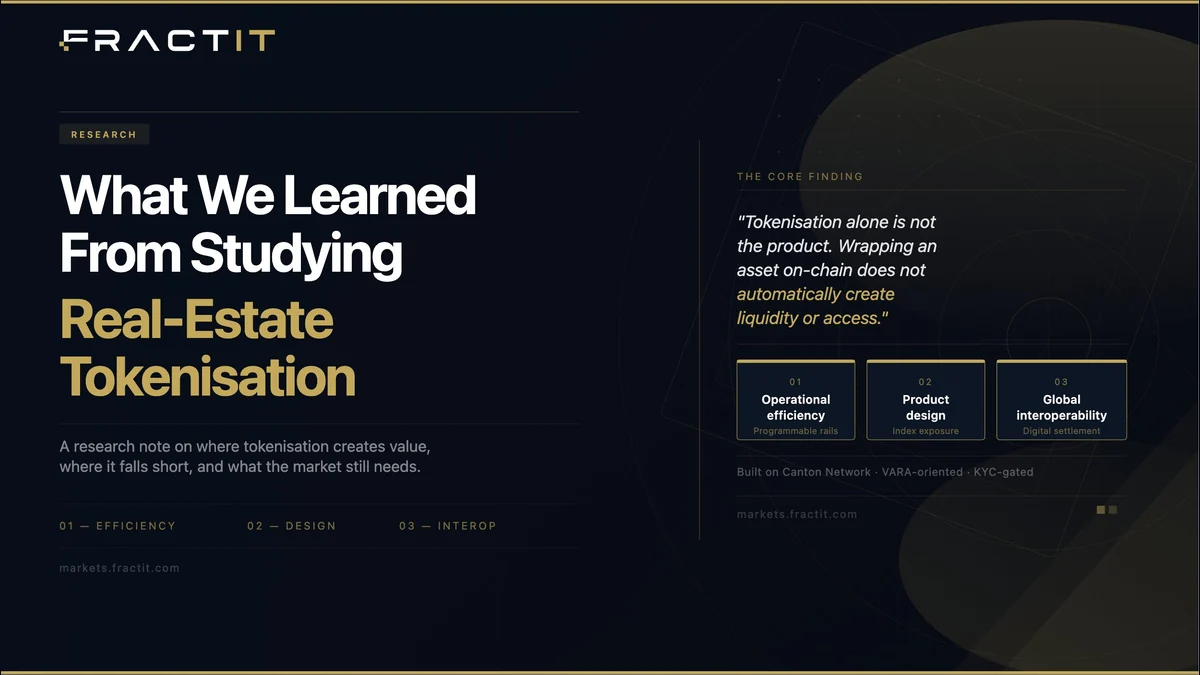
FractIt: We studied real-estate tokenisation.
We studied real-estate tokenisation. Our biggest takeaway: single-asset tokenisation is not the same as real market access. Fractit is building the next layer of access.