
Selected Canton updates from November 11, 2026. Source.
Tritemius has expanded its iOS wallet through TestFlight, while The Hub reports reaching 1,000 members. New validator notices name Circle and Upflam among allocation recipients, and five other operators have gained approval.
This Canton Roundup also covers a reopened rewards-tool funding vote and Memora’s explanation of how it intends to check the SOL backing of SOLx. It gathers November 11 developments not included in the previous edition.
Tritemius adds assets and Lightning options
Tritemius Labs says its latest iOS wallet update is available through TestFlight, Apple’s service for distributing test versions of apps.
The update adds support for cETH from onRails, HANDL from HandlPay and Edel’s tokenized stock and index products labelled AAPL, MSTR, QQQ and SPY. It also includes two ways to use Bitcoin’s Lightning Network:
- A one-click option: start using Lightning without operating a personal node.
- A personal-node option: connect a node the user runs and use Tritemius as its controller.
Lightning is a payment network built on Bitcoin. These are separate wallet capabilities alongside Canton asset support; the update does not mean Bitcoin Lightning transactions settle on Canton. Availability is through TestFlight, rather than a newly confirmed general App Store release.
The Hub reports 1,000 members
The Hub has announced 1,000 members. Its platform combines creator content, live rooms and tradable community tickets on Canton.
The figure is a membership milestone reported by the project. It follows the SprintFAM creator-network partnership announced earlier this month, although the posts do not establish how many sign-ups came from that collaboration.
Circle and Upflam appear in the latest allocation notice
A MainNet validator-allocation notice names Circle Internet Group and Upflam, along with AUM–Digik, HostDeFi Validator Collective and Noah HQ.
The message was published on November 11 under the heading “Validator Allocations - November 9th”.
An allocation gives an organisation a place in the MainNet onboarding process. It does not by itself confirm that the node is running. For Circle, it also does not establish a launch date for native USDC on Canton.
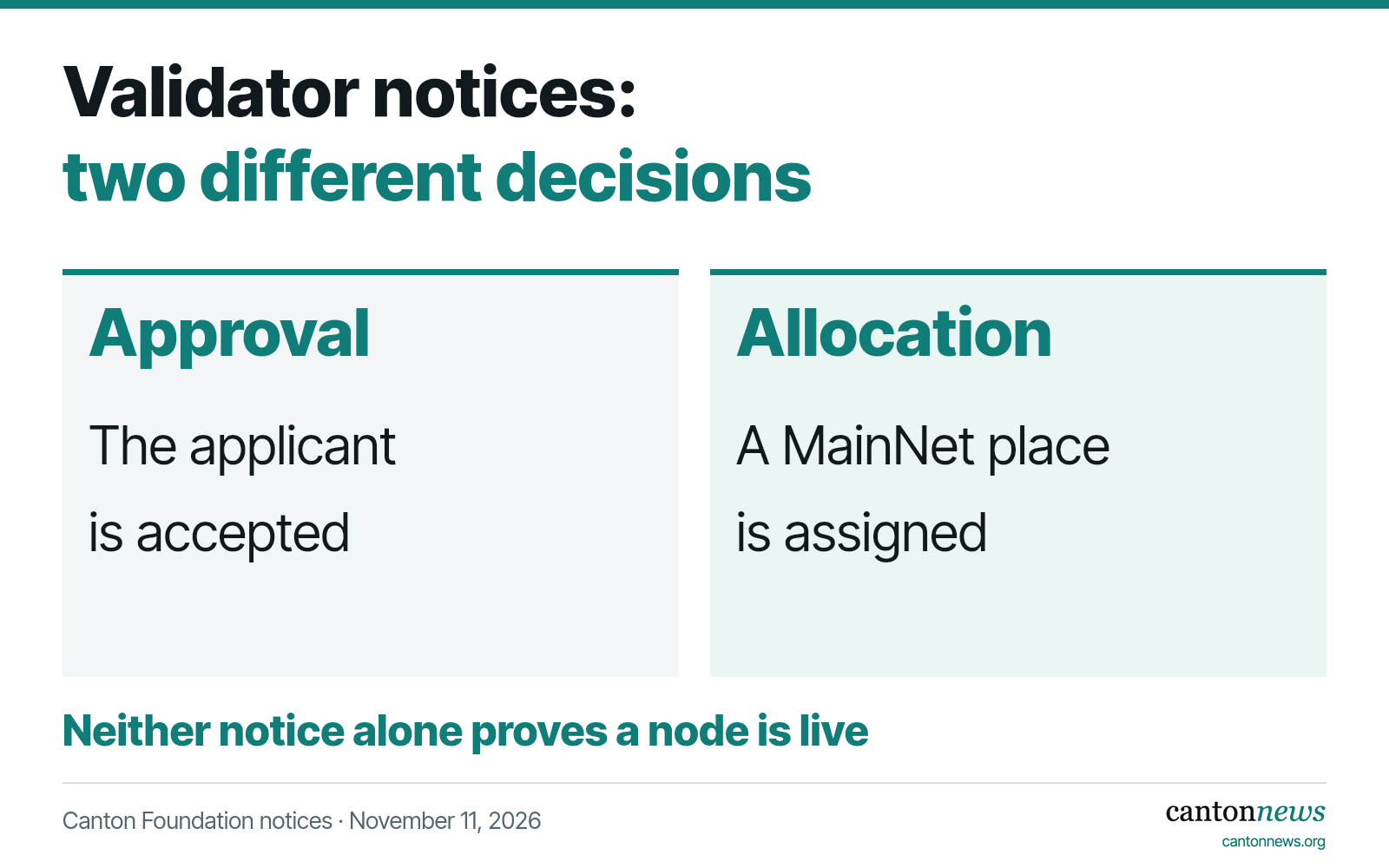
Two separate notices: operator approvals and MainNet allocations.
Five more validator operators approved
A separate approval notice names Canborsa, Carbazena, GateKeeper, Initiativ and Talwex. Their applications describe uses ranging from trading and liquidity provision to institutional commodities and corporate-bond markets.
Operator approval accepts the applicant, while allocation assigns a place for a MainNet node. The approval notice retains further onboarding and allocation steps. It is not confirmation that all five are already operating on MainNet.
R13N’s Reward Engine gets a fresh vote
A new funding vote has opened on R13N Labs’ proposed Canton Reward Engine. The software would help applications calculate and distribute rewards funded by campaign sponsors.
The previous vote closed without passing after receiving no binding votes. That is different from committee members voting against the proposal.
The reopened vote follows the deadline revisions covered in the earlier roundup. It remains the existing request for up to 3,636,363.64 CC, with approval still pending.
Memora explains how it would check SOLx backing
Memora says each SOLx should be backed one-for-one by SOL held in reserve on Solana. In its November 11 explanation, the project says it is using RedStone CAPS to check the reserve on Canton before minting tokens.
The stated rule is straightforward: if reserve data is unavailable or the figures do not match, minting stops. Minting means creating new tokens; a reserve check is intended to prevent their issuance without the required backing.
The explanation adds detail to Memora’s role in RedStone’s CAPS work. It describes the proposed safeguard, rather than establishing a new live bridge launch or independently verified reserves.
Project updates: Tritemius · The Hub · Memora.
Governance records: Validator allocations · Operator approvals · Reward Engine vote.