
The Canton Foundation is backing RedStone’s development of a pricing standard designed to let institutions use shared market data while keeping their positions and negotiated terms private.
RedStone announced the support on October 29. The Canton Access and Privacy Standard, or CAPS, has a 12-month development plan and a grant budget expressed as 15,775,000 Canton Coin at its baseline valuation.
The funding decision predates the announcement. The Development Fund record says the proposal was approved at the September 16 Technology & Operations voting meeting, with the record merged on September 18. CAPS remains in development, and its separate standards proposal has not been approved.
A shared price without revealing the whole trade
An oracle supplies outside information, such as an asset’s price, to a blockchain application. Institutions need that information to value funds, assess collateral and settle trades. They also need to control who can see their positions and how they use the data.
CAPS is designed to separate those functions. A pricing update establishes a common reference that participants can verify. Institutions then receive or create narrowly shared data contracts, called capsules, for the counterparties and applications that need them.
The draft specification describes a shared record identifying which pricing update applies, while the data itself travels through these scoped contracts. A consumer checks that the data was signed by the right source and matches the agreed update.
For example, two banks could start from the same Treasury reference price while privately agreeing how much collateral value to recognise in their particular trade. Their shared starting point would be auditable, without giving the data provider access to the negotiated valuation or the positions behind it.
This privacy depends on the deployment following the standard’s rules. The draft keeps the data operator out of the consumption path and restricts it from also taking roles that would reveal usage. The goal is controlled disclosure, with access limited to the parties entitled to see the information.
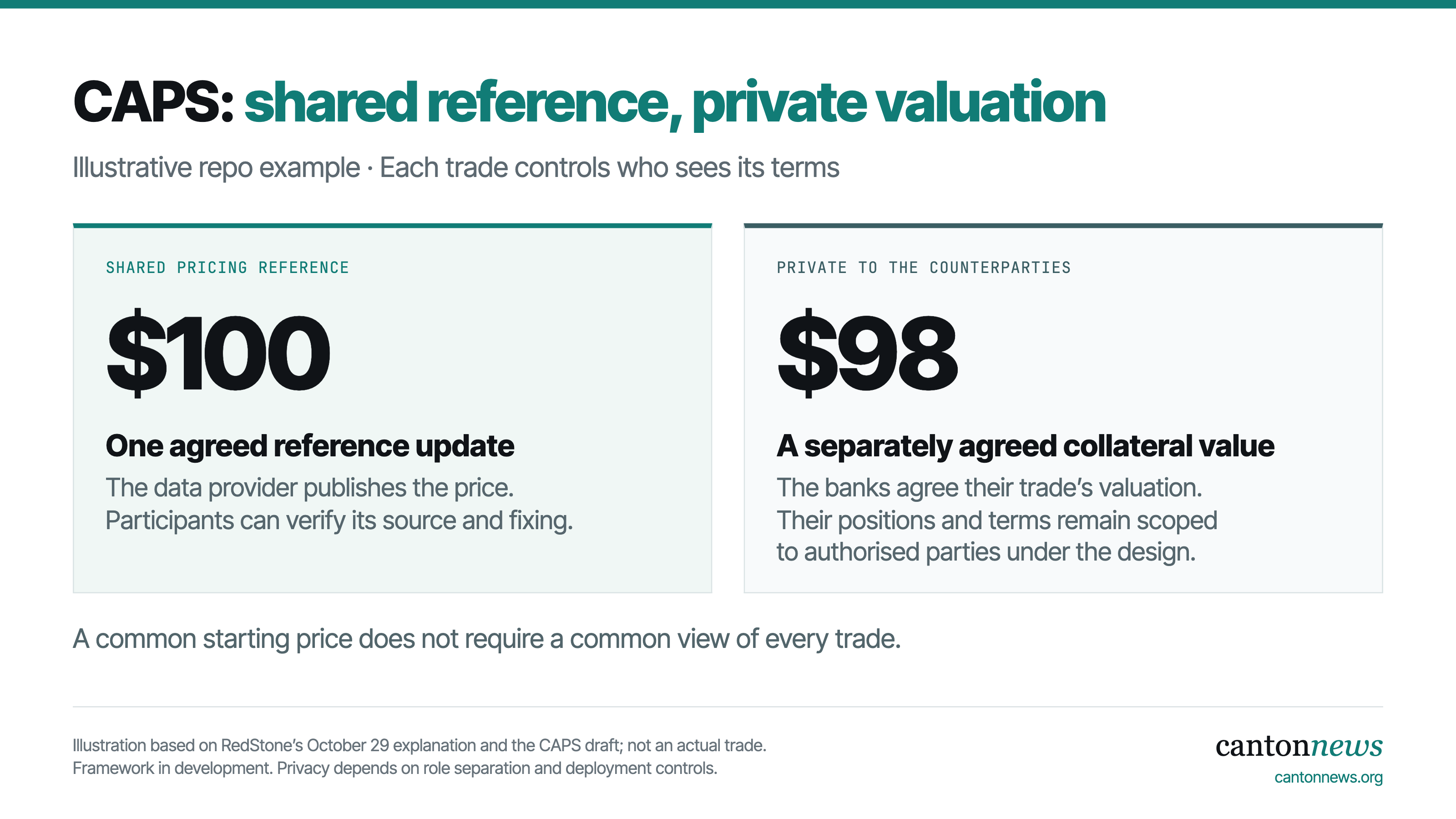 An illustrative repo valuation from RedStone’s explanation, not a reported transaction. The CAPS draft defines disclosure and role-separation rules; production privacy depends on following them.
How the grant is paid
The approved funding proposal divides the work into eight milestones. Half of the budget is tied to engineering delivery, and half to demonstrated adoption.
Its funding baseline is approximately $1.83 million, calculated using a reference rate of $0.116 per CC. The proposal calls for recalculating milestone disbursements using the seven-day time-weighted average CC price immediately before acceptance, preserving the milestone’s baseline fiat value. The number of CC released can therefore change with that calculation.
The adoption tests are concrete. One month-six target requires at least 20 active Zenith MainNet price feeds and 10,000 successful updates over 30 consecutive days. A month-eight target requires at least $1 million of liquidity bridged through Memora, with at least 100 distinct bridging events relying on CAPS.
Later milestones include $1 million in monthly trading volume dependent on CAPS and final acceptance covering an external security audit, remediation and evidence of institutional use. These are conditions for future milestone acceptance, rather than usage figures already achieved.
That structure follows the Development Fund’s wider emphasis on reusable tools and verified adoption. Grant approval establishes support for the work; milestone acceptance determines payment.
Built for more than one data provider
RedStone says Zenith and Memora are the first design partners, with both integrations in development. Zenith would use CAPS for application pricing. Memora plans to use it for proof-of-reserves information supporting its bridge. These are planned uses, rather than announcements that CAPS is running in production.
The framework is intended to be available under the Apache 2.0 open-source licence. Its public reference implementation builds on the Canton Data Standard and includes interfaces for different oracle providers to supply and verify data.
The licensing component would also let premium data owners retain commercial access and redistribution terms. Open-source software can therefore support feeds whose underlying data remains licensed.
RedStone already has pricing relationships in the ecosystem. In June, Noves announced an integration of RedStone feeds for stablecoins and tokenized funds. An August Temple Digital Group announcement described RedStone pricing for its gold and silver markets. Those earlier integrations provide context for the data business; they do not establish deployment of CAPS.
What still needs to happen
RedStone opened the CAPS standards proposal on October 26. It remains a draft under the temporary alias cip-redstone-caps, pending an assigned CIP number. Funding approval and approval of the standard are separate decisions.
The grant’s first milestone includes acceptance of the formal CIP, alongside a published specification and a demonstration of scoped data access. Later evidence must show working integrations, sustained price updates and adoption that meets the agreed thresholds.
For Canton applications, the intended benefit is a common way to verify and use pricing data across several providers while preserving each workflow’s disclosure boundaries. The standards review, accepted milestones and production evidence will show how far that shared framework has progressed.