
The CIP-0104 amendment was approved on October 27, 2026. The traffic-based reward switch remains subject to implementation and a further go-live decision. Source: approved CIP. Graphic: CantonNews; Canton logo belongs to its owner.
Canton’s Super Validator node owners have approved the CIP-0104 amendment on traffic-based app rewards. The October 27 approval notice records nine votes in favour and four non-votes. The decision advances a new way to measure eligible app activity, but it does not switch the network’s reward calculation today.
A Canton Improvement Proposal, or CIP, sets out a change to the network. This amendment would replace activity markers that apps create to record reward-eligible use with measurements of the traffic their transactions generate. Its plan targets a December 2026 dry run and a February 2027 production switch, with a further Tokenomics Committee go-live decision required.
What would count towards app rewards?
Here, traffic means the data used to coordinate transactions, not the dollar value of assets transferred or a simple count of transactions. The approved design would measure that traffic through the Global Synchronizer, Canton’s shared transaction-coordination infrastructure.
Today’s markers require app builders to insert records in the right places. The new mechanism would derive activity from network records for successful transactions and attribute it to eligible apps:
- When a user submits a transaction: traffic is divided among the qualifying apps required to confirm it, according to the size of the transaction data associated with them.
- When a Featured App submits it: app activity is attributed to that submitting app. A qualifying asset-moving app can also generate additional activity credit for Featured Assets involved in the transaction.
Featured status is a governance designation, rather than a label any app or token can assign itself. The amendment aligns the calculation with Featured App Guidance 2.0b, which distinguishes basic apps, asset-moving apps and Featured Assets.
What the $0.79 cap means
The amendment sets an app reward cap of $0.79 for each $1 of attributed burn. Burn is Canton Coin (CC) destroyed to pay for network traffic. Rewards are an allowance to mint CC, not a cash rebate on the value of a trade.
Illustrative example: if $100 of qualifying burn were attributed to an app’s activity, the cap would allow at most $79 worth of CC for that app-activity component. It would not guarantee $79: the amount available for the reward round and the reward rules could reduce it.
The calculation allocates rewards to Featured Apps first. Featured Assets can receive rewards from the allowance left over. Their activity is calculated separately, so the $0.79 figure should not be read as a single combined ceiling on every app and asset reward associated with a transaction.
Approval and activation are separate steps
The previous roundup reported the opening of this vote. October 27’s result is approval of the amendment; CIP-0104 itself was originally approved in February 2026.
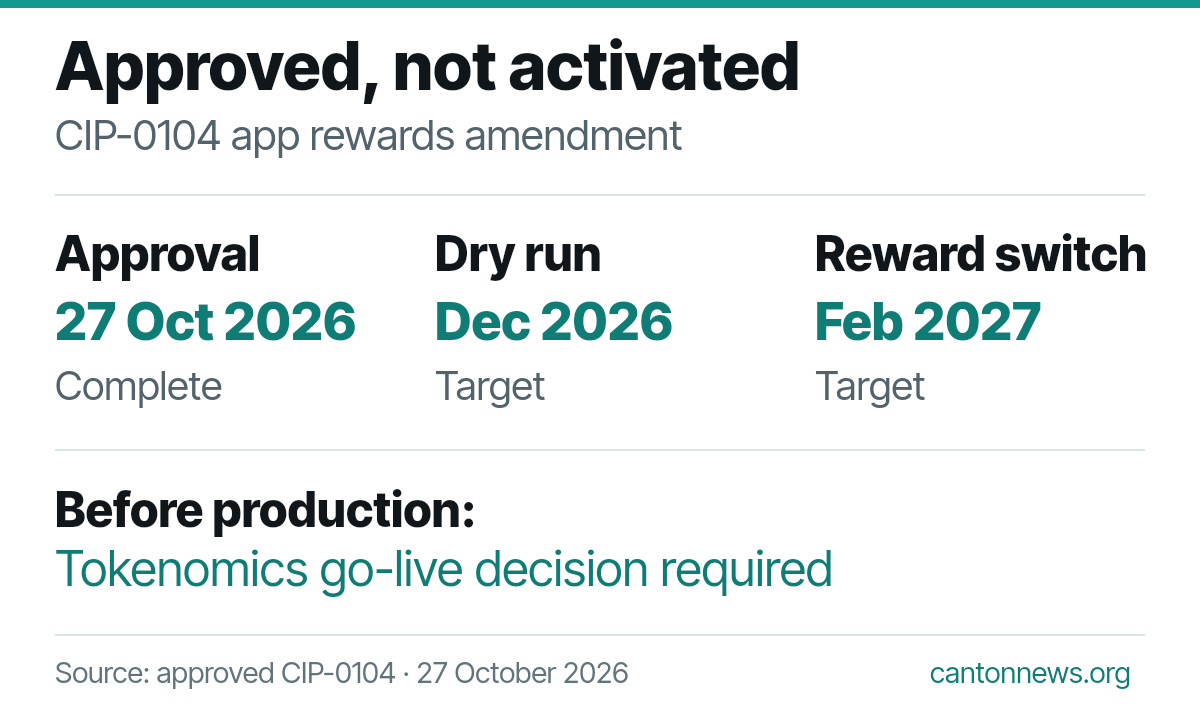
The approved CIP-0104 rollout plan separates amendment approval from activation. December 2026 and February 2027 are targets, and production requires a further Tokenomics Committee decision. Graphic: CantonNews.
- December 2026 target — preview the results: enable dry-run calculations, configure Featured App metadata and make traffic-based activity records visible through Scan, the network’s data interface.
- After reviewing the preview — decide whether to go live: the Tokenomics Committee makes the final decision.
- February 2027 target — switch reward calculation: production activation remains contingent on that approval.
For app operators, the next useful milestone is seeing the dry-run records and how the new calculation attributes their activity before it determines actual rewards. The approval notice does not establish that those records or the production reward switch are already available.
Primary sources: the CIP-0104 amendment approval notice and the approved proposal and rollout plan. Reporting cutoff: October 28, 2026 at 03:20 UTC.