
Featured App Guidance 2.0b was approved on October 22, 2026. The proposed cap and traffic-based rewards have separate activation steps.
Canton’s Tokenomics Committee has approved Featured App Guidance 2.0b, setting new qualification and reward rules for applications and assets on the network. The guidance was approved on October 22. Its rules for activity markers, the records apps submit to claim rewards, take effect two weeks later.
The change separates the basic reward for running an application from the extra weight available when qualifying apps move Featured Assets. It also tightens the rules against paying users to manufacture activity. A proposed $0.79 app rewards cap and the later switch to traffic-based rewards have separate approval and implementation steps.
Three categories, different requirements
The approved guidance defines three categories. A Basic Featured App needs a 5 million Canton Coin lock, an application to the Foundation and separate Canton identities, known as parties, for earning rewards and generating the app’s network fees. While markers remain in use, the Foundation and accountability committee will also check that the app is real and live.
Asset-Moving Featured Apps, including qualifying wallets, trading venues and bridges, face additional scrutiny. The criteria include security audits, checks by independent validators, readiness for users and connections with other apps and assets. Applications are assessed case by case; some criteria may not apply to every business.
Featured Assets normally require a 25 million CC lock for each asset’s Featured App party. A protocol that wraps or bridges several assets does not automatically give every asset it issues featured status through one lock. Exceptions need approval and may carry reduced reward weights.
The lock amounts build on the Featured App locking requirements approved under CIP-0116. Existing apps generally transition into the basic category; those already granted delivery-versus-payment treatment, for exchanges where the asset and payment move together, enter the asset-moving category. Temple’s earlier DvP approval is an example of that existing designation.
What reward weight means
Reward weight helps determine an app or asset’s share of the reward pool. The baseline is 1.0 unit for each $1 of eligible burn generated by an app’s operational party or validator. Burn means CC destroyed to pay network fees. Qualifying activity that moves one Featured Asset can add 0.10 for that asset. With two or more Featured Assets, the additional asset weight totals 0.20 per $1 of burn before any approved reductions.
For a simple illustration, assume an eligible transaction in an Asset-Moving Featured App generates $10 of burn and moves one non-CC Featured Asset, with both the app and asset receiving their full weights. The app receives 10 units of weight and the asset receives 1, for a combined 11.
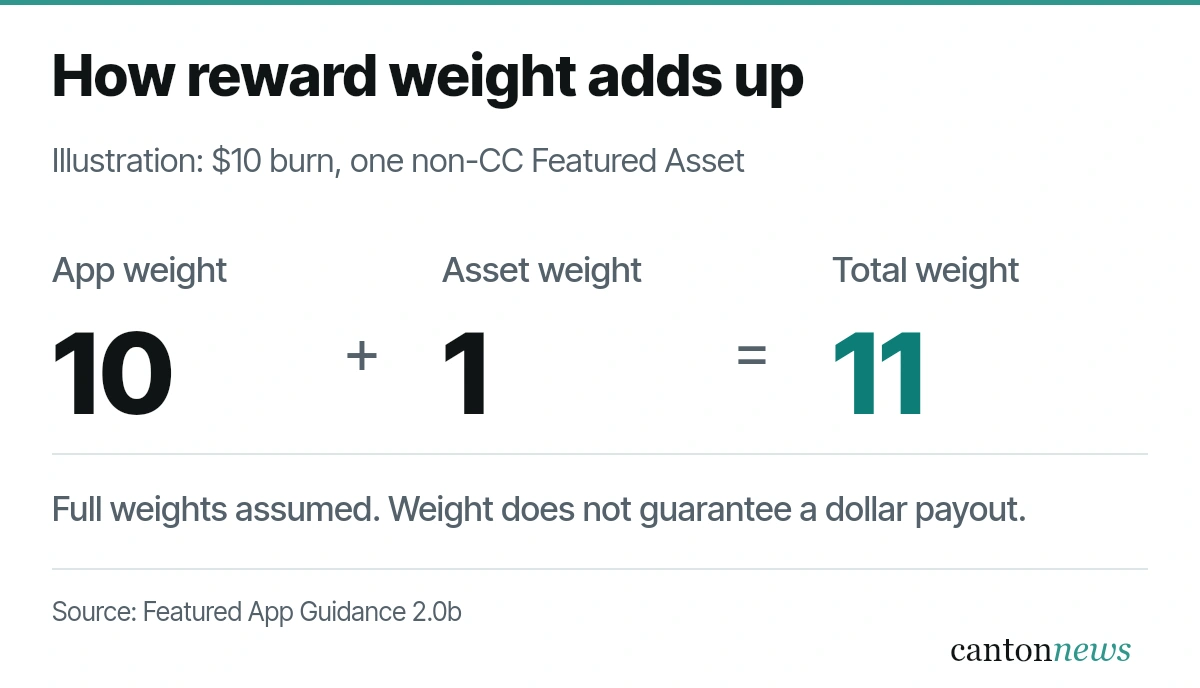
Illustrative calculation under Guidance 2.0b, assuming eligible activity, one non-CC Featured Asset and full weights. Reward weight does not guarantee a dollar payout.
Those 11 units are an input to allocating rewards, not a promise of $11 income. Actual rewards depend on the available pool, competing reward weights and the applicable cap. Canton Coin itself has separate asset-weight treatment, so the example should not be applied unchanged to CC movements.
The rules also address how activity is generated. Apps may reduce fees or offset legitimate costs, but they cannot ordinarily pay users more than their costs to create transactions. Any campaign that pays users more than they spend requires case-by-case coordination with the accountability committee. Marker claims must follow the associated burn or traffic use within two reward rounds. Artificial or inflated activity can trigger a pause without warning.
When the changes take effect
The marker rules are the near-term change. The guidance says Super Validator voting on the proposed $0.79 cap per unit of app reward weight will be scheduled to align with them. Committee approval of the document does not itself activate that cap.
The open amendment to CIP-0104 proposes a December 2026 dry run, allowing traffic-based activity records to be inspected on Scan, followed by a February 2027 production switch contingent on Tokenomics approval. A preview would show the new calculation before it determines actual rewards.
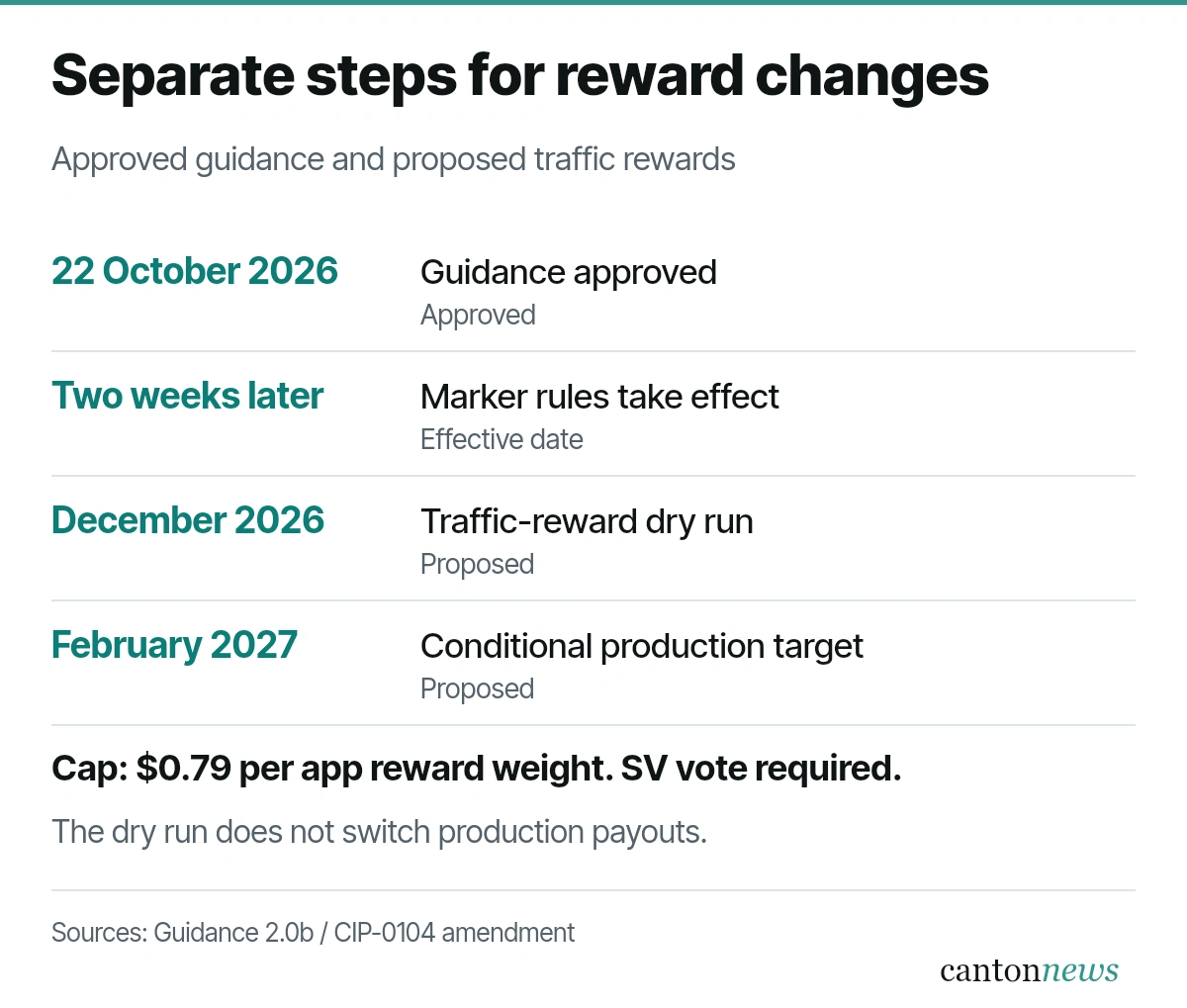
The approved guidance and the proposed CIP-0104 rollout have separate gates. December 2026 and February 2027 are proposed targets, with production subject to further approval. Status at October 23, 2026, 15:04 UTC.
Canton had already enabled supporting CIP-0104 models and Featured App weight voting in August. That infrastructure step did not replace marker-based reward calculation.
Under the proposed traffic-based model, application rewards would be allocated first, with Featured Assets receiving rewards from the remaining pool.
For wallet operators, the eventual switch also changes which activity earns rewards. Under markers, a wallet can claim app weight for user-submitted transactions. Under traffic-based rewards, merely handling those submissions will no longer earn the wallet app rewards. Work performed by the wallet’s own operational party, such as renewing preapprovals or merging coin holdings, can still qualify. Operators will need to distinguish that work from transactions submitted by users when estimating future rewards.
Sources: Tokenomics approval notice, Featured App Guidance 2.0b and the CIP-0104 amendment.