
The planned sandbox uses test tokens to examine bond settlement and short-term financing alongside digital money.
Progmat is preparing a Canton-based test environment for Japanese government bonds, tokenized bank deposits and stablecoins. The work moves a 69-organisation industry study toward practical tests of how bonds and money could move together.
The announcement, published October 21 at 23:30 UTC, sets out the next phase for a working group run through Progmat’s Digital Asset Co-Creation Consortium. Established in May, the group brings together banks, asset managers, securities firms and other organisations examining bond tokenization and repo financing.
A November 2026 kickoff is the target, subject to connections being ready. A further interim report is planned for spring 2027. The sandbox will use test tokens, rather than introduce publicly tradable government bonds or a new retail investment product.
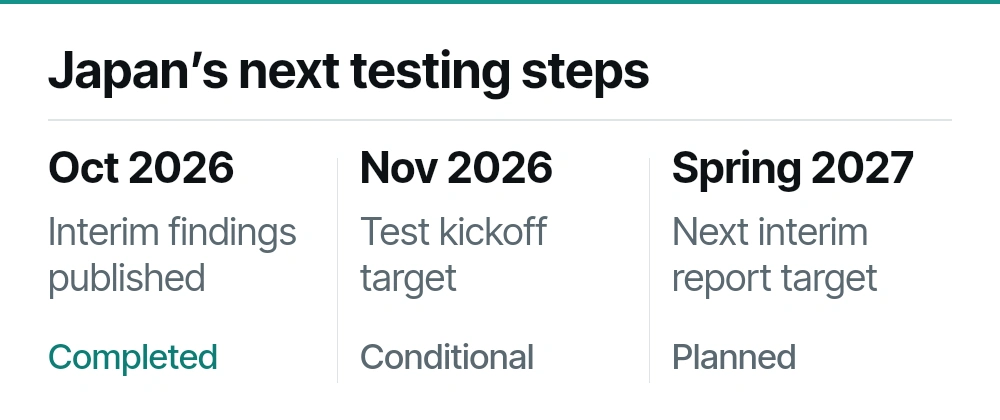 The planned timetable distinguishes completed findings from future targets. The November kickoff depends on connection preparations.
Testing the bond and the payment together
A repo is a short-term financing arrangement: one party sells securities and agrees to buy them back later. For the party providing cash, the securities serve as collateral. Japanese government bonds, often shortened to JGBs, are widely used for these transactions.
The planned tests pair tokenized bonds with digital money so that the securities and payment can change hands together. They will also examine the work around settlement, including checking trade details and managing collateral.
Consider an institution that needs funding for a few hours rather than overnight. Moving the bond and cash is only part of the job. The parties must also track when the arrangement starts and ends, how much interest is due and when the collateral returns. The working group wants to test that repeated process, not simply show that a token can be transferred.
Cross-border financing and transactions outside Japanese business hours are also among the areas identified for testing.
Keeping the bonds’ legal status intact
The proposed design keeps existing JGBs as book-entry bonds, meaning ownership is recorded electronically in accounts. It would change how those records are managed, using accounts synchronised with the blockchain, rather than replace the bonds with a different financial claim.
The initial focus is repo deals agreed directly between two parties rather than handled by a central clearing house. Existing trading channels and master agreements would remain, with an additional digital-asset annex. The change concentrates on what happens after a trade is agreed.
That approach could make adoption less disruptive: institutions would be testing new settlement tools around familiar contracts and market roles. Compatibility with Bank of Japan rules and operating arrangements still needs to be confirmed before practical deployment.
How this fits Japan’s earlier Canton work
The MUFG, Digital Asset and Progmat repo pilot announced in August set out to explore similar questions: keeping JGBs legally intact while coordinating them with digital money. Its design also proposed automating the wider repo process through Secured Finance’s lending protocol.
The new phase opens participation beyond the original 69-organisation working group. Progmat plans to connect the sandbox to multiple domestic and international repo and collateral platforms.
Participants will need to agree to the sandbox’s terms, including costs. They can then test the linked platforms’ actual screens and processes before deciding how the tools might fit their own trading and custody arrangements.
Further reading: Progmat’s release and detailed interim findings, and the August JGB repo proof-of-concept announcement.