
Temple Digital Group has opened cash RFQ trading for institutional clients on Canton, letting selected dealers compete to quote for a transaction.
RFQ means request for quote. Instead of placing an order into an order book, a participant asks selected dealers for a price on a particular trade. Temple combines that process with settlement on Canton.
Cash is the first of three markets in the wider offering. In its product announcement, shared on October 21, Temple says fixed-income and repo access will follow as the required assets and counterparties become available. Access is through Temple’s contact process and approved counterparties, not an unrestricted retail trading screen.
A price for the trade you want to make
A firm using Temple RFQ specifies the asset, size and settlement terms. Dealers return firm quotes, meaning prices they are prepared to trade at rather than rough indications. The participant can compare those responses before executing.
For a large trade, the distinction is useful. An order book shows available bids and offers. An RFQ asks a set of counterparties what they would pay or charge for the requested size. Competition takes place within that selected group, not across every possible buyer or seller.
Once agreed, the asset and payment move together through atomic settlement. Both transfers complete, or neither does. That addresses the risk of delivering one side without receiving the other; it does not protect either party from a change in the asset’s value.
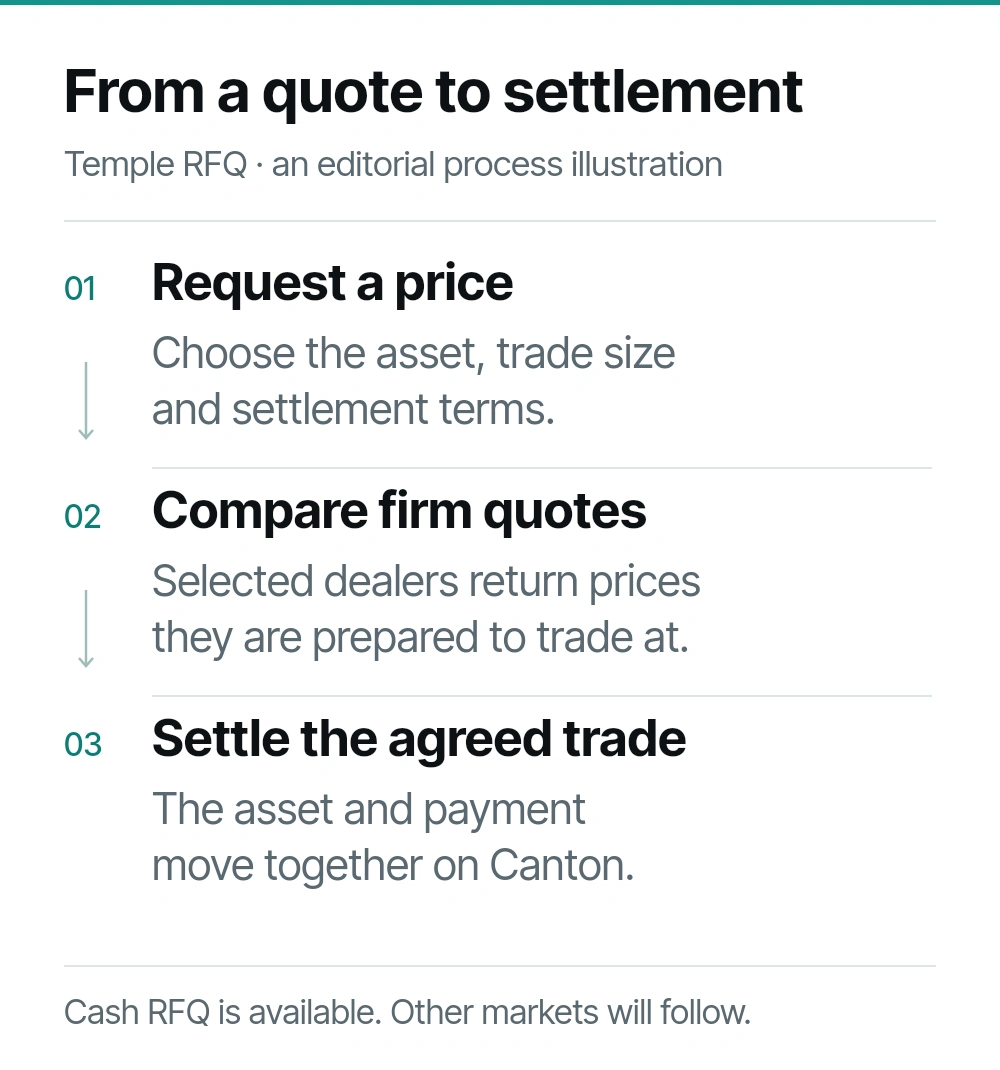 Illustration of the process described in Temple’s RFQ overview, checked October 21, 2026. Cash RFQ is available; fixed-income and repo access will follow. Not a product screenshot.
Buying an asset or financing one
The plan covers three different needs.
Cash trading means buying or selling an asset outright. Temple’s cash-market offering covers digital assets, tokenized commodities and equities. Assets remain in the participant’s custody, or with its qualified custodian, until the trade is filled.
Fixed income is planned around instruments such as tokenized US Treasuries. Dealers would quote by yield, the return implied by the bond’s price, or by its difference from a benchmark yield. Interest accrued since the last payment would be accounted for in the transaction.
Repo provides financing through a sale with an agreement to repurchase the security. Temple’s planned repo market would let counterparties agree the rate, duration and collateral terms, from borrowing within a day to longer arrangements.
Consider a firm that holds a Treasury but needs cash temporarily. An outright sale disposes of the position. A repo raises cash with a repurchase already agreed. The financing cost and amount of collateral required still determine whether that arrangement is attractive.
Building on an earlier Treasury transaction
Temple’s RFQ infrastructure already has a Canton precedent. In July, it arranged a tokenized US Treasury repo using the DTCC Tokenization Service.
Temple’s account of that transaction identifies DRW and HIFI as the trading counterparties, with Marex acting as prime broker and settlement agent. A tokenized Treasury was financed against USDCx, while the underlying security remained within DTC’s existing ownership-record system.
That completed trade shows an earlier use of the infrastructure, not general access to the new repo market. Cash RFQ’s release expands Temple’s trading services, rather than marking its first use of RFQ.
For Canton, the potential value of the wider offering is the combination of trading and financing. An institution could do more than buy an asset: it could also find a price to sell it or raise cash against it. Bringing the remaining markets into service, with willing dealers and acceptable terms, is what would make that choice useful in practice.