
Kaiko has joined the UK’s Wholesale Digital Markets Champion taskforce, bringing market-data tools to work on secondary markets, where investors trade assets after they have been issued.
The October 19 announcement adds a data specialist to a programme already involving banks, asset managers and trading firms. Kaiko’s role concerns the information those markets need to function: reliable prices for decisions, and usable records of what has traded.
Where Kaiko fits
The programme is led by HM Treasury’s Wholesale Digital Markets Champion, Chris Woolard, with the City of London Corporation providing support. Its July roadmap sets out practical work on tokenized trading, collateral and payments, including an end-to-end repo transaction. Repo is short-term borrowing secured against securities.
Digital Asset / Canton was among the 54 firms named in July. The current action-group roster places it in Collateral & Prudential Standards. Kaiko joins the separate Secondary group, which addresses liquidity, connections between platforms and cross-border trading tests.
The UK programme brings together firms working across different networks and market systems.
Data needs to move both ways
Kaiko will provide access to two services. Data On-Ramp brings licensed prices and reference information into blockchain-based financial applications. Data Off-Ramp turns blockchain activity into standardized information for valuation, risk management and reporting.
Consider a bank assessing a tokenized bond as collateral. It needs a usable price to decide how much it can lend against that bond. After a trade, its risk team also needs records it can interpret. Recording the bond’s transfer addresses neither question on its own. Pricing inputs and understandable transaction records serve different jobs.
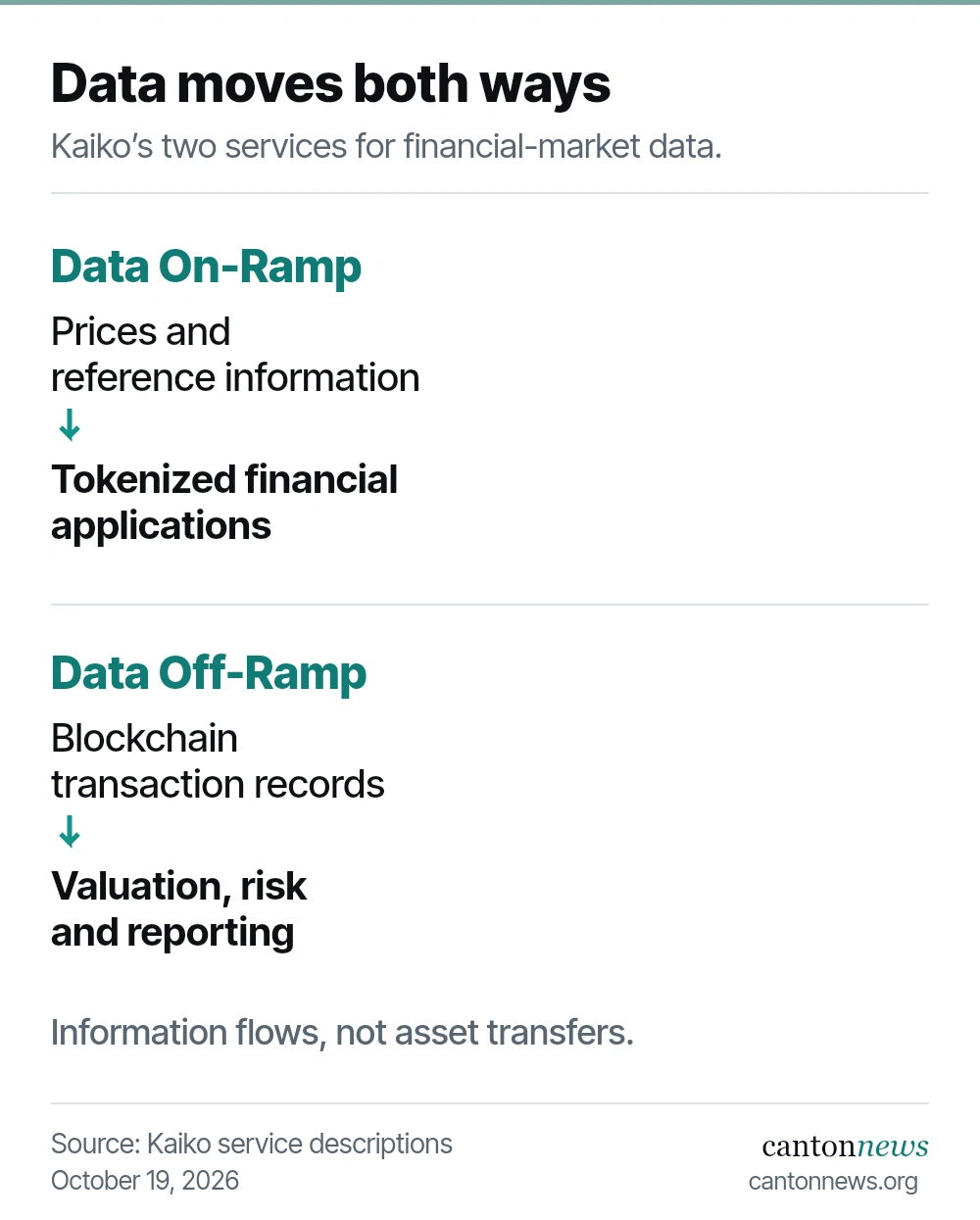 Editorial explanation of the two data services described in Kaiko’s October 19, 2026 announcement. The arrows represent information, not asset transfers.
The potential benefit is less manual work translating between trading systems and the records that banks already use. Better information can help participants judge prices, but liquidity still depends on willing buyers, sellers and available capital.
Kaiko’s work on Canton
Kaiko already participates in the Canton Foundation’s Collateral Sub-Committee. That separate work examines how clearing houses and other financial-market operators can accept tokenized assets as collateral.
DRW and Marex executed a total return swap on Canton through Derivnex, announced on October 13. This type of contract tracks an asset or index’s return without requiring ownership of the underlying securities. Here, it references S&P Dow Jones Indices’ iBoxx USD Liquid Investment Grade Index, which Kaiko tokenized on the network.
Kaiko also delivers the official, signed index values used to value that position. The transaction announcement describes a shared trade record alongside controls that preserve the benchmark owner’s data-licensing rights. The October 13 announcement described connecting cash and collateral movements to that record as future functionality.
Shared pricing and reporting standards could make it easier for a Canton application to work with institutions using different systems. Kaiko’s existing deployments already span Canton, Stellar and Ethereum-compatible networks.
Source: Kaiko’s October 19 announcement.