
BitSafe has launched BETH on Canton, with BETH–USDCx trading live on Temple from October 19. The market gives approved participants a way to exchange an ETH-backed token for dollar-linked USDCx within Canton.
BETH is a wrapped asset: a token on Canton representing ETH held on Ethereum. BitSafe’s design links each BETH to one ETH in its bridge contract. Canton records the token’s ownership and transfers, while the backing ETH remains in the Ethereum bridge until redemption.
Trading and minting are different routes
To trade the new pair, users need an account with Temple Digital Group and must complete its onboarding. The launch announcement lists wallet support from Bron, Console, Send and Loop.
Creating BETH directly from ETH is a separate process. Participants must complete BitSafe’s onboarding and obtain permission to mint and redeem. An eligible Ethereum deposit is verified before BETH is issued on Canton. Redemption reverses that process: BETH is burned, then ETH is released to the participant’s Ethereum destination.
Buying on Temple therefore does not require a buyer to create new BETH for each trade. It changes who holds existing tokens. Direct minting and redemption connect the Canton asset with its Ethereum backing.
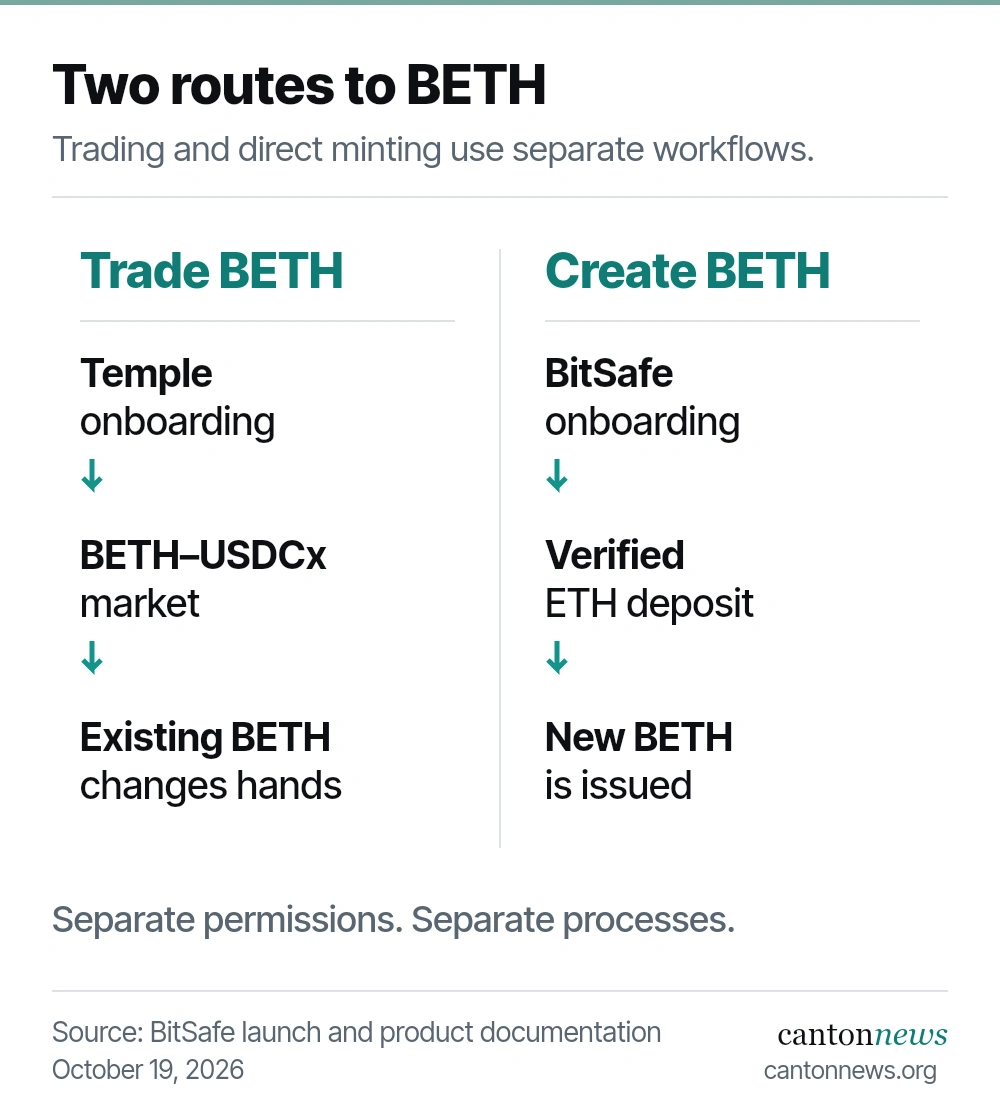 Trading and direct minting are separate workflows. Eligibility depends on the relevant provider’s approval. Based on BitSafe’s October 19 launch details and product documentation.
What sits behind the token
BETH extends the operating model used by BitSafe’s Bitcoin-backed CBTC. Independent operators verify deposits and participate in approvals. No single operator is sufficient to authorise issuance or move the backing assets alone.
Redemption still depends on sufficient operator approvals and Ethereum processing. The bridge can also be paused under its administrative controls.
The two tokens are separate products, with their own contracts, credentials and governance. CBTC represents Bitcoin; BETH represents ETH. Reusing infrastructure does not make their reserves interchangeable.
BETH’s current design does not stake the reserve ETH or automatically pay staking rewards. It represents native ETH, not a staking token such as stETH. That distinction matters for anyone comparing ETH products: holding BETH is not, by itself, a way to earn Ethereum staking income.
Canton restricts who can see BETH holdings and transfers. The related Ethereum deposits, bridge balances and redemptions remain public.
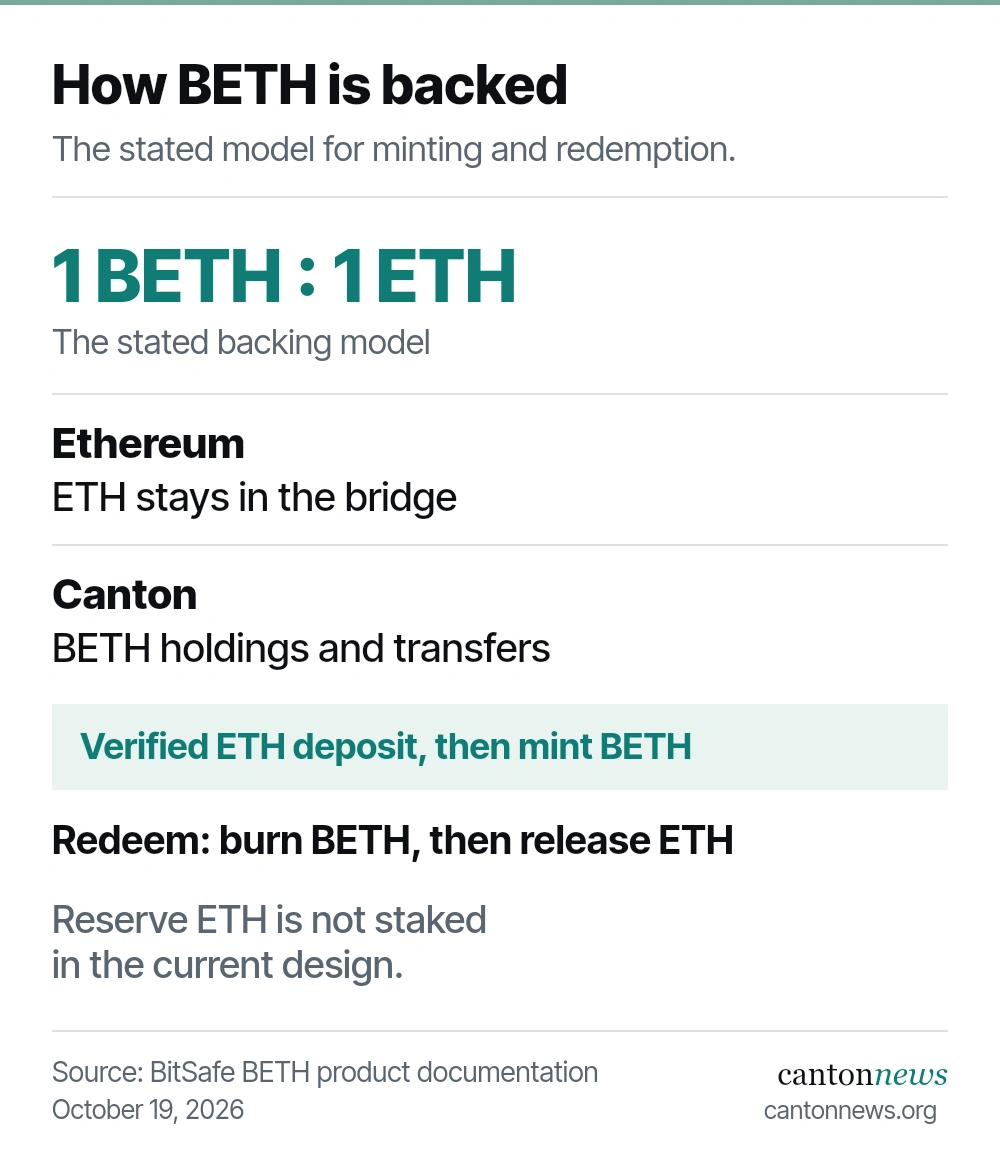 A simplified diagram of BitSafe’s published operating model, not an independent reserve audit. BETH transfers within Canton do not move the backing ETH each time.
A new market, not Canton’s first ETH asset
BETH was among the eight applications that cleared Tokenomics review on October 2, before Five North opened its Featured App vote on October 7. The October 19 announcement concerns the product launch and trading availability, a separate milestone from that governance process.
Canton already has another ETH representation, onRails’ cETH, which reached Swap Monster in September. BETH and cETH are different tokens, even though both are designed to represent ETH one-for-one. Users need to check which asset their chosen venue and wallet support.
The practical addition is another trading route for ETH exposure on Canton, this time through BitSafe’s infrastructure and Temple’s market. Its usefulness will depend on available buyers and sellers, pricing and access. More supported assets can give traders greater choice; a listing alone does not establish how much liquidity is available for a particular order.
Read BitSafe’s BETH launch announcement and the minting and redemption documentation.