
Canton Foundation is broadening its work in Taiwan, with training and local financial-sector cooperation at the centre of its plans.
At an October 21 press conference in Taipei, the Foundation outlined cooperation with the Taiwan Digital Assets and Future Capital Markets Association, the Institute for Information Industry, the Taiwan Financial Services Roundtable and the Taiwan Blockchain Association. CryptoCity’s on-site reporting identifies three priorities: developing talent, connecting tokenized Taiwanese assets with global markets, and contributing to cross-border standards.
The work includes a memorandum of understanding with the Institute for Information Industry’s FinTech Center, described by Wealth Magazine as a basis for training and practical digital-finance work. The announcement sets out cooperation plans, not a new asset offering.
Starting with the people who run financial services
Professor Ming-Hua Hsieh, speaking for the Taiwan Digital Assets and Future Capital Markets Association, said the cooperation would begin with courses for graduating students and internal training for financial institutions.
The planned education extends beyond software developers. Wealth’s account describes workshops and exchanges bringing together people from finance, technology, compliance, accounting and risk management.
That breadth matters. Turning a financial asset into a token is only part of the work. Someone still has to decide who may hold it, what a transfer means and how the transaction appears in the institution’s records. Training those teams together could help them design a service they can all support, rather than leaving the decisions until after software has been built.
Thomas Chou, the Foundation’s APAC lead, encouraged institutions to start with their own workflows and counterparties. Becoming a validator, he said, need not be the starting point.
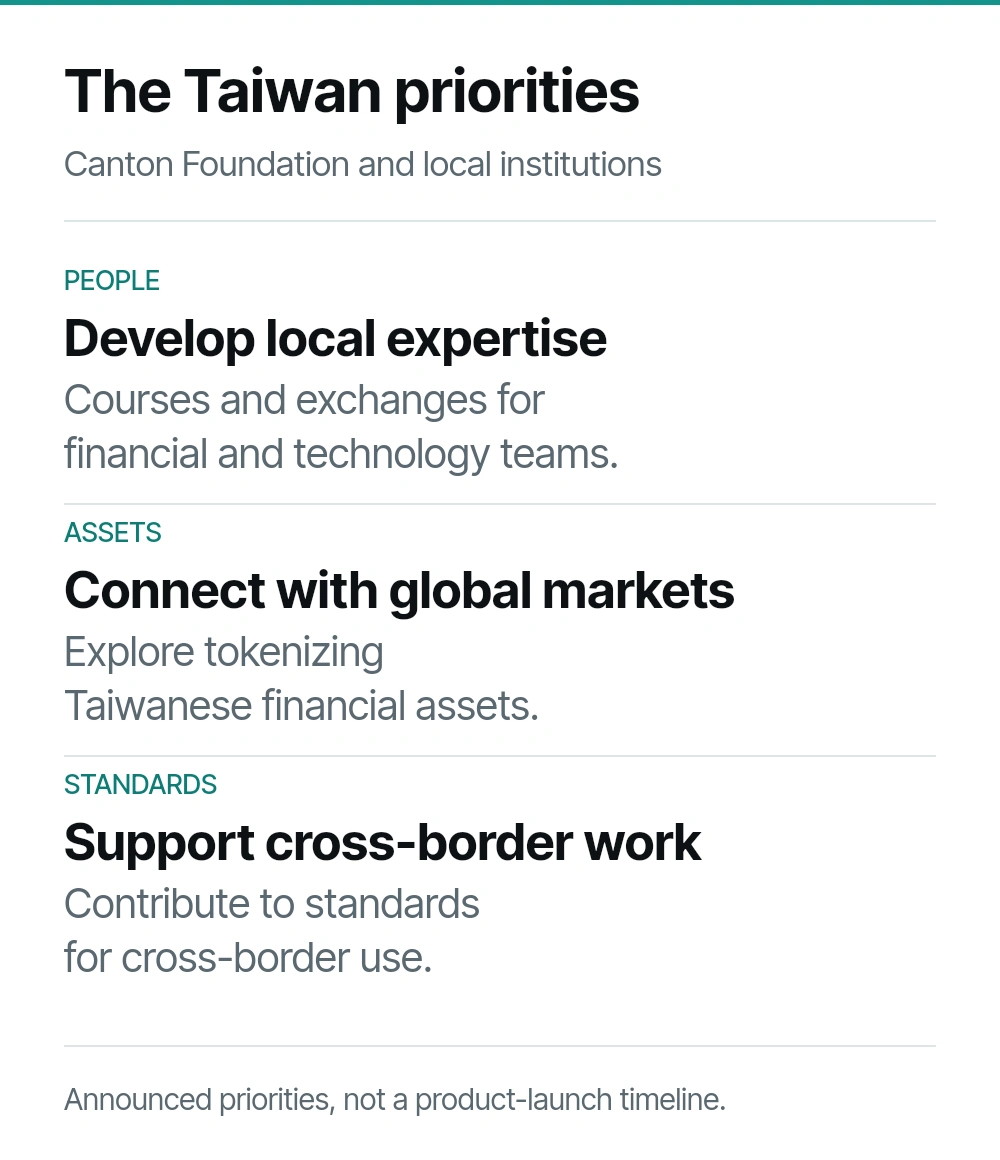 Announced priorities, not a product-launch timeline. Based on October 21 reporting from Taipei.
Building on an existing Taiwan connection
Taiwanese participation in Canton predates this announcement. Taishin Bank appeared among the validator operators welcomed in June. A validator is an institution’s connection to Canton applications, processing the transactions in which it participates.
Running a validator gives an organisation a technical connection. Bringing industry bodies and educators together can help a wider group learn what to do with it. The earlier Taishin announcement and the new training effort therefore represent different forms of participation, rather than a first arrival of Canton in Taiwan.
There is a regional parallel in Meritz Securities’ October agreement with the Foundation. That separate Korean initiative explores domestic asset tokenization and cross-border uses.
What the work could add to Canton
Canton lets applications set their own access and data-sharing rules while connecting with other applications. That is relevant to institutions that need to transact with one another without exposing all their customer or trading information.
For example, a hypothetical tokenized fund would need rules for eligible buyers and ownership transfers, as well as a way to exchange its units for payment. Canton can provide the shared transaction infrastructure. The fund’s operators must still decide the product’s terms and meet the rules that apply to it.
The useful outcome would be local teams able to build and operate such services. Training is an early step toward that, while work on cross-border standards could make future connections easier to agree. For Canton, the potential gain is a wider pool of institutions that can develop applications suited to their own markets and counterparties.