
T-RIZE’s completed integration supports asset transfers between Canton and supported Ethereum-compatible networks, subject to each instrument’s controls.
T-RIZE has integrated Chainlink’s Cross-Chain Interoperability Protocol, or CCIP, into its Canton infrastructure. The completed integration supports tokenized asset transfers in both directions between Canton and supported Ethereum-compatible networks.
T-RIZE is a Canadian company building infrastructure for digital investment products. Its work covers how an investment is structured, who can hold it and how it is managed after issuance. The new connection extends that work to transfers between networks.
What the connection enables
The integration was completed in technical collaboration with Chainlink. Assets arriving from supported networks can enter Canton workflows for collateral and settlement. Instruments issued on Canton can also reach approved applications on those networks. Collateral means assets pledged to support an obligation, such as a loan.
CCIP connects applications across blockchains by carrying messages that can instruct them to transfer tokens. It can also combine a transfer with instructions for the receiving application. Chainlink provides the messaging infrastructure; it does not take custody of the underlying assets.
A token’s destination does not remove the conditions attached to it. T-RIZE structures transfers around each instrument’s ownership rights, investor permissions, custody arrangements and ongoing obligations. The receiving application must meet those requirements too. Access remains limited to eligible assets and supported applications.
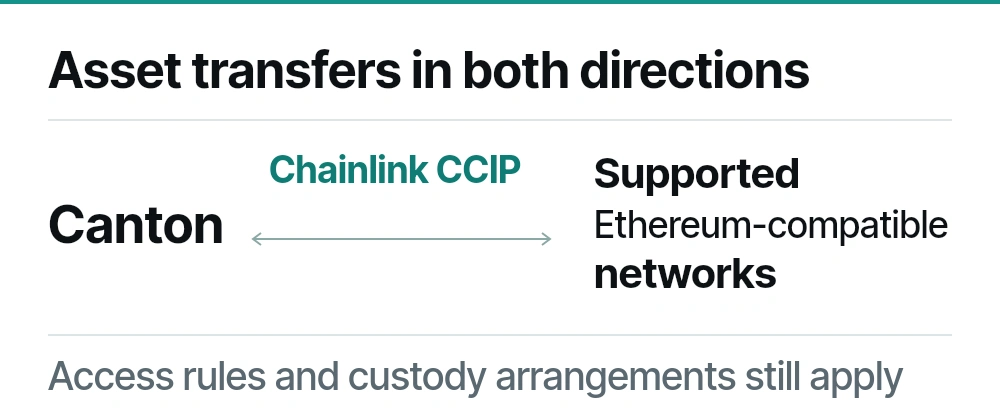 Editorial illustration of T-RIZE’s announced connection. Transfers remain subject to each asset’s requirements and the receiving application’s rules.
From verifying information to moving assets
The new integration builds on an existing relationship. In June, T-RIZE adopted Chainlink for proof of insurance on Canton. That work gave authorized participants a way to check the digital record of insurance coverage associated with a tokenized private-credit investment.
The insurance framework starts with records supplied by the insurance provider. Chainlink publishes verifiable reports that let participants check whether their coverage record is included without revealing sensitive information. It addresses the evidence supporting an investment, rather than the movement of the investment itself.
T-RIZE is now adding asset-transfer capability alongside that work on verifiable investment data. The underlying network connection predates this integration: Chainlink’s July 14 release added Canton support to CCIP, initially connecting it with Ethereum.
Why this could matter for Canton
The practical opportunity is a wider choice of where an eligible asset can be used. An issuer choosing Canton does not necessarily want to limit an instrument to applications on that network. An investor holding an asset elsewhere may want to use a Canton service without replacing the investment with something different.
As an illustration, a lender on Canton could accept an eligible asset from a supported network as security for a loan. The holder would need permission to borrow, and the lender would need to accept that asset. The connection provides a route between them; the lending decision remains separate.
For Canton, the opportunity is to make assets issued elsewhere useful within its own applications. Turning that access into a more active market still depends on issuers, investors and service providers choosing to use the connection.
Primary source: T-RIZE’s October 21 integration announcement.