
Nasdaq receives a validator allocation, Unhedged dates two new market categories, and builders seek funding or report milestone payments.
Nasdaq has been awarded a Canton MainNet validator allocation, while Unhedged plans November 1 markets on GPU rental costs and graded trading-card prices. Payvol and BitSafe are also planning payment support for CBTC and BETH.
This edition covers developments since the previous roundup was published on October 26 at 10:58 UTC, checked through October 27, 2026 at 03:48 UTC. Two earlier, uncovered app announcements are labelled as carryovers below.
Institutional access and new markets
Nasdaq receives a MainNet validator allocation
An October 26 allocation notice names Nasdaq, Inc. for one validator node on MainNet, Canton’s production network. A validator is an organisation’s connection to Canton applications, processing the transactions in which its users participate.
As with earlier allocation batches, this is an onboarding step. The notice does not establish that Nasdaq’s node is running, grant Super Validator status or announce an exchange integration.
Unhedged sets November 1 for compute and card markets
Unhedged’s AI-compute plans were previously previewed. The latest announcements set a November 1 launch date for two categories:
- GPU compute: markets about the cost of renting processors used for AI computation.
- Graded cards: three baskets of PSA 10 trading cards, each tracked as one price number, with weekly markets on where it closes.
PSA 10 is PSA’s top card-condition grade. These markets give users a way to take a view on prices. They do not involve buying GPU equipment or receiving physical cards. No precise launch hour is stated.
Payvol plans support for two BitSafe assets
Payvol announced its BitSafe partnership at 10:30 UTC on October 26; BitSafe confirmed the plans at 19:52 UTC. Payvol intends to add CBTC and BETH, BitSafe’s tokens representing bitcoin and ether respectively, to its payment requests, settlement checks and reconciliation.
Reconciliation means matching a completed payment to the request or invoice it settles. That is central to Payvol’s payment infrastructure. The collaboration is announced, with delivery timing still unspecified.
Swaps, points and tracked volume
Carryovers: the following OneSwap and Morpheus announcements preceded the previous roundup’s publication.
OneSwap adds a daily streak. The October 26 announcement says one swap worth at least $10 each day keeps the streak going. Its advertised Diamond multipliers are:
- Day 7: 1.5×.
- Day 10: 2×.
- Day 15: 3×.
The feature adds an activity incentive to OneSwap’s swap service. Diamonds are points; the announcement does not establish a cash return or guaranteed token allocation.
wCC trading is announced on Morpheus. EA Finance and Morpheus both announced trading on October 26. Morpheus describes wCC as Wrapped Canton Coin. The linked Morpheus site identifies itself as a Robinhood Chain exchange. The pool’s pair, asset backing and available liquidity were not independently verified.
Canton Venues reports $168.5 million for October 19–25
Canton Venues’ weekly dataset totals $168.5 million in spot trading across Temple, Cantex, Tradecraft and Pool Party, down 11.4% against the same venue set in the previous week. Temple accounts for 94.6% of the reported total. Spot markets exchange the assets themselves.
This is a covered-venue figure, rather than total Canton network volume. The report excludes OneSwap and perpetuals, which are price-tracking contracts. Rocky is left out because October 19 is missing. Some daily inputs are rolling 24-hour readings, so the series is not an independent reconstruction of every trade within each UTC day.
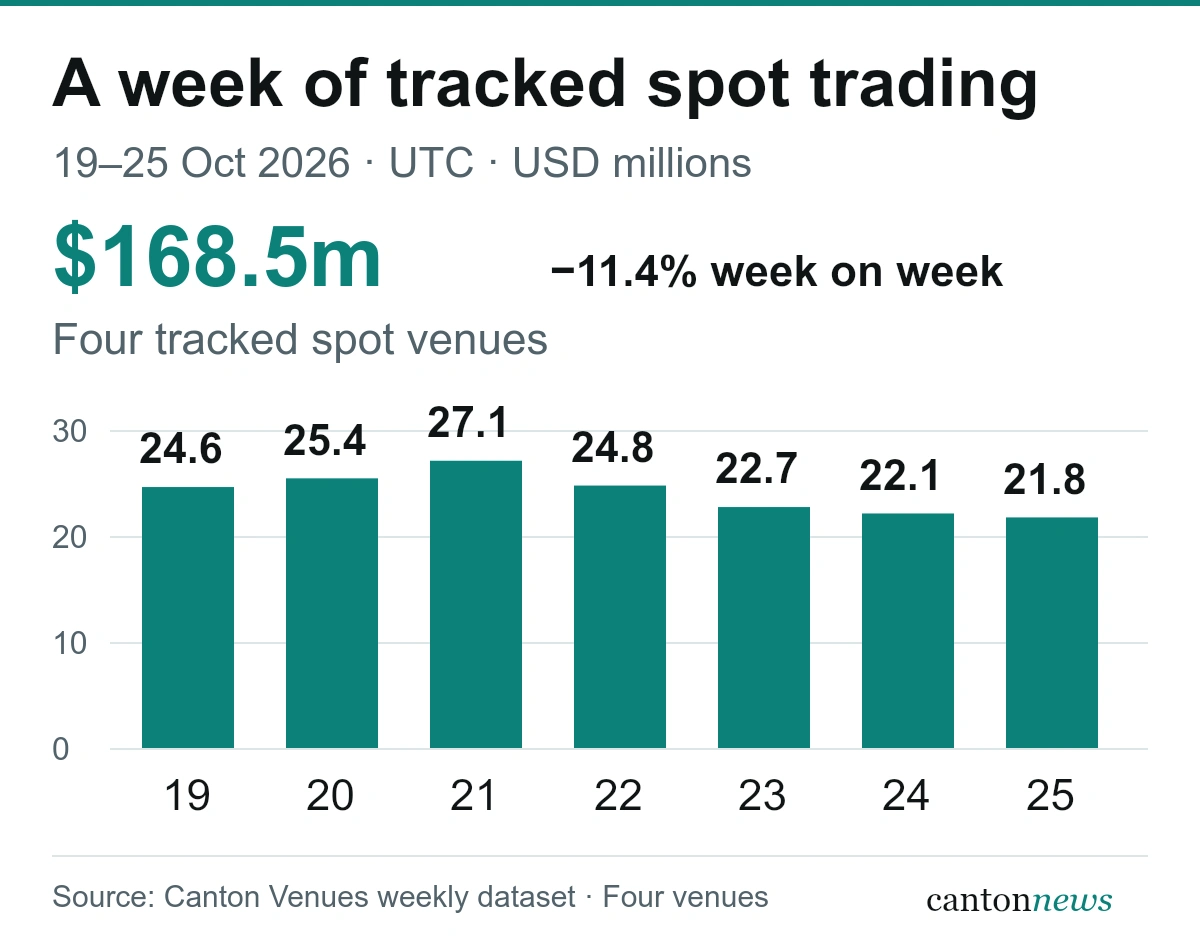
Daily figures from Canton Venues’ October 19–25 report, covering Temple, Cantex, Tradecraft and Pool Party. Some inputs are rolling 24-hour readings; this is the provider’s tracked dataset, not total Canton volume.
A separate vote on app rewards
The CIP-0104 amendment was put to a Super Validator vote on October 26. A CIP is a Canton Improvement Proposal, the network’s public process for considering changes. It would link app rewards to measured transaction traffic—the data used to coordinate transactions—in place of the activity markers apps submit.
It also proposes making validators’ standard confirmation messages free. Its current text remains marked “Proposed Amendment”; no public passage notice was found by the cutoff. The approved Featured App guidance and this amendment have separate activation steps.
Funding: a request, a vote and payment reports
Equilibrium proposes cleanup tools for node operators
Equilibrium’s October 26 proposal seeks up to 1.33 million Canton Coin (CC): 580,000 for engineering and up to 750,000 tied to adoption. Maintenance would cost a separate 60,000 CC per quarter.
Its proposed tool would inspect and deactivate leftover contract copies after a party—an identity acting on Canton—leaves a node. Copies still needed by other parties on that node would stay. Cleanup would use a maintenance window; it would not erase valid contracts across the network. Funding remains unapproved.
Obsidian’s Python proposal reaches a vote
A 21-day Tech & Ops Committee vote opened on October 27 for Obsidian Systems’ existing 1.27 million CC request. The planned tool would generate Python code for working with packages written in Daml, Canton’s contract language. That would save app developers from recreating those data types by hand.
The proposal targets delivery by month three. Its full 15-month duration also covers adoption and maintenance. The vote needs 51% of the committee’s eligible voters in favour; it had not passed by the cutoff.
Payment reports for three DPM Trace milestones
Development Fund comments on October 26 report payment for DPM Trace’s first milestone, followed by its transaction visualizer and prepared- and failed-transaction comparison work.
The specified allocations are 320,000, 320,000 and 310,000 CC respectively. The milestones’ acceptance votes closed on October 19. These are later payment reports, rather than fresh acceptance decisions; recipient claims and full on-chain receipts were not independently verified.
Two notices for node operators
DevNet software readiness. An October 26 notice says Splice 0.9.4 is ready for DevNet validators, after two-thirds of Super Validator nodes had upgraded, including the Foundation’s node. This advances the earlier DevNet schedule; it does not establish completion by every validator.
TestNet contract-model vote. A separate October 26 proposal would adopt the Daml models from release 0.9.0 on TestNet. These models contain the contract structures and rules used by applications. The notice supplies a vote tracking ID, without announcing passage. DevNet and TestNet are development and testing environments, distinct from production MainNet.
Primary sources include the validator allocation notice, Unhedged’s launch plan and the funding records linked beside each update.