
Five uses of Canton, from short-term lending to company payroll.
A bank needs cash for a few hours. An investor wants to buy a bond. A company has staff to pay. Each job involves moving money and keeping a reliable record of what changed hands.
Canton lets participating firms share transaction records while controlling who can see the details. The five uses below expand Canton Army’s October 14, 2026 list of 37 milestones, covering private Canton-based systems as well as public-network transactions.
Five jobs to keep in mind
- Repo: borrow cash for a short time.
- Bonds: create an investment, then exchange it for payment.
- Funds: keep a usable record of invested cash.
- Derivatives: track a contract as markets change.
- Payments: get money to institutions and employees.
Three useful terms
- Shared ledger: a common digital transaction record.
- Tokenization: creating a digital representation of an asset or claim.
- Settlement: completing the transfer of money or assets.
1. Borrow cash for a short time
Owning investments does not always mean having cash available when you need it. A bank holding government bonds can arrange a repo, short for repurchase agreement.
Here is an illustrative repo:
- The bank agrees to sell bonds and buy them back later at an agreed price.
- The bank receives cash in exchange for the bonds. The bonds act as collateral, assets securing the cash provided.
- At the agreed time, the bank pays to get the bonds back.
Both sides must track the same agreement. Broadridge’s Distributed Ledger Repo platform brings that processing onto a shared system. It moved to Canton in 2023.
Broadridge reported $7.5 trillion of September 2026 transactions, averaging $359 billion a day. This is recurring transaction activity, rather than the value of distinct assets held. The company is extending that experience into work on other tokenized markets.
2. Exchange a bond for payment
A bond is a loan to a company or government. Creating and selling it is called issuance. Investors can later trade it with one another.
Creating the investment
The European Investment Bank issued and settled a €100 million digital bond on November 29, 2022, using Goldman Sachs’ private GS DAP platform, built using Canton technology. The two-year Project Venus issue is a historical example, rather than new public-network activity.
Trading an existing investment
A separate July 1, 2026 announcement described Franklin Templeton transferring a tokenized US Treasury to Virtu for USDCx digital cash. Tradeweb arranged the trade and helped establish its price. Canton coordinated the investment and payment transfers.
The completed Treasury trade shows delivery-versus-payment: the buyer receives the investment as the seller gets paid. Both transfers complete together.
3. Make a fund holding easier to use
A money market fund pools investors’ money in short-term debt investments and cash. Each investor owns shares in the fund, rather than directly owning the individual investments inside it.
BNY and Goldman Sachs’ fund-record service announced on July 23, 2025 creates two related records:
- BNY keeps the official fund records and handles settlement. Investors buy or sell back shares through its LiquidityDirect platform.
- GS DAP creates a matching digital record of the value of those holdings, called a mirror token.
The announced aim was easier transfers and future use as collateral. That could allow borrowing against fund holdings without first selling them.
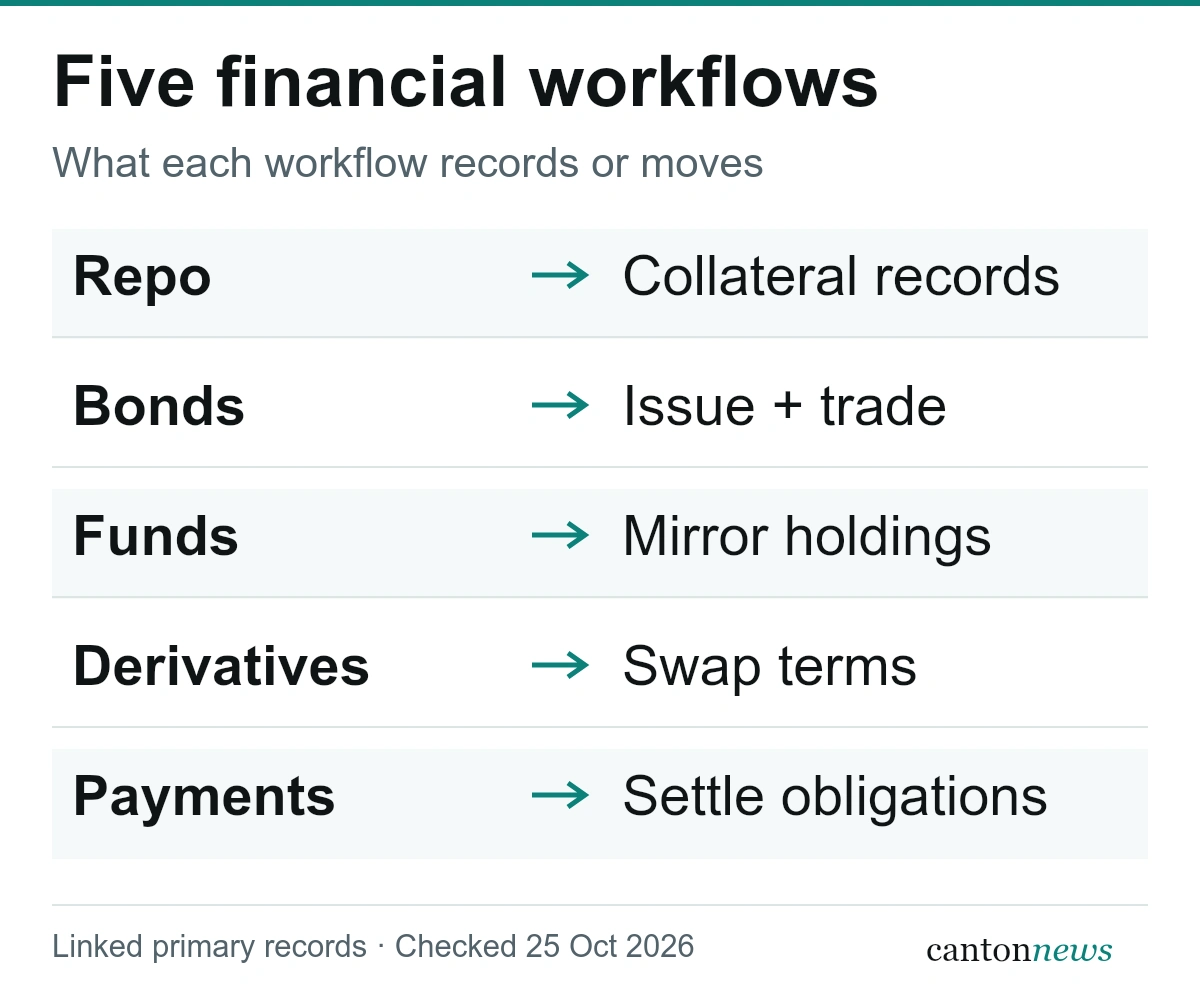
What each example records or moves. These cases include private Canton-based platforms and public-network transactions, from historical bond issuance to ongoing services and pilots. Sources: Broadridge, EIB, BNY, S&P Dow Jones Indices and Lloyds.
4. Agree on what a contract is worth
A firm may want its profit or loss to follow an investment without buying it.
A total return swap can arrange this: the parties exchange the investment’s gains or losses and income for another agreed payment. It is a derivative: a contract whose value depends on something else.
The parties then need agreed terms and a common reference for working out the contract’s value as markets change.
In the DRW and Marex swap announced on October 13, 2026, the reference was an index tracking corporate bonds: S&P Dow Jones Indices’ iBoxx USD Liquid Investment Grade Index.
- Kaiko supplied the tokenized index and official values, with permissions controlling use of the index data.
- Derivnex recorded the contract’s terms on Canton, giving both firms a shared record for working out its value over time.
The official announcement described cash and collateral integration as future work. The trade used a tokenized index; it did not turn the bonds inside it into tokens.
5. Get money to its destination
Between financial institutions
The Lloyds and Visa pilot announced on September 30, 2026 settled US$750,000 of real payment obligations over seven days. Lloyds bought USDC, a stablecoin designed to track the US dollar, through Archax. Funds reached Visa in under an hour, including at the weekend.
Lloyds used its own Canton node, a computer participating in the network. Visa supported settlement on a separate public blockchain. The pilot tested transfers behind payment activity, rather than a new service for shoppers.
From an employer to staff
A completed payroll run announced on February 10, 2026 used private stablecoin transfers on Canton for an unnamed multinational company. Toku handled payroll instructions; Cantor8 supplied employee wallets for receiving and managing funds.
The participants reported a completed run. They did not disclose its value or headcount. Privacy matters here because salary information is sensitive.
Keep the big numbers separate
- $7.5 trillion: Broadridge’s processed repo transactions during September 2026.
- €100 million: the amount borrowed in EIB’s historical bond issue.
- US$750,000: obligations settled in a seven-day Lloyds/Visa pilot.
Each measures a different job. The useful question is what changed for the participants: a shared loan record, a coordinated exchange, a digital fund record, agreed contract values or a delivered payment.
Examples documented through October 25, 2026 at 14:59 UTC. Primary sources include Broadridge’s September figures, BNY’s fund-record announcement and the Derivnex swap announcement. Other sources are linked beside the examples.