
An application can need locked Canton Coin without owning all of it. A Super Validator can hold a large CC balance without that balance satisfying its locking requirement. In both cases, the important question is which coins are committed, to whose role, and under what rules.
Canton’s October 23 approval of CIP-0127 brings those operational questions into focus. The design implements two existing policies: one for Featured Apps, the other for Super Validators. Their requirements are different, and a market has already formed around supplying the capital they need.
Featured Apps: a commitment attached to an application
CIP-0116 sets the basic amounts. A non-issuer Featured App party must maintain 5 million CC in locks; an asset issuer party must maintain 25 million. The requirement applies per PartyId, the on-ledger identity representing the application.
The policy also requires good standing with the Canton Foundation. Funding the lock is therefore one condition of Featured App status, rather than an automatic route to approval. As our coverage of CIP-0116 explained, applicants identify the coins and account before review and need sufficient funding before the network vote to feature that party.
Actively locked CC counts toward the requirement. The policy gives withdrawals a 60-day vesting schedule, with one-sixtieth becoming available each day. That makes the commitment different from an ordinary wallet balance that can be spent immediately.
Super Validators: a proportion of earned rewards
The Super Validator framework in CIP-0105 uses a percentage rather than a fixed app threshold. Its starting schedule awards full forward SV Weight for locking 70% of aggregate lifetime-earned SV rewards. Locking 45% earns 60% weight; locking 35% earns 40% weight.
Those are the initial tiers, not percentages to assume remain unchanged indefinitely. The specification reduces the top-tier locking requirement over time. It counts historical and future SV earnings and aggregates the position for organisations operating more than one Super Validator.
Custody remains flexible. Locks can be spread across wallets and custodians, rather than being held on the validator itself. For withdrawals, 1/365.25 of the requested amount becomes liquid each day, and funds already vesting stop counting toward the required lock. Our earlier explanation of the SV framework sets out that relationship between committed rewards and forward weight.
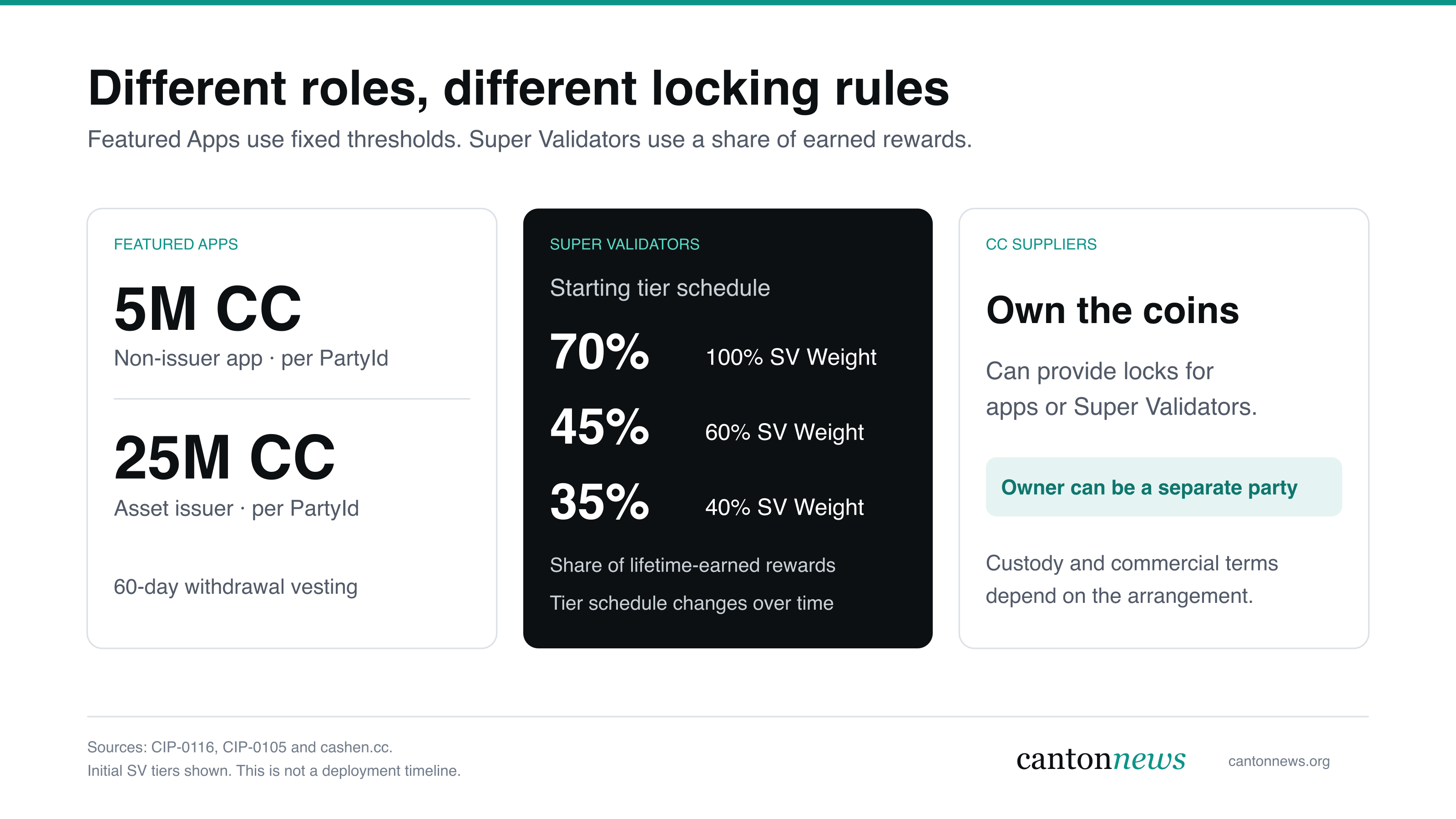
The underlying policies set different requirements for apps and Super Validators. Sources: CIP-0116 and CIP-0105. The SV percentages shown are the starting schedule.
A separate owner can provide the capital
Cashen’s marketplace shows how this works commercially. It connects institutional CC suppliers with Featured Apps and Super Validators seeking locks. Cashen says suppliers retain custody; counterparties agree the amount, interest rate, minimum term and recall notice for each deal.
The application can arrange a lock without buying the entire amount itself. The supplier earns interest under the agreement. Cashen operates the marketplace, while its participants are the legal counterparties to the deals.
That is the model behind Maha Wallet’s arrangement for a continuous 5 million CC lock. The arrangement addresses the capital requirement; it does not, by itself, establish Featured App approval. Our Cashen milestone article explains the wider market and its earlier growth.
The distinction matters when assessing any such announcement: who supplies the coins, who keeps custody, what the lock supports and whether the application has separately completed approval are different questions.
What CIP-0127 adds to the operating model
The approved specification separates the owner of locked funds from the app or SV those funds support. It also defines permissions for managing a lock.
A transfer can change ownership while preserving the lock’s type, subject and vesting state. It requires acceptance by the new owner and the relevant controllers. This offers a way to change custody without first releasing the commitment.
The delivery plan ties migration to software reaching MainNet. SVs have a 30-day migration window after Increment 1; Featured Apps have theirs after Increments 1–3. Approval alone does not start either clock.
For operators and funding providers, the next useful evidence is the deployment notice and wallet support for the operations they need. The practical test is whether they can keep the required commitment intact while changing the funding or custody arrangements behind it.