
Cashen now has more than 500 million Canton Coin in live locking deals. At the network’s on-chain CC price of about $0.1275 on October 13, that is roughly $63.8 million.
The marketplace went live in June. Just four months later, it accounts for approximately 1.26% of all circulating Canton Coin, with 75+ institutions onboarded. “The curve has not flattened,” Cashen said. The numbers support that claim: the platform added roughly 170 million CC in the five weeks following September 8, outpacing the approximately 10-week period before that.
Cashen at a glance
- 500M+ CC live in locking deals, about $63.8 million at the October 13 on-chain price
- 75+ institutions onboarded, after 50+ platforms in July and 65+ in September
- 5.07% average deal APR earned by CC suppliers
- 1.26% of circulating Canton Coin, committed through a single marketplace
- Four months from launch to half a billion CC
From launch to half a billion in four months
Cashen’s own updates trace the climb. It reported more than 215 million CC in active deals at the end of June, 266 million by mid-July and 275 million as it passed 50 platforms. By September 8 it had 330 million CC across 65+ platforms. Then growth sped up: the 500 million mark arrived only five weeks later.
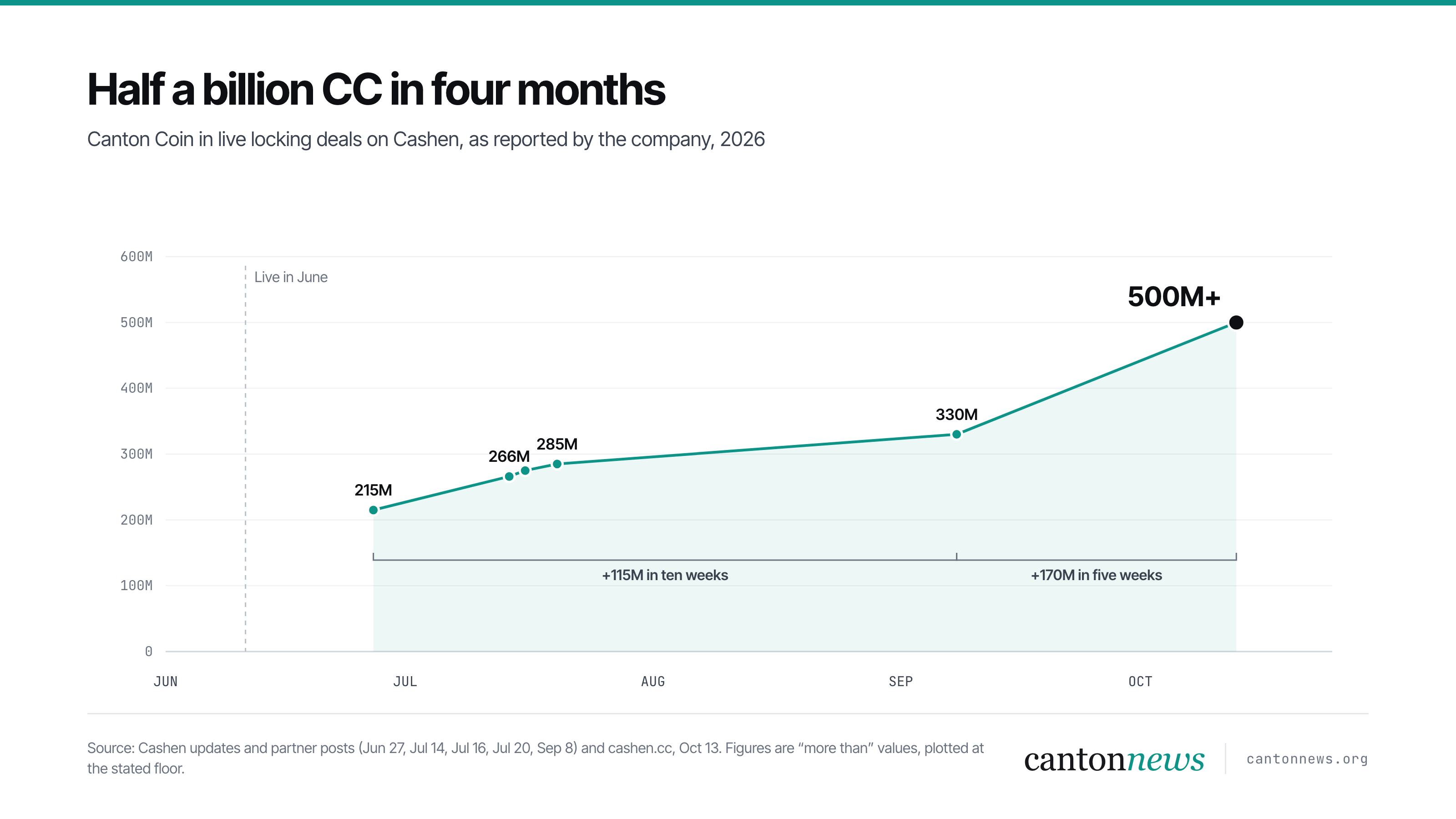
That acceleration matters because Cashen’s demand comes from a steady pipeline rather than one-off events. Every new Featured App and every growing Super Validator on Canton needs locked CC, and the queue of applicants is long. In the past week alone, Nocturnal Wallet, cBNB, CHYPE, Meriq and ForecastDesk were all moving through the Featured App process.
Why Canton needs a market for locked CC
Cashen exists because of two governance rules. CIP-0116, approved on May 20, made Featured App status something an application has to fund. Non-issuer Featured Apps must keep 5 million CC locked per party, in an identifiable, segregated account, and asset issuers lock 25 million. CIP-0105 applies the same principle to Super Validators, tying their weight to locking 70% of the Canton Coin rewards they have earned over their lifetime.
Those rules turned Featured App status, and the application rewards that come with it, into a position that has to be funded and defended. At today’s price, a single 5 million CC lock is worth about $640,000. For a young app, tying up that much of its own capital can be the difference between applying and waiting. That is the gap Cashen fills: the app pays a holder to lock CC on its behalf, instead of buying and locking the coins itself.
“Cashen has become the go-to marketplace for Featured Apps and Super Validators meeting their CC locking requirements under CIP-0116. A good example of the ecosystem building real infrastructure around a governance rule.”
Canton Foundation, August 11
How a Cashen lock works
Cashen is a bilateral marketplace with two sides. Applicants, meaning Featured Apps and Super Validators, list the amount of CC they need and their preferred terms. Suppliers, typically institutional CC holders, respond with offers, and the applicant picks a counterparty. Each deal is fixed at origination: the CC amount, a fixed APR, a minimum lock period, the notice needed to recall the coins, and a breach rate that applies if a recall goes unresolved.
The supplier’s coins are then locked against the applicant’s requirement, so the lock counts toward its CIP-0116 or CIP-0105 obligation. According to Cashen, suppliers keep full custody throughout and carry no principal credit risk. Interest accrues every Canton round, roughly every ten minutes, and is visible on a live dashboard, with monthly settlement by invoice; fully on-chain settlement is planned for a later phase. Suppliers currently earn an average deal APR of 5.07%, according to Cashen’s homepage.
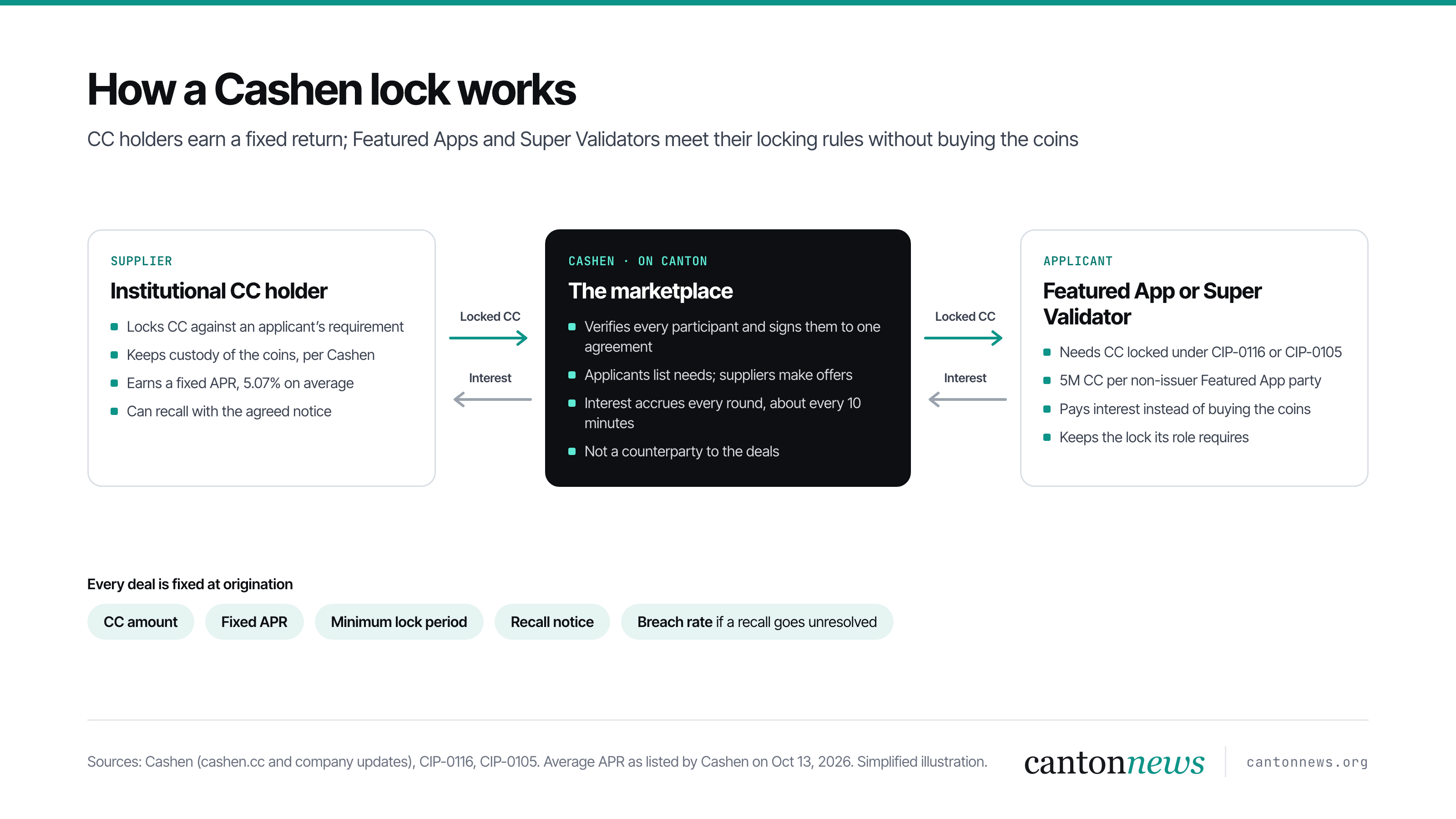
Access is institutional. Participants go through business verification and sign a Network Participation Agreement before they can list, match or supply a deal. Cashen runs the marketplace but is not a legal counterparty: the agreements are between the applicant and the supplier.
Who is locking through Cashen
Two recent deals show the range. Nuxaris locked 25 million CC through Cashen for cBNB, its BNB-backed asset, alongside a Featured App application that would bring cBNB to more of Canton’s trading venues. At the other end, Maha Wallet partnered with Cashen for a continuous 5 million CC lock, exactly the amount a non-issuer Featured App must hold.
Super Validators use the market too. Cashen says they can access new locked capital or refinance existing locks to free up liquidity while keeping their tier, and that newly approved Super Validator participants can source capital there. That side of the market could grow as more institutions take up Super Validator weight; Marex and LSEG both brought hosted arrangements onto MainNet in October.
Institutional backing and a seat on the collateral committee
Cashen is backed by DRW Labs, formerly known as Ergonia, a Cumberland DRW company. In September it joined the Canton Foundation’s Collateral Subcommittee, chaired by DTCC, where it works on cross-application collateral mobility alongside BNY, Euroclear and Broadridge. The company is led by chief executive Luke Farrell.
What half a billion locked CC means for Canton
For the network, 500 million CC in locks is more than a company milestone. It is capital that applications and validators have put behind their roles, which is exactly what CIP-0116 and CIP-0105 were designed to achieve. It is also CC committed for the term of each deal rather than trading freely: suppliers can recall it, but only with the notice they agreed to. And it gives CC holders a way to earn a fixed return on coins they already hold, without handing them to someone else.
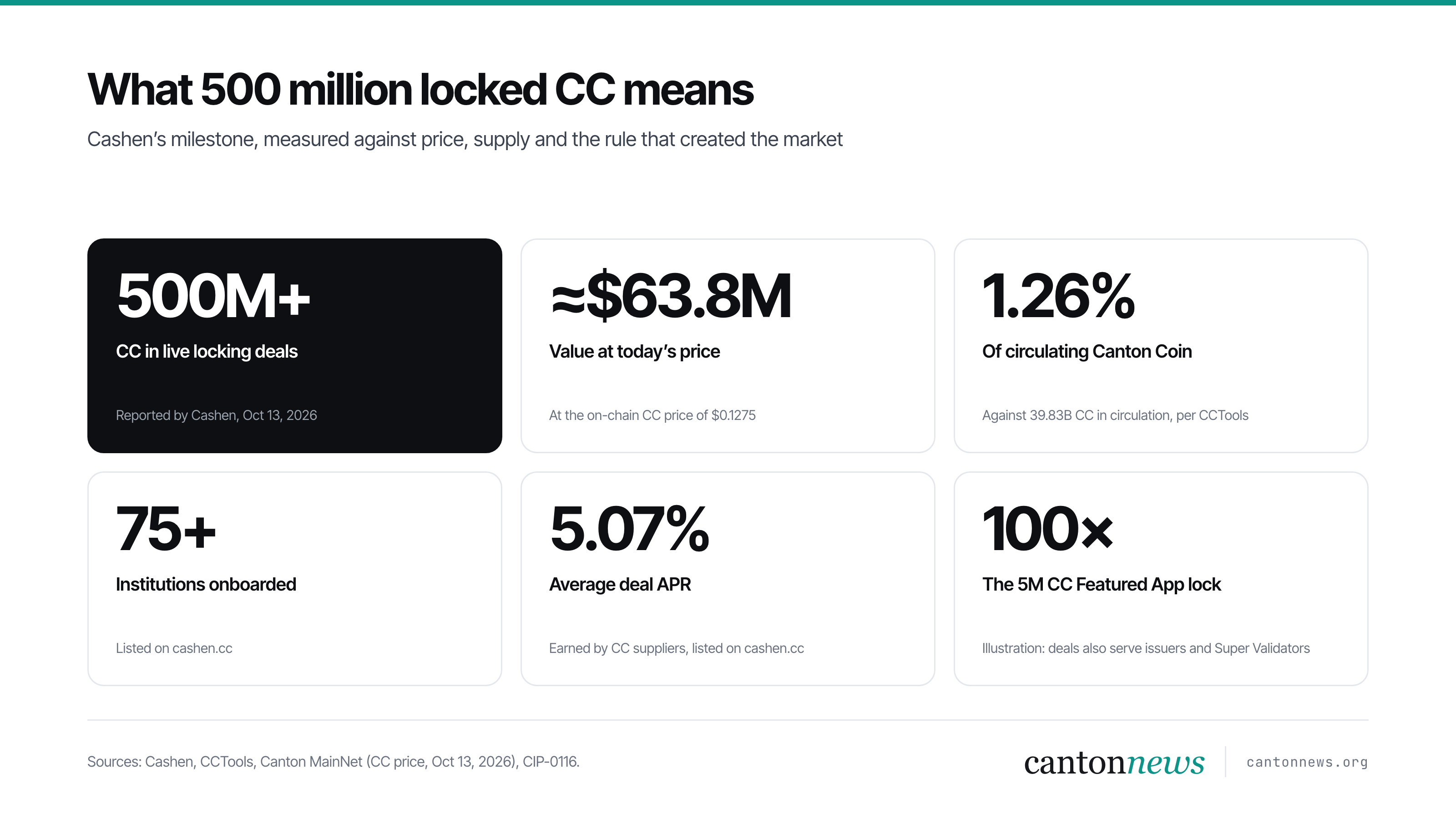
The scale is easiest to see against the rule that created it. 500 million CC is enough to cover the 5 million CC requirement for 100 non-issuer Featured Apps. That is an illustration rather than a breakdown, since Cashen’s deals also serve asset issuers and Super Validators, but it shows how much of the Featured App economy now runs through one marketplace.
What to watch next
- The Featured App pipeline. Every approval needs a funded lock, so the pace of Featured App votes is the clearest leading indicator for Cashen’s volume.
- Locked-CC transfers. A draft update to CIP-0127 would let locked CC change owner without being unlocked, which could make switching suppliers or custodians far simpler.
- On-chain settlement. Moving interest payments from monthly invoices to on-chain settlement is the next step Cashen has outlined.
- Super Validator demand. As institutions such as Marex and LSEG grow their Super Validator weight, demand for CIP-0105 locks could grow with them.
- Rates. The 5.07% average APR is the price of locked CC. Whether it rises or falls as supply and demand both grow will say a lot about the market’s balance.
Quick answers
What is Cashen?
Cashen is a bilateral marketplace on Canton Network that connects Featured Apps and Super Validators that need locked Canton Coin with institutional holders willing to supply it.
How much CC is locked on Cashen?
More than 500 million CC, according to Cashen, worth about $63.8 million at the on-chain CC price of roughly $0.1275 on October 13, 2026.
Why do Featured Apps lock Canton Coin?
CIP-0116 requires non-issuer Featured Apps to keep 5 million CC locked per party, and asset issuers 25 million, to hold Featured App status and its application rewards.
Do suppliers give up custody of their CC?
According to Cashen, no. Suppliers keep full custody, earn a fixed APR, and can recall their CC with the notice agreed in each deal.
Who can use Cashen?
Institutional participants that complete business verification and sign Cashen’s Network Participation Agreement.