
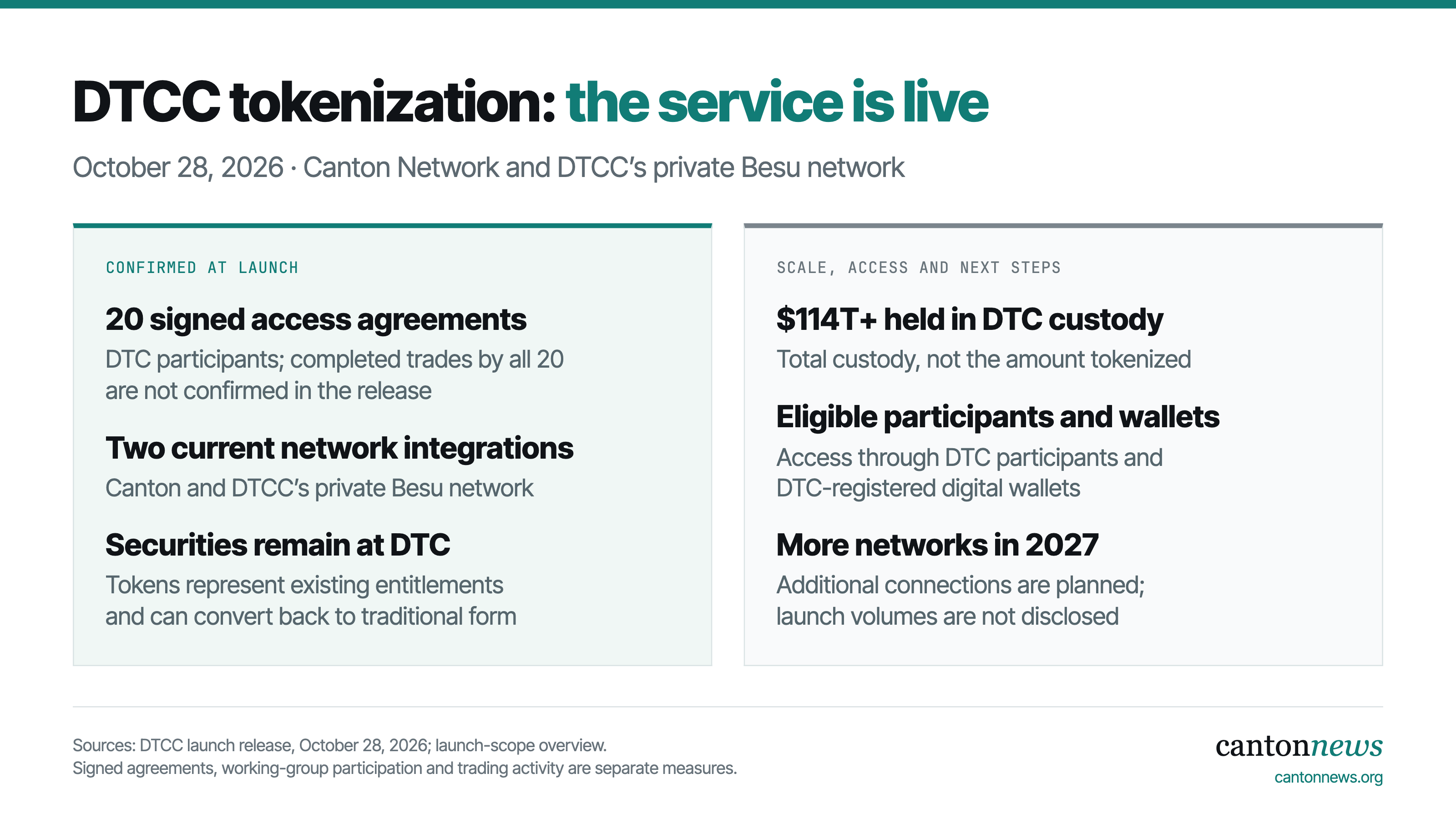
DTCC’s Tokenization Service went live on October 28 with Canton Network and DTCC’s private Besu network as its two current blockchain integrations, bringing a closely watched launch in institutional tokenization into operation.
The Depository Trust Company, DTCC’s depository subsidiary, launched the service after July’s limited-production trades and months of preparation. DTCC said 20 DTC participants have signed agreements to access it, including J.P. Morgan, Bank of America, Citadel Securities, Fidelity Investments and Morgan Stanley.
For Canton, the announcement delivers the launch anticipated in our end-of-October preview. The network is now connected to a live service that lets eligible institutions hold and transfer tokenized entitlements to securities kept at DTC.
What goes live
The DTCC announcement describes a service for creating digital representations of existing securities. An eligible participant can convert its position into tokenized form, receive it in a registered digital wallet and convert it back into traditional form.
The underlying securities remain at DTC. DTCC says the tokens retain the ownership rights, investor protections and economic entitlements of their traditional counterparts. That makes the service a new way to hold and move an existing securities entitlement within DTC’s framework.
DTCC reports more than $114 trillion in assets under custody at DTC. That measures the depository’s scale; today’s announcement does not disclose the value tokenized at launch or how much activity is running on Canton.
The pre-launch scope document, covered in our October 16 breakdown, specified 25 securities available to tokenize and approximately $30 trillion in assets available for tokenization. Those are eligibility figures, separate from assets actually converted.
Twenty firms have signed access agreements
The full list named by DTCC is Alpaca, Apex Clearing Corporation, Barclays, Bank of America, BNP Paribas, Brown Brothers Harriman, Citadel Securities, Citi, Clear Street, DriveWealth, Edward Jones, Fidelity Investments, Interchange Clearing, J.P. Morgan, Marex, Mirae Asset Securities (USA) Inc., Morgan Stanley, State Street, UBS and Velocity Capital LLC.
DTCC says further users will be onboarded on a rolling basis. The agreements identify firms with access arrangements in place; the release does not say that all 20 have already completed transactions.
The service was developed with input from more than 150 firms in the DTC Digital Assets Solutions Industry Working Group. That broader group is distinct from the 20 participants with access agreements.
DTCC also names wallet, infrastructure and market partners including BitGo Bank & Trust, Blockdaemon, Broadridge, DFNS, Fireblocks, Kaleido, Ondo, Talos, Taurus and Tradeweb. These firms support the wider ecosystem around the service, with roles separate from direct DTC participation.
How the securities move
DTCC’s launch-scope overview sets out the practical distinction between converting a security and transferring its token.
Conversion orders run through a web interface or API from 2 a.m. to 6 p.m. Eastern time on business days, targeting completion within 15 minutes. Once created, tokens can move peer to peer around the clock between DTC-registered wallets on the same network.
The tokens carry transfer restrictions, and DTC retains the official books and records. Treasury distributions and maturity payments are serviced on-chain, while the money is paid in fiat to participants’ traditional accounts.
Access therefore runs through eligible DTC participants and registered wallets. An ordinary Canton wallet does not, by itself, provide access to these securities. The round-the-clock transfer capability also should not be read as every securities market or conversion process operating 24/7.
From July’s trades to today’s launch
On July 15, more than 30 firms took part in limited-production transactions using DTC-tokenized assets. DTCC said the digital conversions occurred on Canton and Besu, covering workflows including collateral pledges, securities lending, Treasury repo and equity transactions.
Later participant disclosures made Canton’s role more concrete. As we reported in September, Fireblocks described how Citadel Securities created a tokenized Treasury entitlement on Canton, transferred it between registered wallets and posted it to CME as collateral during that event.
Today’s announcement advances that sequence from a limited-production event to a launched service. It gives institutions an operating route for converting eligible DTC positions into tokens, while July’s transactions show some of the workflows firms have already demonstrated.
The regulatory foundation remains the December 2025 SEC staff no-action letter, covering a defined preliminary service for three years from launch. Its eligible asset classes include Russell 1000 securities, ETFs tracking major indices and US Treasury bills, notes and bonds.
What comes next for Canton
Canton is one of the service’s two current integrations and its public blockchain connection. DTCC says additional networks will be added in 2027. Its earlier overview identified Stellar and Circle’s Arc as anticipated additions, alongside a broader roadmap for more securities, asset servicing, settlement and collateral capabilities. That roadmap remains subject to change.
The next measure of adoption is routine use: how many signed participants begin transacting, which securities they convert, the value held in tokenized form and the share of activity carried by Canton. Today’s release does not yet provide those figures.