
The 9.5 million CC request covers implementation and first-year maintenance, rather than a completed rollout.
Digital Asset and Obsidian Systems have requested 9.5 million Canton Coin from the Development Fund to implement automated locking rules for Featured Apps and Super Validators (SVs).
The public filing opened on October 26, following approval of Canton Improvement Proposal 0127 (CIP-0127) on October 23. The design has passed; the funding request remains open and unapproved.
What the software would change
Featured Apps are applications recognised for Canton’s app rewards. Super Validators help operate the Global Synchronizer, the shared service that coordinates transactions between Canton applications.
Locking means committing CC against the requirements attached to an app or Super Validator’s network role. The proposal describes current checks and enforcement as relying on convention and manual votes.
CIP-0127 sets out software for creating, managing and monitoring those locks on the ledger. It implements existing locking policies for those network roles.
The proposal would pay the two teams to add those functions to Splice, the network software, and deploy them to MainNet, Canton’s production network. It supersedes the older June implementation proposal, rather than adding a second request for the same work.
Where the 9.5 million CC would go
The proposed first-year budget has two parts:
- 8.5 million CC for implementation, split equally between Digital Asset and Obsidian across four delivery milestones.
- 1 million CC for Obsidian’s maintenance, in quarterly tranches of 250,000 CC from MainNet deployment.
That gives Digital Asset 4.25 million CC and Obsidian 5.25 million CC in the first-year request. Maintenance would renew annually and be reassessed quarterly against the CC price. The 9.5 million CC covers the first year; ongoing maintenance would add to the cost. The proposal also requires a six-month funding re-evaluation.
Four delivery targets, with conditions
The approved design breaks the work into six smaller implementation steps. The grant groups them into four milestones. Their deadlines depend on both CIP-0127 acceptance and grant approval; they do not all start from the October 23 design vote.
- Manage locks, after two months. Basic lock operations, including locks for apps still seeking Featured App status.
- App controls, after six months. Support for locking services and automated checks for app shortfalls. Featured App rights are suspended during an underlock, with permanent loss if it remains unresolved beyond the default seven-day grace period.
- Automate SV locking, after eight months. Put new Super Validator rewards directly into locks and automate top-ups.
- Enforce SV shortfalls, after at least ten months. This also depends on the separate implementation that records individual SV reward rights and weights on the ledger. Weights determine relative reward shares.
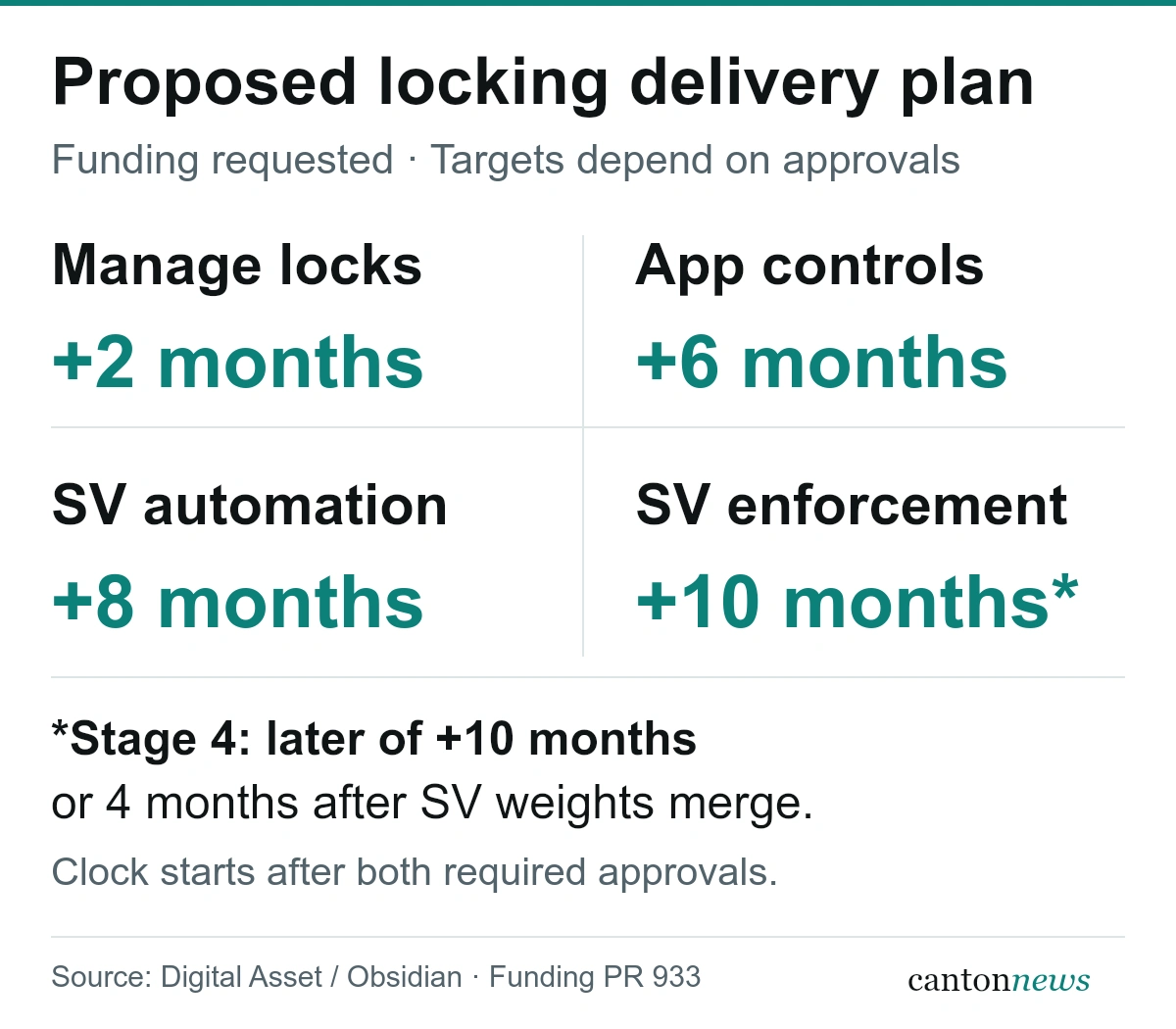
Conditional targets in the CIP-0127 funding request. Stage 4 is due at the later of 10 months after both approvals or 4 months after on-ledger SV-weight implementation merges into Splice’s main code branch. These are proposed delivery targets, not fixed MainNet launch dates.
The last deadline is the later of ten months after both approvals or four months after the SV-weight implementation is merged into Splice’s main code branch.
These targets concern completed code merged into the main or an equivalent release branch. Implementation milestones are paid when their code is included in a Splice release. MainNet deployment still depends on Super Validator votes, and release scheduling is outside the grant’s control.
Migration dates still depend on MainNet software
The approved CIP-0127 specification gives Super Validators and Featured Apps separate 30-day migration windows. Those clocks start only when the software required for their respective locks is live on MainNet.
For Super Validators, the initial lock-management step starts the clock. Featured Apps need the first three implementation steps. Approval of the funding request would not itself start either deadline.
Wallet teams have a practical preparation task
Digital Asset has asked wallet providers to support transfer memos of at least 1,000 characters. A memo is the transfer’s description field; CIP-0127 uses it to carry structured lock instructions as name-and-value pairs.
Wallet teams are asked to check that these longer messages can be entered, displayed and submitted without silent truncation. The request supplies no deadline and does not announce that automatic MainNet enforcement is live.
Primary sources: the new fund filing, full grant proposal, approved locking specification and wallet memo request. Reporting cutoff: October 27, 2026 at 03:48 UTC.