
The configuration update records a16z crypto’s conditional reward allocation under MPC hosting. Graphic: CantonNews.
Canton’s configuration repository has merged the entry for a16z crypto’s milestone-linked Super Validator rewards, assigning a reward weight of 10 under the MPC-Holding-Inc operator. A newly published snapshot of network configuration also records the corresponding increase in MPC’s aggregate reward weight on MainNet.
This implements part of the arrangement approved in September under CIP-0123. It records the allocation through a hosting operator; it does not establish that a16z has completed its milestones or received the associated Canton Coin rewards.
What the weight change means
The configuration raises MPC’s aggregate reward weight from 55 to 65 and adds a separate a16z beneficiary entry with a weight of 10. The same changes appear in the MainNet, TestNet and DevNet files.
Reward weight is a factor used to divide Super Validator rewards. It is not a number of coins, an ownership percentage or a count of governance votes. Here, the extra weight sits under MPC’s existing operator entry rather than a newly added a16z-operated node.
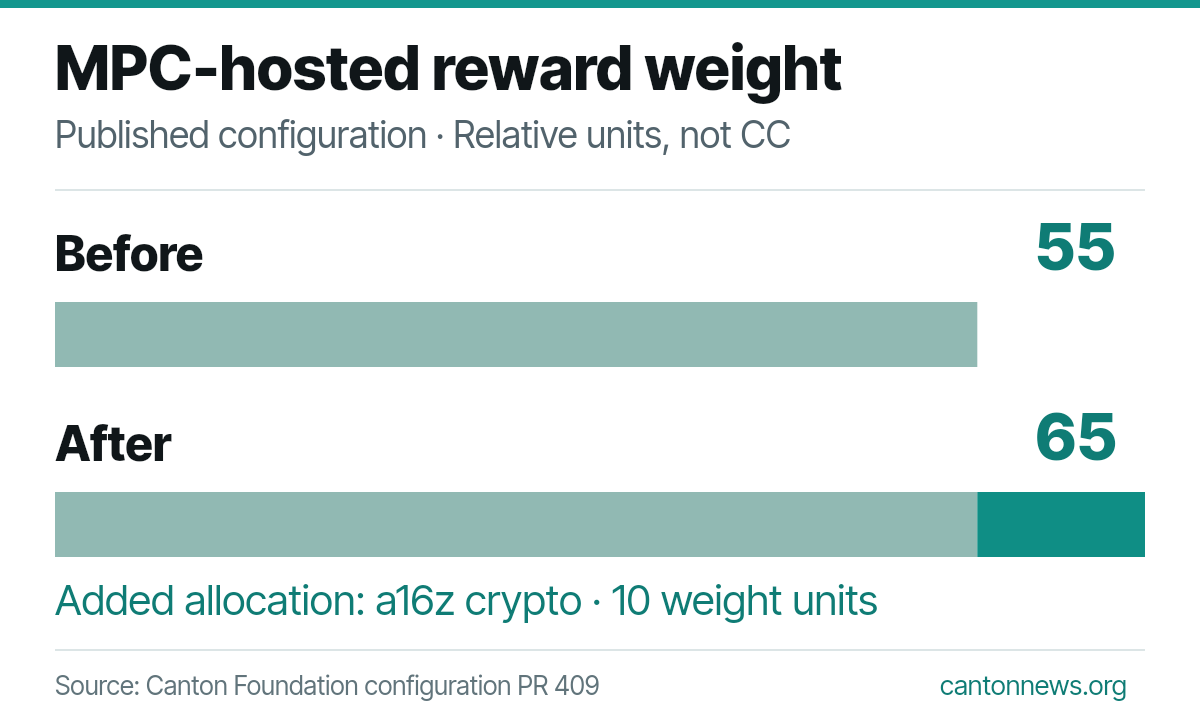
The configuration change adds a16z’s weight under MPC. The runtime snapshot records the higher aggregate. These are reward weights, not Canton Coin amounts or evidence of a reward payment. Graphic: CantonNews.
The record predates the repository update
The timing needs separating. The runtime snapshot was published on October 29 at 00:15 UTC. Its MainNet governance contract, which contains the weight of 65, was created on October 28 at 07:20 UTC. The configuration pull request was then merged on October 29 at 00:18 UTC.
That means the merge time is not the activation time. The new snapshot provides public evidence of a network record already created the previous day. TestNet and DevNet snapshots show the same aggregate increase.
Rewards still depend on verified milestones
The approved CIP sets a maximum earnable weight of 10, with commercial commitments and deadlines agreed privately. Its representative-operator mechanism directs the associated rewards into an unclaimed pool while those conditions are being assessed.
After the specified review and agreement on the reward calculation, two-thirds of Super Validator operators must authorize a portion of the unclaimed rewards to be minted by the applicant’s validator. They must also authorize the corresponding ongoing weight. Unmet milestones can lead to the remaining representative weight being removed.
The practical change is therefore a recorded allocation within that conditional process. The configuration and runtime files do not, by themselves, demonstrate a milestone award or a payment to a16z.
Primary sources: Canton configuration update, runtime snapshot, CIP-0123 and reward-weight field documentation. Reporting cutoff: October 29, 2026 at 00:57 UTC.