
Zenith describes a JGB collateral workflow tested on a local stack, spanning Canton and Zenith EVM. Source: October 28 pilot report. Graphic: CantonNews; Zenith logo belongs to its owner.
Zenith has published a technical account of a local pilot connecting Japanese government-bond collateral with lending on Zenith EVM. Its October 28 report describes a workflow covering issuance, purchase, borrowing and the eventual release or transfer of collateral across Canton and its Ethereum-compatible execution environment.
The test used an asset representing a Japanese government bond, or JGB. Zenith says the workflow ran on a fully local software stack. The report describes a technical demonstration, rather than a commercial JGB lending service.
What happens to the bond?
The design keeps the bond’s ownership and transfer rules in Daml, the smart-contract language used on Canton. Payment and lending run in Solidity contracts on Zenith EVM, an environment for Ethereum-style applications. Collateral is the asset committed to secure a loan.
Zenith’s account follows the asset through four stages:
- Issue and buy: a Canton contract records the asset and who may hold it. The purchase exchanges it for a stablecoin payment on Zenith EVM. Delivery versus payment means the asset transfer and payment complete together, or neither completes.
- Lock and borrow: the Canton asset is locked against reuse. A token representing it is created on Zenith EVM and deposited into a lending contract. Canton finalises its collateral record after verifying the successful EVM borrowing operation.
- Monitor: a Daml contract checks the loan’s debt and collateral condition using EVM records tied to a block recorded on Canton. A deteriorating loan can trigger a margin call, requiring action to restore sufficient collateral.
- Resolve: repayment of principal and interest allows the representation to be withdrawn and destroyed, then the Canton asset to be unlocked. If the loan is liquidated, the workflow transfers the entitlement to an eligible recipient instead.
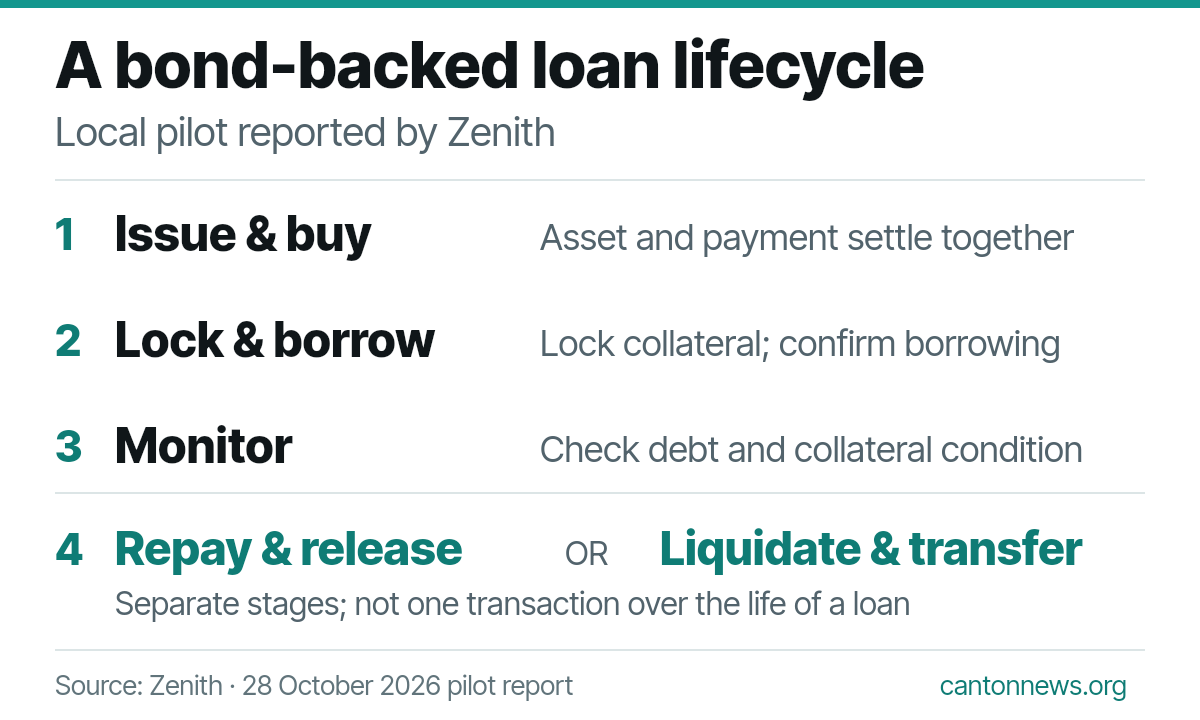
Simplified lifecycle from Zenith’s October 28 pilot report. These are stages of a locally tested workflow, not one transaction spanning the life of a loan. Graphic: CantonNews.
What the demonstration adds
CantonNews reported Zenith’s participation in Progmat’s JGB working group in June. That initiative studies tokenized JGB rights and repo transactions, a form of short-term funding secured by securities. The new account adds a reported implementation covering what happens after an asset has been issued: purchase, borrowing, monitoring and both ways a loan can end.
Keeping the two environments consistent matters. A buyer should not pay without receiving the asset, and collateral should not be released while its loan remains outstanding. Zenith says its design coordinates the linked operations through Canton and checks EVM evidence before updating Canton’s asset records.
The company also reports testing deliberately inconsistent read results, unauthorized readers, duplicated monitoring references and replayed settlement attempts. It says those cases were rejected. These are Zenith’s reported test results; CantonNews has not independently reproduced them.
A local pilot and a public testnet are different milestones
Zenith’s public EVM testnet opened on September 28. Its developer documentation explains how to deploy Solidity contracts and test interactions with Canton. That gives builders an environment to experiment with the underlying technology, but does not establish that this complete JGB lending workflow is commercially available.
The new report’s significance is the scope of the locally tested workflow: it connects the creation of an asset to the obligations and decisions that follow when that asset backs a loan.
Primary sources: Zenith’s collateral-lifecycle report, its June consortium announcement and September testnet announcement. Reporting cutoff: October 28, 2026 at 17:13 UTC.