
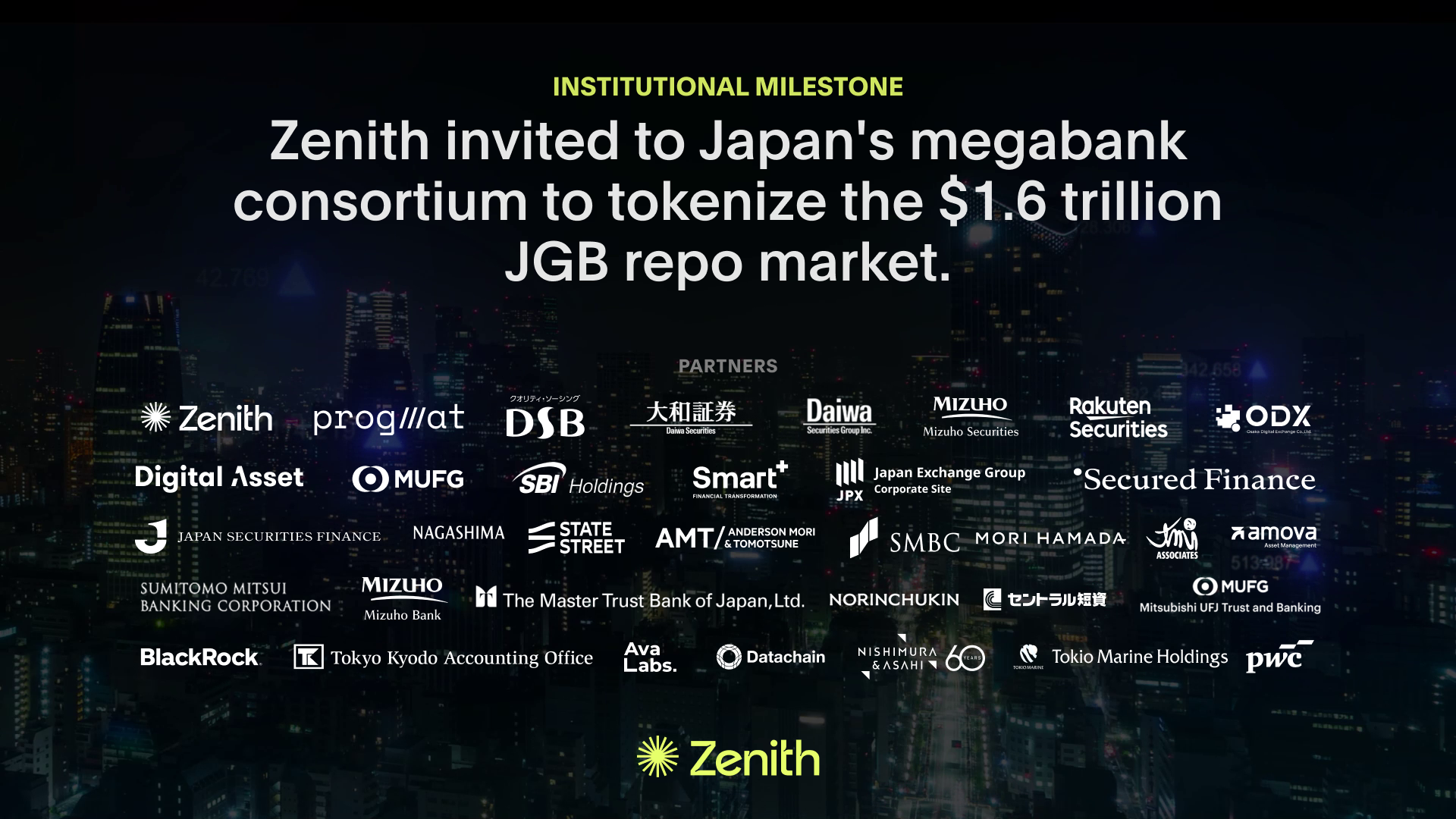
Zenith has joined Progmat’s Tokenized JGB / On-chain Repo Working Group, a Digital Asset Co-Creation Consortium initiative focused on bringing Japanese Government Bond repo workflows onto institutional blockchain infrastructure.
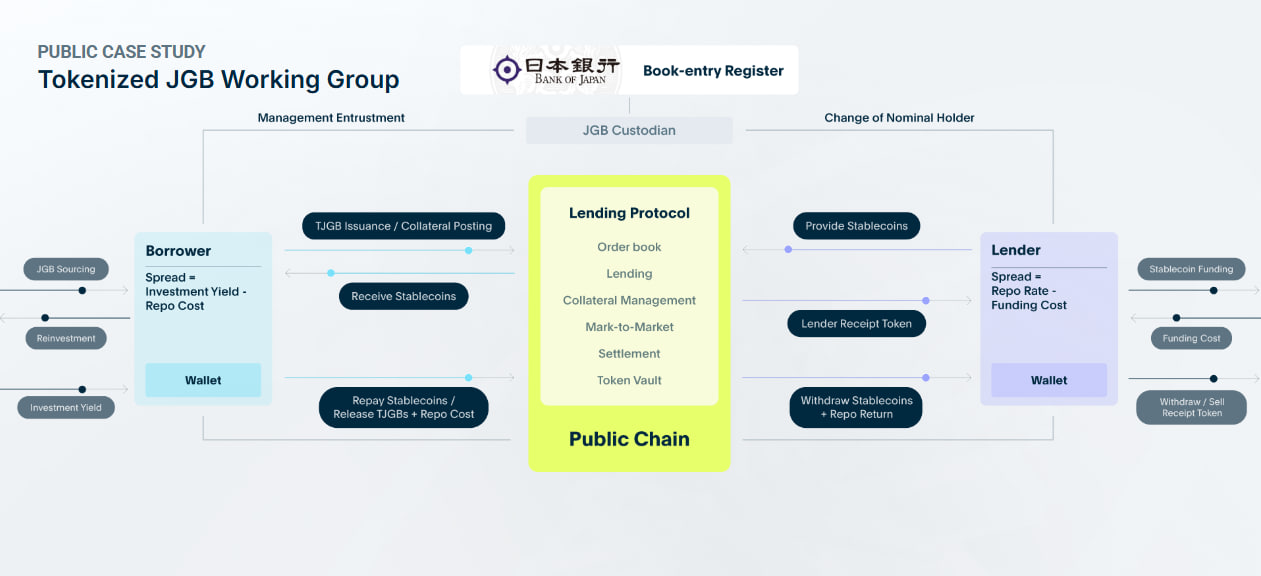
The working group is studying tokenized rights to Japanese Government Bonds and fully on-chain repo transactions using tokenized JGB collateral paired with stablecoin cash legs through lending protocols. The initiative includes major financial institutions such as MUFG Bank, Mizuho Bank, Sumitomo Mitsui Banking Corporation, State Street Trust and Banking, SBI Securities, and Japan Exchange Group’s Market Innovation & Research, among others.
The market under review is large. Japan’s JGB repo market is estimated at ¥250 trillion to ¥270 trillion, or approximately $1.6 trillion, representing roughly 10% of the estimated $16 trillion global government bond-backed repo market.
The group is targeting improvements including T+0 settlement, 24/7 market availability, and smoother cross-border access. Its work began in May 2026, with a comprehensive report expected in October 2026 and potential tokenized JGB issuance pilots targeted for later in 2026.
Zenith will contribute to protocol design, interoperability standards, and regulatory-compliant infrastructure. The company positions its Canton-based execution infrastructure as a way for developers and institutions to bring familiar application environments into markets that require institutional-grade privacy, compliance, and settlement controls.

About Zenith
Zenith is the EVM and SVM execution layer for Canton Network, advancing real-world capital markets initiatives on-chain.
“Zenith’s addition of atomically composable EVM, and planned SVM, execution expands Canton’s capabilities in a way that can increase network utility,” said Eric Saraniecki, Head of Network Strategy at Digital Asset. “It enables developers to deploy Solidity applications that can interact atomically with Canton-based infrastructure, bringing established financial building blocks to institutional-grade rails already operating at significant real-world volumes.”