
The open source wallet connection layer for the Canton Network crosses a six figure adoption milestone and sets out its plan for the next twelve months
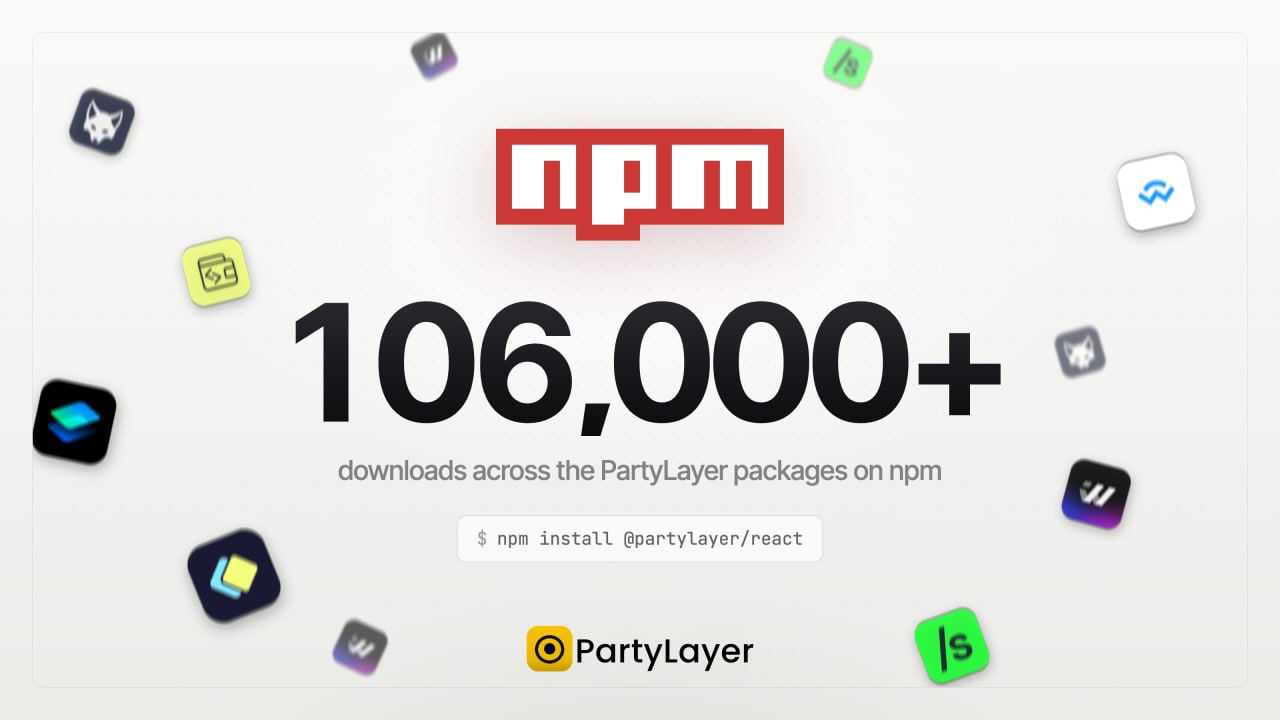
PartyLayer, the open source infrastructure that connects Canton Network applications to wallets, announced that total downloads of its packages on npm have passed 106,000. The project also shared a new roadmap covering the next twelve months.
Every application on the Canton Network has to solve the same problem first: find the user's wallet, establish a secure session, and get transactions signed. PartyLayer brings that layer together in a single family of open source packages, turning wallet connection into an afternoon's work.
What PartyLayer does
PartyLayer is built on CIP-0103, the Canton ecosystem's wallet communication standard. Leading wallets including Console Wallet, Cantor8, Nightly and 5N Loop are supported out of the box. Beyond that, any wallet that supports the standard is discovered automatically with no extra code: new CIP-0103 wallets such as Send and Walley appear on their own in the connection screen of every application using PartyLayer. Wallets connecting over the WalletConnect protocol are supported as well.
On the developer side, its capabilities come down to five things:
Full integration in under ten lines. A ready made Connect Wallet interface, wallet selection screen and connection flow drop into a project as a single component. Developers who have used RainbowKit in the Ethereum ecosystem will recognize the flow immediately.
Three frameworks, one core. Dedicated packages for React, Vue and React Native all run on a shared core, so what a team learns on the web carries over to mobile.
Session security and continuity. Sessions are stored encrypted, restored automatically on page reload, kept in sync across open tabs, and users are prevented from operating against the wrong network.
A data layer. Not just the connection, but everything after it: reading balances, transfer flows, transaction status tracking, and showing users the cost of a transaction before they sign.
A curated and signed wallet registry. The names, icons and capabilities of the wallets listed in an application come from a verified registry.
Built on the ecosystem's standard
PartyLayer is not an alternative to Canton's official developer tooling. It is a complementary application layer built on the same standard, CIP-0103. The standard commoditizes the protocol and wallet discovery; PartyLayer provides everything above it that developers touch daily: ready made interface components, data management, session security and multi framework support. Wallet providers across the ecosystem can also use PartyLayer's open test suite to verify their own integrations against the standard.
Two example applications running on a real network
PartyLayer's capabilities are demonstrated end to end in two open source example applications, both running live against a real Canton network.
tokenization.partylayer.xyz shows token balances being viewed, transferred, and incoming transfers accepted.
dvp.partylayer.xyz shows a delivery versus payment flow between two parties: each side approves its own leg, and the transaction settles atomically, meaning it either completes in full or not at all.
Both are published as open source templates, so teams can build their own products directly on top of them and start in a single step with npm create partylayer-app.
The new roadmap: four priorities
Automatic code generation. Generating the majority of the code developers write by hand today. The most direct way to cut development time and reduce errors.
A faster start. Reducing the work of connecting an application to Canton to a few lines.
Sign in with Canton. A proposed open standard, available to the entire ecosystem, that lets users sign in to applications securely with their wallets.
Mobile. Maturing the tools that make mobile development on Canton possible, an area that remains largely unserved today.
Alongside these, PartyLayer is evaluating a deeper adoption of Canton's official dApp SDK within its own foundations. The aim is to stay fully aligned with the ecosystem's common ground at the protocol level, and to direct the team's energy to the layer developers actually touch.
The thinking behind the roadmap is straightforward: as standards commoditize the infrastructure, value moves to the layer developers actually touch. PartyLayer's plan is built on deepening that layer.
About Cayvox Labs
Cayvox Labs, the studio behind PartyLayer, builds products on the Canton Network as an open source studio. The team focuses on building the infrastructure the Canton ecosystem needs on open standards and in the open, and PartyLayer is the most visible project in that portfolio. Every PartyLayer package is open source under the MIT license and free to use, with the source code publicly available on GitHub.
Links
PartyLayer: https://partylayer.xyz
Cayvox Labs: https://cayvox.com
Source code: https://github.com/PartyLayer/PartyLayer
Example application: https://tokenization.partylayer.xyz
Example application: https://dvp.partylayer.xyz