
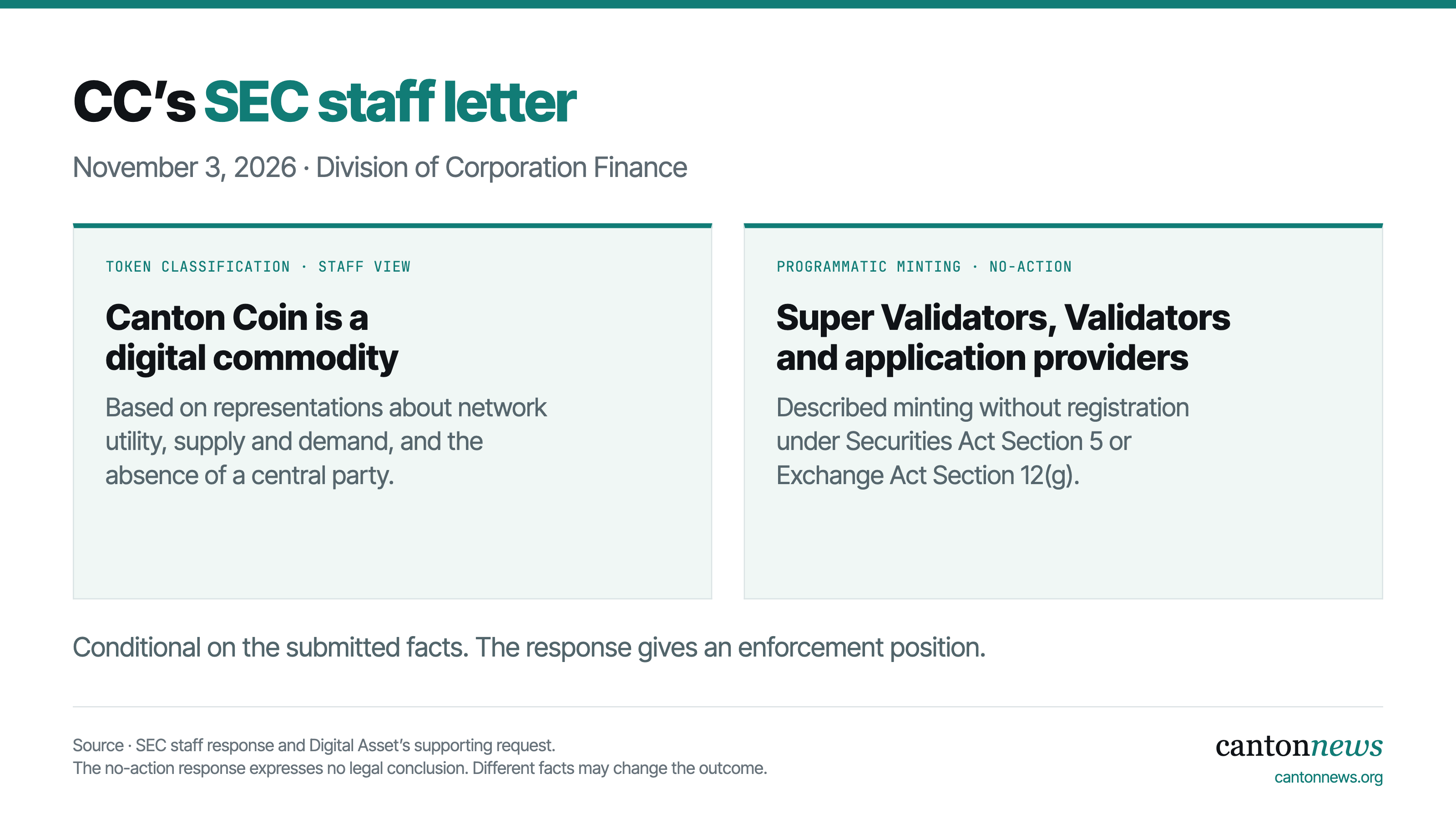
The SEC’s Division of Corporation Finance has stated that it views Canton Coin as a digital commodity, giving the network’s native token a specific staff position under the agency’s crypto framework.
In its November 3 response, the Division also says it will not recommend enforcement over CC’s programmatic minting by Super Validators, Validators and application providers without registration under the two provisions identified in the letter.
The position relies on the facts and conditions submitted by Digital Asset’s counsel. For businesses earning CC through network operations, it addresses a central question about how those tokens come into circulation.
Why staff view CC as a digital commodity
The response applies the SEC’s March 2026 crypto-assets interpretation. That framework describes digital commodities as assets whose value comes from a functioning crypto system and supply and demand. It treats those assets themselves as outside the securities category.
Staff highlight two representations about Canton. CC’s value is tied to the network’s programmatic operation, and the network has no central party under the interpretation’s definition.
That definition concerns operational, economic or voting control. The interpretation also distinguishes a token’s own characteristics from a transaction involving it. An asset that is itself a non-security can still be offered through an investment contract, depending on the arrangement.
How minting fits the analysis
Cravath lawyer Jeffrey T. Dinwoodie submitted the October 30 request on behalf of Digital Asset Holdings. It describes CC as payment for Global Synchronizer fees and as compensation earned through operating infrastructure or applications.
According to the submission, rewards follow protocol-generated activity records. Participants mint against their contributions. CC used for fees is burned, removing it from circulation.
The filing also says holding CC does not itself produce passive yield or confer rights to Digital Asset’s income, profits or assets. It describes a June 2024 launch without an ICO, pre-mine or pre-launch token allocation.
Its legal argument centres on participants’ own work. Operators and application providers earn compensation through services and activity they contribute. That is the factual account counsel asked staff to assess.
The no-action position specifically covers minting in the described manner without registration under Section 5 of the Securities Act or Section 12(g) of the Exchange Act.
The governance facts behind the request
The submission describes protocol changes as requiring approval from at least two-thirds of Super Validator Node Operators. It says neither Digital Asset nor the Canton Foundation can change those rules unilaterally.
For September 30, it distinguishes approximately 60 Super Validators from 13 node operators. That distinction matters when reading its account of who votes and controls protocol changes.
Governance has also shaped Canton’s economic development. We covered the October vote on Universal Burn, including the separate implementation work needed after approval. The new letter adds a securities-law staff position to that broader operating context.
What it means for Canton’s financial ecosystem
The letter gives infrastructure operators and application businesses a public, Canton-specific staff response to reference when assessing their CC activity. Its conditions remain part of that assessment.
The Division explicitly says its no-action response expresses an enforcement position and provides no legal conclusion on the issues presented. Different facts or conditions could produce different conclusions.
Canton’s wider securities activity follows its own regulatory routes. DTCC’s October service launch brought tokenized securities entitlements to Canton and Besu. Our coverage of Canton Strategic’s share-tokenization plan examined a separate exemption for trading venues and liquidity providers.
Those developments concern securities represented and traded on the network. This response addresses the native coin and its described issuance.