
Société Générale has detailed a transaction in which its Prime Services & Clearing division accepted $10 million in tokenized US Treasuries as collateral on Canton Network, connecting an on-chain securities transfer to the bank’s existing collateral operations.
In a November 2 statement republished by The Asian Banker, the bank said the assets were tokenized through the soft launch of DTCC’s Tokenization Service. It said the transaction showed that the securities could move on-chain and be reflected in its back-office and collateral systems under its governance, risk and control framework.
The announcement gives a more detailed operational account of the bank’s Canton collateral work. It does not specify when the transaction took place, and earlier public records already documented completion of a related collateral milestone.
From a token to usable collateral
Collateral is an asset a client pledges to support an obligation. For a tokenized security to serve that purpose, the receiving institution must recognise it within the systems and rules used to manage the exposure.
That is the practical significance of Société Générale’s disclosure. The bank describes both the on-chain movement and its recognition in established collateral operations, rather than simply the creation of another tokenized asset.
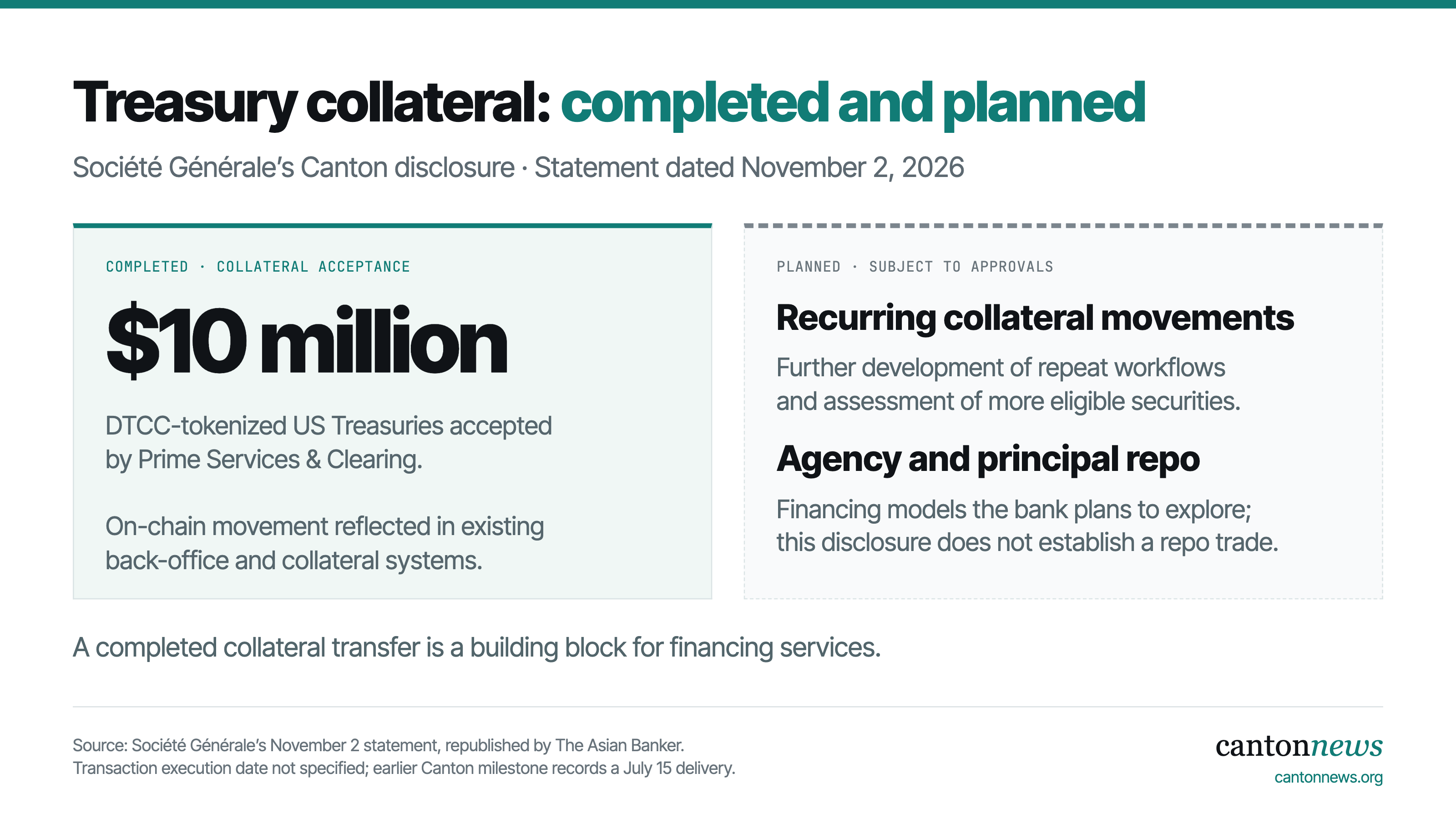
The $10 million refers to the Treasuries accepted as collateral. The release does not disclose a loan amount, financing rate, collateral haircut or named counterparty. It also does not describe this transaction as a completed repo trade.
In a repo, one party sells securities while agreeing to repurchase them later, creating a form of secured financing. Collateral acceptance is a building block for such markets, but the terms of an actual financing transaction determine how it works.
How DTCC and Canton fit together
The transaction used securities tokenized through DTCC’s service, with Canton providing the network on which the collateral moved. These roles connect existing securities infrastructure with an on-chain workflow and the bank’s own systems.
DTCC’s service description explains that its tokens represent entitlements to securities held at The Depository Trust Company, its depository subsidiary. Eligible users can convert positions between traditional and tokenized form, with the tokens retaining the ownership rights, investor protections and economic entitlements of their traditional counterparts.
The service therefore changes how an existing securities position can be represented and transferred. The announcement concerns tokenized representations of Treasury securities, rather than a new US government bond issued directly on Canton.
DTCC’s broader service went live on October 28, as we reported, with Canton and DTCC’s private Besu network as the initial integrations. Société Générale’s statement specifically refers to assets tokenized during the soft launch; its publication after October 28 should not be read as proof the collateral transaction occurred after that launch.
The earlier milestone matters
This latest disclosure follows a sequence we have already covered. In May, Société Générale set out its Canton plans, including collateral acceptance, repo activity and SG-FORGE’s digital settlement work. It also announced its Ecosystem Super Validator role.
On October 1, we reported that Tokenomics had approved its first collateral milestone. The underlying September 30 outcome records a July 15 delivery date.
That milestone sits under CIP-0115, the bank’s approved Super Validator framework. It requires Prime Services & Clearing to accept eligible tokenized assets and complete at least one production collateral transaction on Canton MainNet worth a minimum of $10 million.
The November statement adds detail about the Treasuries and the bank’s operational integration. It does not identify whether this was a separate transaction from the one supporting the earlier milestone, so the disclosures do not establish two distinct $10 million trades.
CIP-0115 also sets separate targets for agency and principal Treasury repo, adoption volumes and SG-FORGE stablecoins. Completion of the collateral milestone does not establish completion of those other targets.
What the bank plans next
Société Générale says it intends to develop support for recurring collateral movements and assess additional eligible tokenized securities. It also plans to explore on-chain financing through agency and principal repo models.
Those are planned extensions. The bank says they remain subject to internal approvals, regulatory requirements and further development of the supporting operational and control framework.
The next useful measures will be repeat transactions, the range of assets accepted and evidence that collateral can move through the full financing lifecycle. The November statement does not provide recurring volumes or a general rollout date.
For Canton, the concrete result is the connection between a tokenized security, an institutional recipient and the bank’s existing collateral records. Building that into a recurring service would give tokenized Treasuries a more routine role in the financing markets they already serve.