
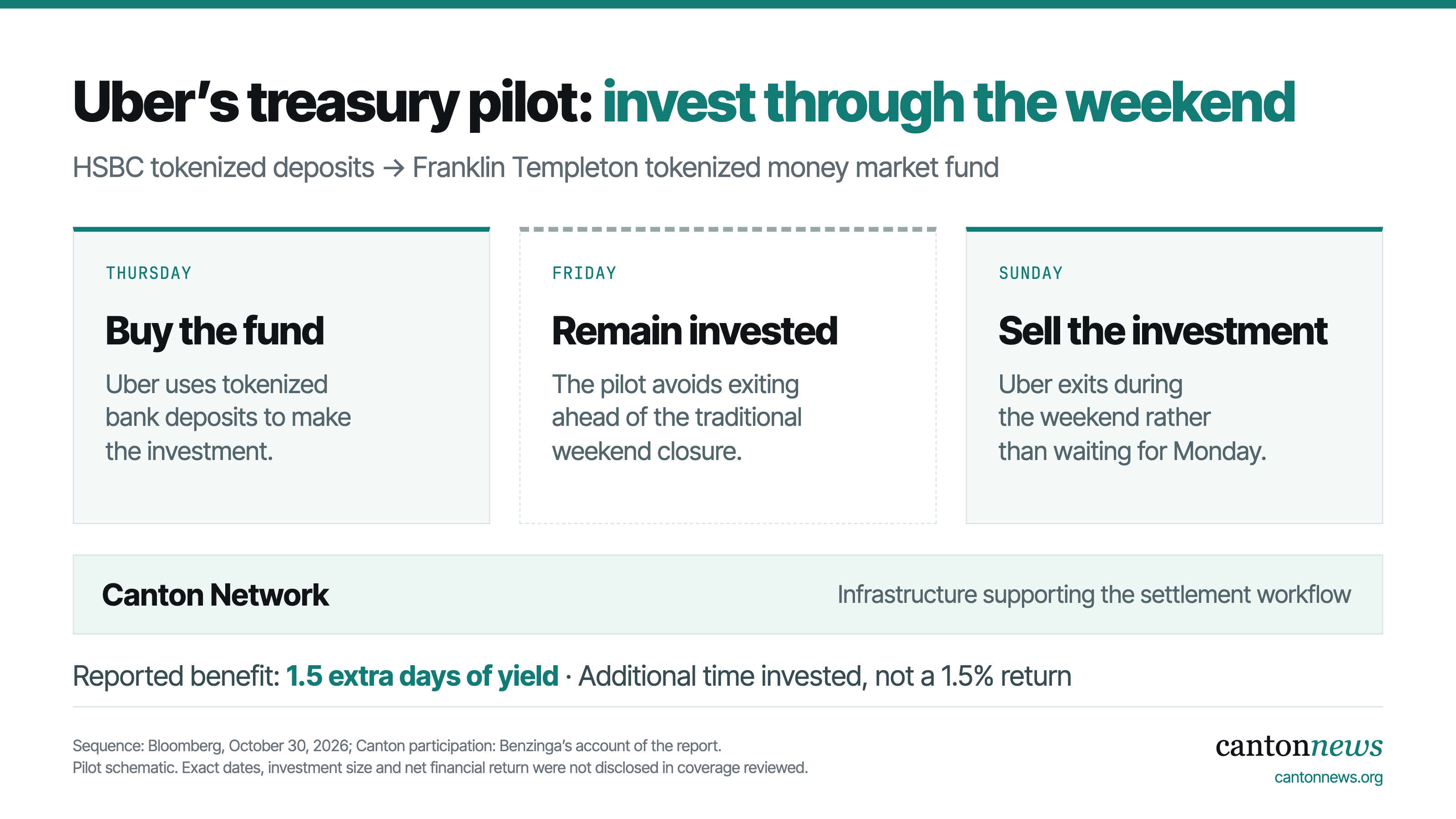
Uber has tested using blockchain infrastructure to keep corporate cash invested through the weekend, buying a Franklin Templeton tokenized money market fund with HSBC tokenized deposits and selling the investment on a Sunday.
The transaction, described in an October 30 Bloomberg report, captured an additional 1.5 days of yield compared with exiting on Friday. Tradeweb and Fireblocks also participated, with Canton Network supporting the liquidity and settlement workflow.
For Canton, the significance is the user at the end of that workflow: a company putting surplus operating cash to work between payments. It connects the network’s institutional infrastructure to a practical corporate treasury task.
What Uber tested
Bloomberg reports that Uber bought the fund on a Thursday and sold it on Sunday. That extended the time its cash could earn a fund return while still allowing a weekend exit.
The reported gain is 1.5 additional days invested, rather than a 1.5% return or an increase in the fund’s annual interest rate. The benefit comes from timing: money can remain invested for longer if it can be released when the company needs it.
The report describes a recent transaction without identifying its calendar dates. The coverage reviewed does not disclose Uber’s investment size, the dollar amount earned or its net return after costs. Those details would be needed to assess the financial benefit beyond the additional time invested.
Where Canton fits
There are two financial assets in the reported workflow: HSBC’s tokenized bank deposits and Franklin Templeton’s tokenized fund investment. Canton supplies the network infrastructure through which the participating institutions can connect and settle transactions.
That distinction matters. HSBC provides the bank-deposit side; Franklin Templeton provides the investment. Canton’s settlement infrastructure enables assets and applications to work together while retaining their own controls. The network itself is not the source of the fund’s investment income.
Canton’s Global Synchronizer is designed to coordinate transactions across separate applications, with transaction information restricted to the relevant stakeholders. Its atomic-settlement capability allows linked transfers to complete together, avoiding one side handing over an asset while waiting for the other side to deliver.
The Uber coverage does not provide a contract-level account of each step. The broader capability explains why connecting a bank deposit to a fund matters: faster movement is useful only if the cash and investment sides can operate together.
Tradeweb and Fireblocks bring earlier Canton experience. We covered Tradeweb’s on-chain U.S. Treasury transaction in July, where it supplied execution and price discovery. In September, we outlined Fireblocks’ Canton wallet, contract and approval capabilities. Those earlier roles provide context, rather than a complete specification of their responsibilities in Uber’s pilot.
Building on earlier HSBC and Franklin work
HSBC’s Canton work predates this transaction. In April, we reported its first tokenized-deposit pilot on the network. That controlled exercise simulated deposit issuance, transfers and atomic settlement against other digital assets.
The new report adds a named corporate treasury user and a specific investment outcome. It should be read as a subsequent pilot, rather than treating April’s simulation as an already unrestricted investment service.
Franklin Templeton has also been working on the fund side. In August, we reported the approval of its first Canton treasury-management milestone. Its approved CIP-0118 framework separately sets out a milestone for operational, round-the-clock creation and redemption of fund shares against on-chain cash.
Uber’s weekend transaction illustrates the usefulness of that direction. It does not, by itself, establish that a separate governance milestone has been formally accepted.
What comes next
Benzinga’s account of the Bloomberg report says HSBC plans to extend access to other U.S. corporate customers and explore more investment options. That makes broader availability the next development to watch.
Access still depends on the financial products and their operating arrangements. HSBC’s general U.S. Tokenized Deposit Service describes an onboarded corporate service on its private blockchain; that product page should not be mistaken for confirmation that the Canton fund workflow is open to every customer.
For a treasury team, the next questions are practical: which clients can use it, how weekend liquidity is supplied, what dealing and exit terms apply, and what the service costs. Repeated use and disclosed transaction volumes would show how far the model has progressed beyond a pilot.
Uber’s test gives the Canton story a concrete outcome: corporate cash stayed invested longer because the investment could be exited on a weekend. Turning that flexibility into a routine treasury service is the next step.