
The services supporting Canton applications: protecting assets, supplying market information, building software and keeping it connected.
Before a bank or investment firm uses a Canton application, it needs answers to everyday questions. Who can move the assets? What is happening in the market? Who keeps the software working?
At a glance
- Custody: protect assets and control approvals.
- Data: turn trading activity into useful information.
- Engineering: build the software and its connections.
- Network operations: keep connected applications in agreement.
- Research: test a design before real use.
Canton Army’s October 8, 2026 map selects 375 organisations with current or historical involvement. The examples below explain the different jobs behind those connections.
Protect the assets and control approvals
What custody protects
Custody means safeguarding assets and controlling access to them. For digital assets, it includes protecting private keys, the secret credentials used to sign transactions. Signing gives electronic authorisation for an action.
Illustration: a fund could require two authorised employees to approve a transfer before its system signs it. The approval rule controls who can act.
How the tools are used
Fireblocks’ July 21, 2026 Canton guide describes wallet tools and instructions to applications. One example is pledging collateral, which means using assets to back a debt or another obligation.
Its approval controls help institutions govern these actions. Supplying custody technology is different from acting as the custodian holding assets for a client.
BitGo’s March 30, 2026 announcement combines Canton Coin custody, trading and Go Network settlement, or completion of transactions. That settlement is offchain: outside the blockchain’s transaction record. Supporting Canton Coin does not mean every trade is recorded on Canton.
Turn market activity into usable information
Market data helps teams work out what assets are worth, check risks and prepare reports. It can answer simple questions:
- How many trades took place?
- What was the value of that activity?
Kaiko’s example
Kaiko’s Data Off-Ramp launched on September 10, 2025. It distributes combined data from Broadridge’s Distributed Ledger Repo platform to subscribers, including RWA.xyz.
Repo means selling securities, such as bonds, for cash with an agreement to buy them back later. Kaiko’s feed includes trade counts and measures of repo value.
The distinction: the service delivers combined information about trading. It does not transfer the securities or publish every private trade.
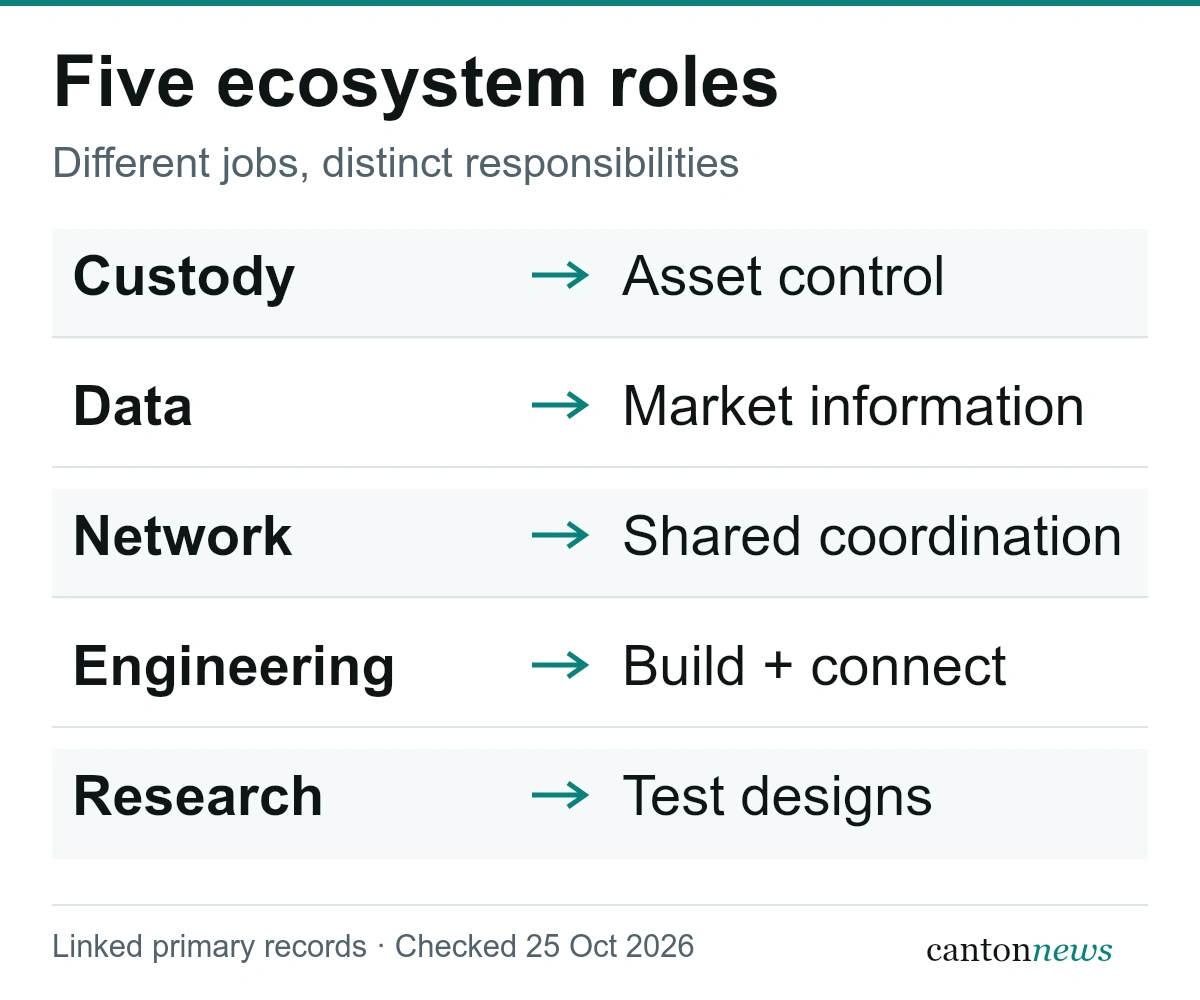
Five jobs behind Canton applications. Sources: Fireblocks, Kaiko, Canton’s technical primer, Moonsong and SIFMA’s Regulated Settlement Network (RSN) findings. RSN was a 2024 research exercise using simulated data.
Build the software and its connections
Business rules have to become working software. An institution must decide who can request an action, what needs approval and how records reach its existing systems.
Illustration: an application might need to send records into the institution’s reporting system. Engineers build that connection.
Moonsong’s June 2026 service-provider listing describes a Canton practice. Its published services include:
- Building application software.
- Setting up nodes, the computers running network software.
- Connecting applications to Canton’s shared coordination service.
Keep applications working together
When separate applications take part in a transaction, their participants need a consistent result. Canton gives the different parts of that process specific names.
Three names, three different jobs
- Participant validator: an organisation’s gateway to applications. It processes the transactions relevant to that participant.
- Global Synchronizer: the shared service that puts transaction messages in order and collects confirmations.
- Super Validator operators: the independent organisations that help run that shared service.
Canton’s technical primer explains these roles. Operating the shared service does not, by itself, give access to other participants’ private contracts.
Kaiko announced Super Validator approval on June 12, 2025. This is separate from supplying market data.
Applications can also use private synchronizers, coordination services run by application operators. Using Canton technology therefore does not automatically mean using the public Global Synchronizer.
Test a design before real use
A research test can use simulated records, created for the exercise, to check how a design works before real customers use it.
The Regulated Settlement Network findings, published on December 5, 2024, describe such a test. It used simulated data in a test environment.
The participants contributed different parts of the work:
- Technology: Digital Asset supplied the core system; Swift supplied a prototype for connecting networks.
- Legal and advisory work: Sullivan & Cromwell provided legal services; Deloitte advised SIFMA, which managed the programme.
The New York Fed’s Innovation Center was a technical observer focused on the participants’ research. That role did not amount to Federal Reserve endorsement or a production payment service.
Sources: Canton Army’s ecosystem map, the provider records linked above and SIFMA’s RSN findings.