
Three November 1 developments for Canton lenders, builders and node operators. Source. Graphic by CantonNews.
If a borrower defaults on a loan backed by a restricted asset, who is allowed to take possession of it? Vigente Protocol wants lenders on Canton to settle that question before they lend. Its November 1 funding request leads this edition, alongside an accelerator invitation from AppsFactory and new security-testing plans from Stakecraft.
Vigente asks for 750,000 CC to build Calend
A tokenized vault share represents a stake in a pool of assets. Some shares can pass only to approved holders. That poses a practical problem for a lender who accepts them as collateral. If the borrower fails to repay, selling the shares on an open exchange could put them in the hands of someone ineligible to own them.
Under Vigente’s proposed Calend standard, the parties would name an eligible liquidator when they arrange the loan. Calend would also give lenders a way to check a borrower’s credentials while keeping the underlying financial records private. The November 1 Development Fund submission requests 750,000 Canton Coin (CC) over 18 weeks and says Vigente still needs a champion to support the proposal through review.
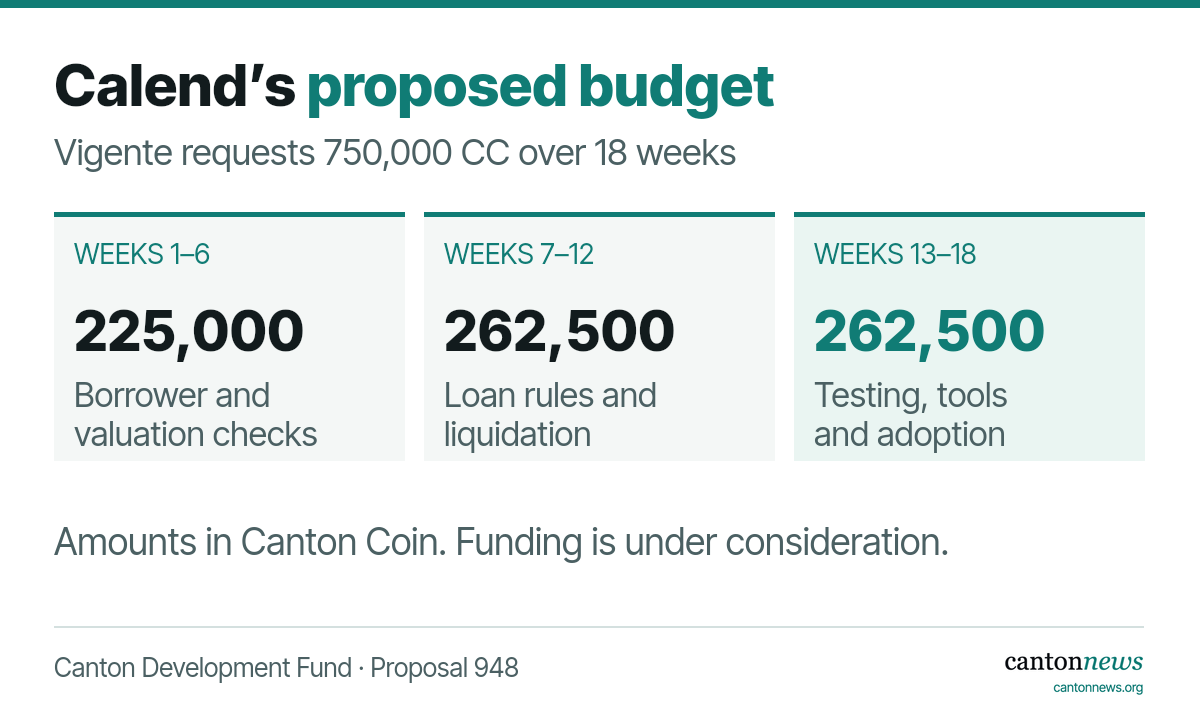
Vigente’s proposed allocations across three six-week stages. The amounts come from the submitted milestone budget. Graphic by CantonNews.
Vigente budgets 225,000 CC for borrower and valuation checks, then 262,500 CC for loan and liquidation rules. A final 262,500 CC would go toward testing, developer tools and initial adoption. A lending app could use the standard to offer its own loans. The funding request itself remains open.
AppsFactory invites teams with a working prototype
Teams coming out of a hackathon often have something that works and a harder question about who will use it. AppsFactory’s November 1 invitation offers up to ten teams eight weeks of mentoring, help reaching customers and access to investors.
Builders may already have seen registration for HackCanton Season 4. The accelerator is a separate application for teams with a working Canton prototype. Details for the second cohort are on the programme page.
Stakecraft sets out the next tests for Rütli
Rütli lets several operators share the authority to sign on behalf of a Canton node. Stakecraft says it has tested the software on the development network with cosigners in three locations. In a November 1 technical update, the team explains an important difference between the keys it protects.
- Signing. Several cosigners contribute shares to authorize an action. One operator alone cannot produce the signature.
- Encryption. Each cosigner stores a sealed copy of the entire encryption key. It uses a different protection model.
Stakecraft names Cure53 for a planned independent audit and calls for at least four weeks of TestNet operation before version 1.0. The team advises operators to wait for the external audit before entrusting production authority keys to Rütli. Operators considering a test pilot can consult the project repository and Stakecraft’s pilot invitation.