
Fairmint introduced its public-company transfer-agent offering on October 28, 2026. Moving an issuer’s official record requires its appointment and authorisation. Source: Fairmint. Graphic: CantonNews; Fairmint logo belongs to its owner.
Fairmint has introduced onchain transfer-agent services for public companies, extending its equity infrastructure beyond private companies. Announced on October 28, the offering would move an issuer’s official shareholder record onto Canton after the company appoints Fairmint TA LLC as its transfer agent.
A transfer agent maintains records of share ownership and processes authorised changes. The register at the centre of this offering is called the master securityholder file. Moving that record changes how ownership is recorded; it does not, by itself, open a stock to unrestricted trading.
What would move onto Canton?
Fairmint says its public-company offering preserves existing shareholder rights. The official record would use the Open Cap Table Protocol, its framework for recording equity events and sharing ownership data with authorised parties on Canton.
The company describes three preparation steps:
- Reconcile the existing record after appointment.
- Manage the handover from the current transfer agent.
- Set the issuer’s requirements for onboarding holders and processing transfers.
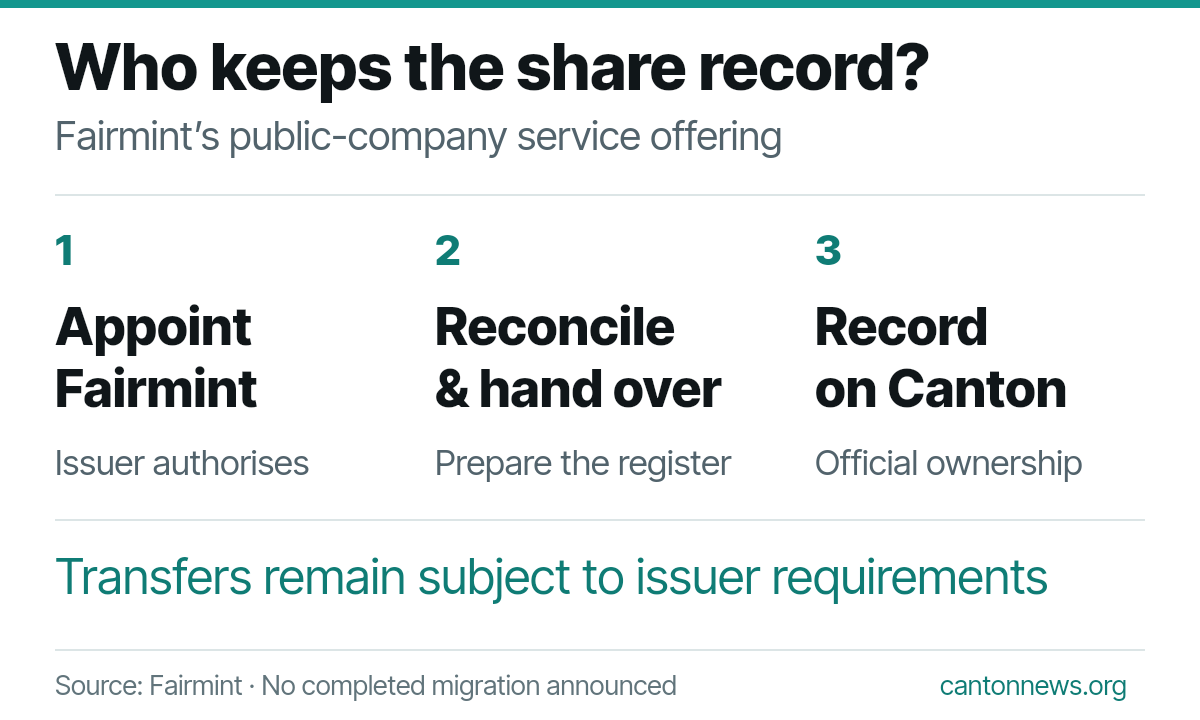
Process described in Fairmint’s public-company offering announced October 28, 2026. This illustrates the service, not a completed issuer migration. Graphic: CantonNews.
A share, a claim or price exposure?
The distinction matters because tokenized stocks do not all give investors the same rights. The SEC staff’s January statement on tokenized securities describes several structures:
- Issuer-sponsored onchain records: the company or its agent integrates blockchain records into its ownership system, so an authorised token transfer can record a transfer of the security.
- Custodial interests: a third party holds the underlying shares, while the token represents an interest in those holdings.
- Synthetic exposure: a separate instrument tracks the stock’s performance without necessarily providing shareholder rights in that company.
A token’s ticker alone therefore does not establish what its holder owns. The governing terms and ownership records matter. Fairmint’s offer concerns the issuer-authorised record, rather than merely a product linked to a share price.
What SEC staff says about the record
SEC staff’s transfer-agent FAQ says a registered transfer agent can use a distributed ledger for its master securityholder file, provided it meets applicable securities-law requirements. Those include accurate, secure records, retention and the ability to produce readable information for regulators.
The FAQ also explains that blockchain transaction data can coexist with personal information kept offchain. An onchain register need not make shareholders’ names, addresses or tax identifiers public.
These are staff views about complying with existing law. They do not endorse Fairmint’s service. Its offering page identifies Fairmint TA LLC as SEC-registered and explicitly says registration is not Commission endorsement.
What happens next?
The announcement names no public-company client whose record has already migrated. An issuer appointment and completed handover would establish adoption beyond the new offer.
Fairmint’s earlier Canton NFT proposal separately described equity certificates as its first planned production use. That proposed asset format and this transfer-agent offering address related work; neither announcement establishes that a public issuer has completed both.
Primary sources: Fairmint’s October 28 announcement, SEC staff’s transfer-agent FAQ and January tokenized-securities statement. Reporting cutoff: October 28, 2026 at 17:13 UTC.