
Canton’s latest app updates bring more assets into trading venues and give users new ways to manage them. Alongside fresh listings from Edel and Modulo, builders are opening lending trials, expanding portfolio tools and connecting AI assistants to payments and trading.
The 15 developments in Canton Army’s October 9 ecosystem roundup cover several stages of that work. Some products are available now. Others are invitation-only, in private beta or working toward an announced rollout. Here is what has changed and how the pieces fit together.
Lending moves into private beta
Kintsu has opened its private beta on Canton, inviting early borrowers, lenders and vault managers to apply. Its lending model is built around a familiar idea: using an asset as collateral to borrow against it, rather than selling it.
Each lending market can have its own collateral, interest rates and risk settings. Curated vaults are intended to let professional managers spread deposits across those markets. Staking infrastructure is also being developed.
Access is being opened in waves. The current beta page identifies Canton Testnet and describes a path toward private MainNet access. This is an early-access stage, not an unrestricted launch of every planned feature.

From Kintsu’s October 8 announcement. Cropped excerpt of the original X post, captured October 10. Read the full thread.
Canborsa has taken a different step with Savings Season 1. Its pool accepts USDT, USDC and USDCx, with daily payouts and launch caps of $300,000 overall and $25,000 per wallet.
The advertised rate is up to 20% APR: a 10% base rate plus an extra 10% boost for one month. APR is annualized, so this is not a 20% return in a month or a guaranteed payout. The temporary boost matters when comparing the offer with a longer-term rate.
More assets, more places to trade
Edel’s NVDAe and SPCXe tokens are trading on Cantex, giving users exposure linked to Nvidia and SpaceX. These are financial tokens linked to the companies, not direct ownership of their shares. Cantex access remains invitation-only.
Nuxaris has added a route for BNB to reach Canton as cBNB. Its app supports holding and transferring cBNB, as well as swaps between CC and cBNB. An invite code is still required to sign up.
The accompanying Nethermind audit covers the bridge’s router and vault contracts on BNB Smart Chain. It lists no critical, high or medium findings, alongside one low-severity and one informational finding, both acknowledged. That is a defined contract review, not a guarantee covering the entire service.
Modulo has also added cSOL, allowing users to buy, sell and hold the token from their wallets. And outside Canton-native apps, SoFi Crypto now includes Canton Coin. Eligible customers can buy, sell and hold CC in the SoFi app.
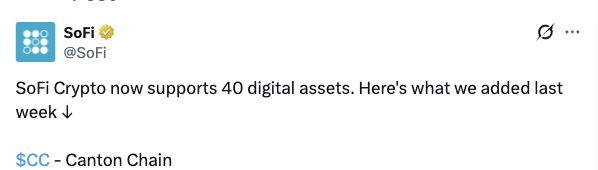
SoFi’s October 6 post lists CC among assets added the previous week. This excerpt shows the listing, not a confirmation of native CC transfers. Original announcement. Dates use UTC.
Swap Monster has meanwhile joined DTC’s Digital Assets Solutions Industry Working Group, convened by DTCC. It gives the project a place to contribute feedback on tokenization and market infrastructure. Membership is a role in those discussions, not a production integration with DTCC’s tokenization service.
Three measures of market activity
Tradecraft’s October 5 update put its total value locked above $3.5 million. A separate October 8 update put liquidity in its live CC/SBC market above $125,000.
Kora’s October 5 update showed more than $7 million in trading volume over 24 hours. These are different measures: TVL describes assets held in a platform’s contracts, pair liquidity concerns a particular market, and volume measures trading activity over a period.
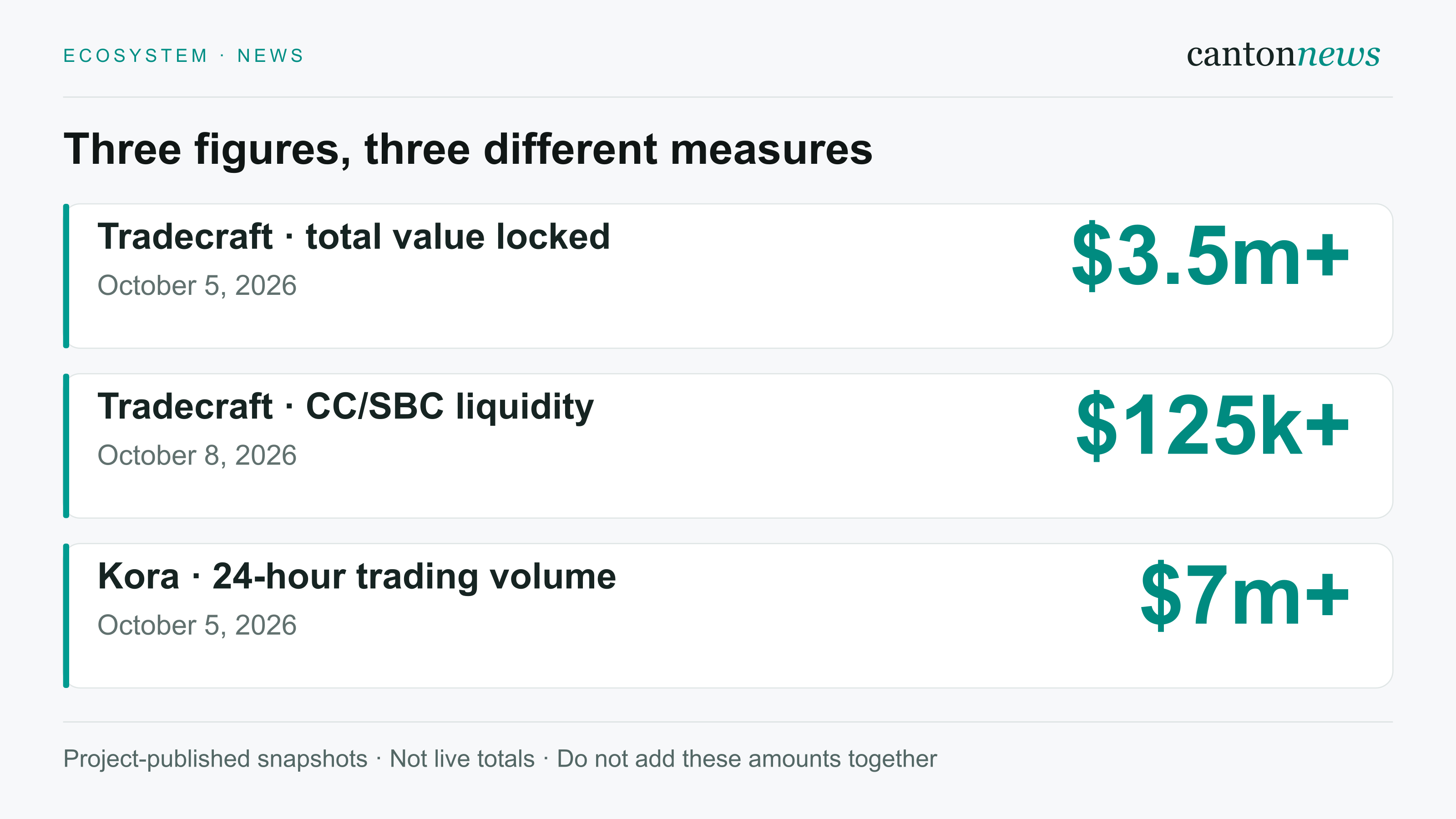
Separate project-published snapshots, not live readings or amounts to add together. Sources: Tradecraft TVL, CC/SBC liquidity and Kora volume.
AI assistants gain payment and trading tools
Unhedged has added prediction-market trading through Claude Desktop, Claude Code, Cursor and Codex. Its connector lets an assistant research markets, inspect an account and place orders with the permissions the user grants.
The platform’s separate October XP programme awards points from qualifying trading fees, with rewards at successive levels. Points are tied to fees paid, not profitable trades, so rewards should not be confused with investment returns.
FTP Tech is approaching AI use from the wallet side. Its hosted Canton wallets let ChatGPT, Claude and Perplexity make payments, transfer CC and swap tokens.
FTP holds the signing keys for those hosted wallets. The documented limits are 5 CC per payment and 20 CC per day, which users can lower. Withdrawal addresses require the user’s passkey confirmation. These controls put boundaries around what an assistant can do, while custody remains with FTP.
Better ways to see what is happening
CCTools has expanded its portfolio tracker with value history, recent activity, supported NFTs and DeFi positions. History builds as a portfolio is tracked, and NFT values use collection-floor estimates rather than individual appraisals.
Grofty’s expanded Lens toolkit brings together route finding, portfolio tracking, price alerts, historical exports and shareable dashboards. Developer tools let other applications use its data. Lens helps users compare markets and monitor positions; a suggested route is not itself an executed trade.
The two updates address different parts of the same task. CCTools adds detail to a holdings view, while Lens combines market research with monitoring and data access. As more assets and venues appear, that information becomes more useful to people moving between them.
What is still ahead
HANDL’s October rollout plan for version 2.0 includes received payments arriving in Canton wallets and multiple social handles connected to one wallet. The changes are planned in stages, with a simpler default interface and advanced crypto features kept behind a separate mode.
Zenith is targeting November for its Ethereum-compatible environment to deploy on Canton’s Global Synchronizer, the shared infrastructure connecting applications. The aim is to let developers use familiar Ethereum tools while building for Canton. November remains a target, not a completed deployment.
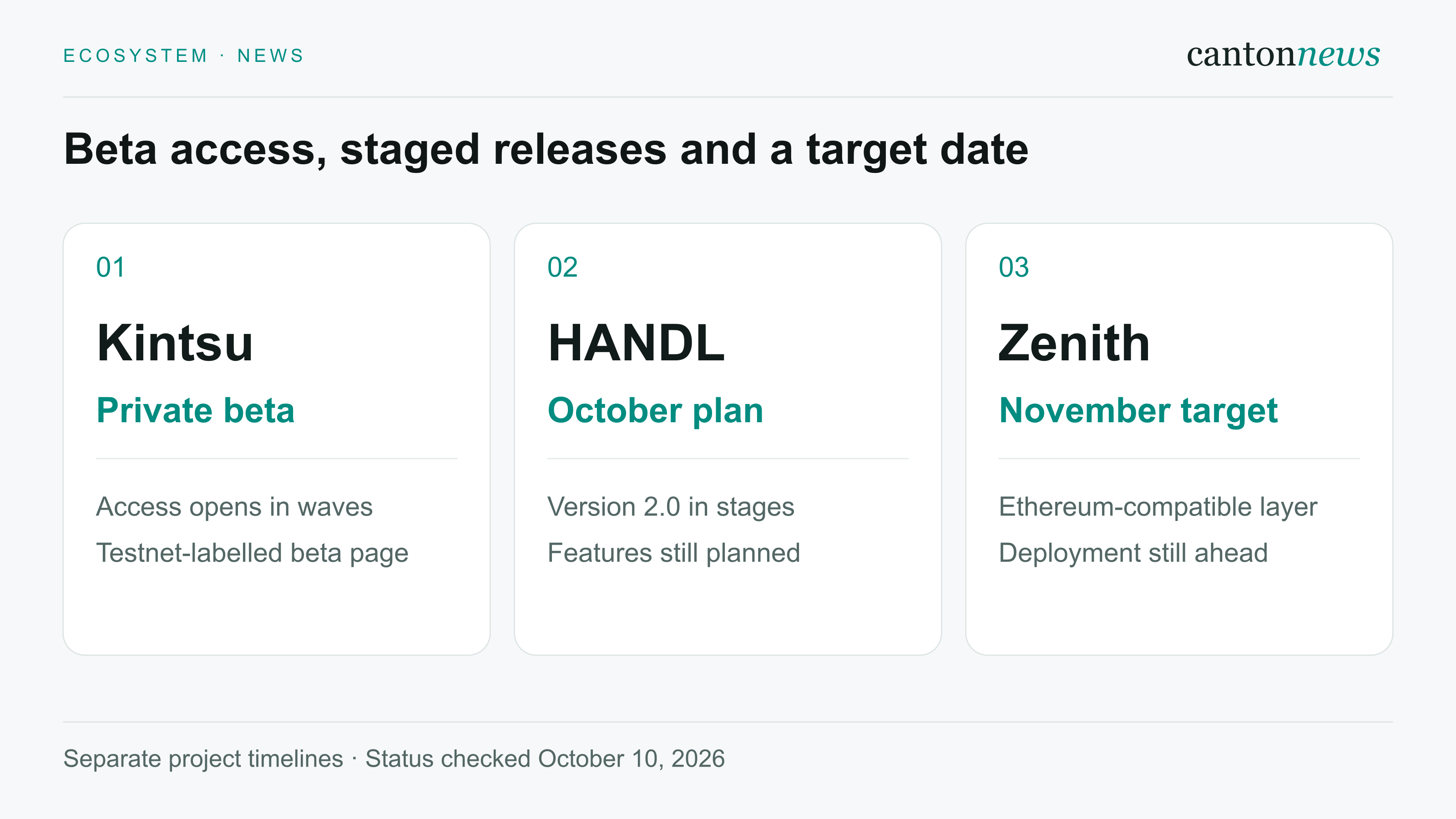
Three projects at different stages, not a shared launch schedule. Sources: Kintsu beta, HANDL roadmap and Zenith update. Checked October 10, 2026.
Taken together, these updates show a broader range of ways to access assets, trade them, monitor positions and build services around Canton. The next developments to watch are practical ones: wider access to the private products, delivery of the announced rollouts, and continued use of the markets already available.